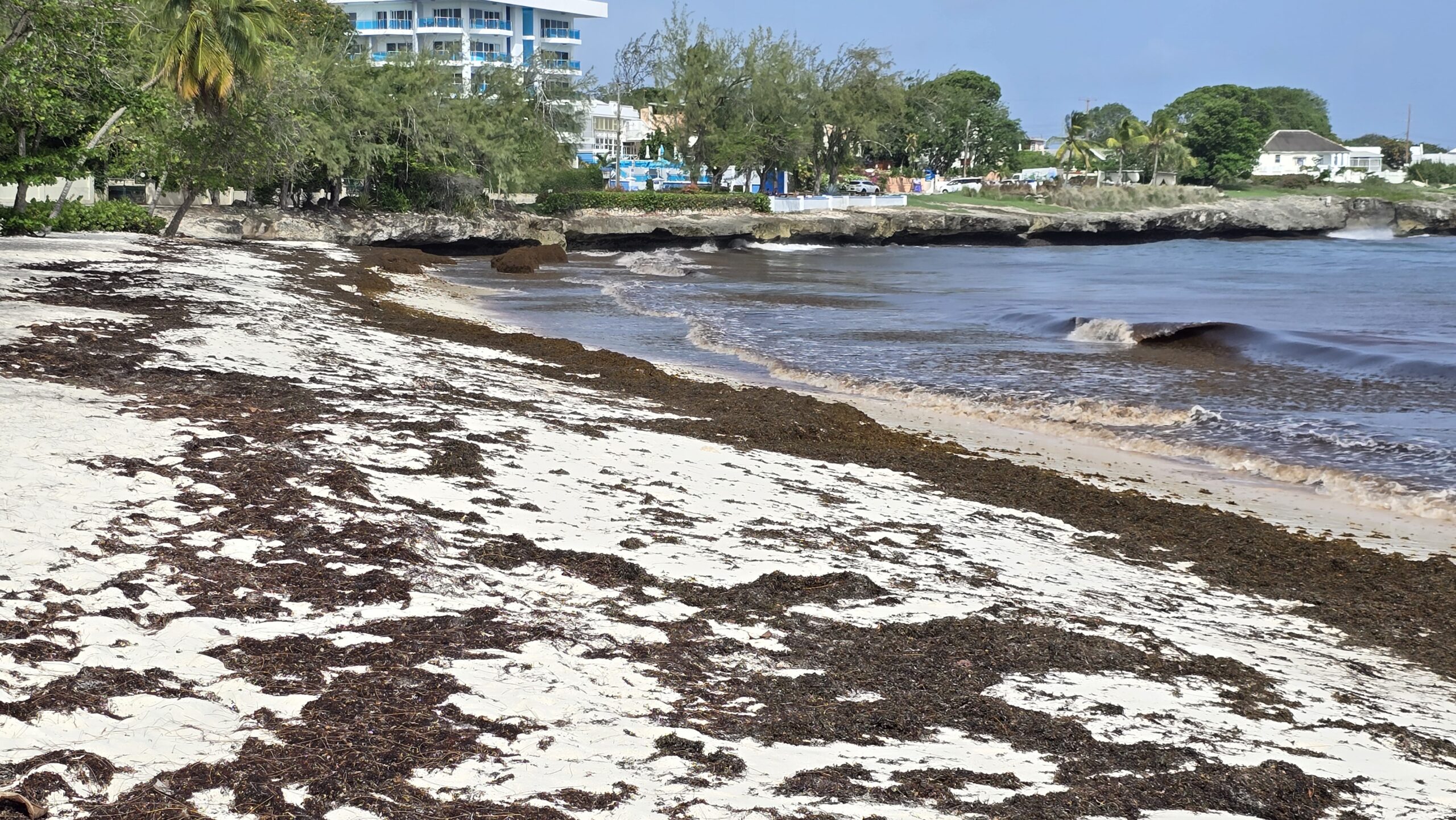
Barbados is pursuing a groundbreaking public-private partnership with international development organizations to transform a growing coastal nuisance — invasive sargassum seaweed — into a range of commercially valuable goods, including locally produced biofuel for vehicle fleets, Finance Minister Ryan Straughn confirmed in an exclusive interview with Barbados TODAY.
The initiative comes as coastal businesses along the popular Miami Beach shoreline at Enterprise Beach, Christ Church, have issued urgent calls for government intervention. Local operators report that record influxes of rotting sargassum have devastated the area’s tourism-dependent economy, driving away visitors and forcing customers to steer clear of nearby hotels, restaurants and retail outlets.
Straughn revealed that government officials recently held high-level talks with three major international partners — the Development Bank of Latin America (CAF), the Inter-American Development Bank, and the European Union — to explore targeted financing options to scale up proven solutions developed by Barbados’ private sector. One standout project already in development comes from a local venture that combines sargassum with byproducts from the island’s iconic rum industry to produce usable biofuel for passenger vehicles and commercial fleets. Straughn noted that the government has committed to following up on this proposal to advance its commercial rollout.
Beyond securing financing, the government is also evaluating how its own fleet of public service vehicles can support the adoption of sargassum-based biofuel, helping to build guaranteed early demand for the new product. With global oil prices remaining volatile and elevated, Straughn emphasized that this transition can deliver both economic and environmental benefits for the island in the near term.
A core priority of the plan is moving sargassum collection offshore, to harvest the seaweed before it washes up on Barbados’ coasts. Straughn explained that once sargassum lands on beaches and begins to decompose, it loses most of its commercial value, meaning fresh pre-landfall harvesting is critical to maximizing value-added production. The European Union is currently supporting work to resolve ongoing logistical challenges, including developing more efficient harvesting processes that reduce the need for large-scale onshore storage and keep the production cycle moving smoothly. Straughn acknowledged that these early-stage “teething issues” still require targeted solutions, but progress is advancing steadily.
Export Barbados, the island’s trade promotion agency, is currently researching affordable vehicle conversion kits that would allow existing diesel and gasoline-powered fleets to run on the new sargassum-rum biofuel. Straughn noted that the cost of each converter is approximately $3,500 USD, a price point that is becoming increasingly feasible for both public and private fleet operators. Beyond the government’s own fleet of vehicles, which includes Sanitation Service Authority trucks that would require minimal retrofitting, the biofuel could also serve thousands of private freight and commercial vehicles operating across the island, creating a large, sustainable domestic market.
Biofuel production is just one of multiple commercial applications the government and private sector are exploring. Straughn confirmed that local ventures are also developing organic fertilizers, construction materials, and other consumer and industrial products from processed sargassum, with the core engineering for most projects already finalized. The remaining work centers on resolving logistics challenges, most notably building a consistent, predictable supply of fresh harvested sargassum to allow private operators to scale their operations long-term.
The Ministry of Finance has already completed the first step of connecting private sargassum solution developers with potential international financing partners, and the government is now reviewing its own internal operational policies to reduce market volatility and support early adoption of the new products. Straughn expressed confidence that the initiative will not only resolve Barbados’ growing sargassum crisis but also unlock new economic benefits for the island, turning an environmental threat into a driver of green growth.