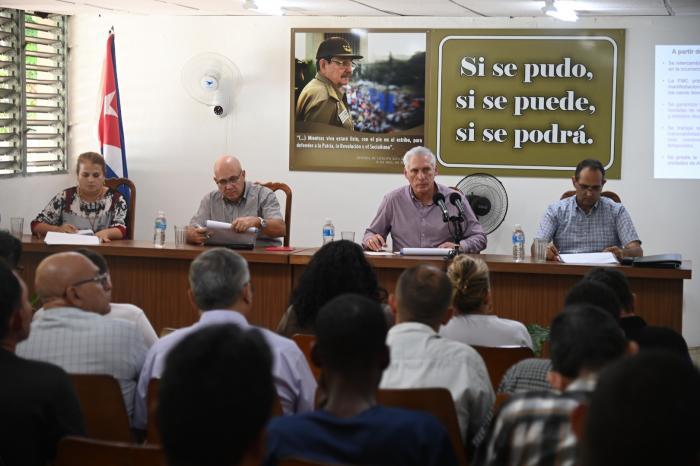
On a Thursday working visit amid long-standing economic pressures from the United States, Cuban President and First Secretary of the Communist Party of Cuba Central Committee Miguel Díaz-Canel Bermúdez continued his direct engagement with Havana’s activated Municipal Defense Councils, touring three districts of the capital: Old Havana, Arroyo Naranjo, and La Lisa.
The local defense councils were first activated in early May, a response to the rapidly worsening crisis triggered by the United States’ intensified 60-plus-year economic, commercial and financial blockade, which has been compounded by a more than six-month oil embargo that has strained the island’s critical infrastructure and basic services. Accompanying Díaz-Canel on the tour was Roberto Morales Ojeda, Political Bureau member and Organizational Secretary of the Communist Party Central Committee. During the visits, the presidential delegation reviewed the status of key basic services that have faced severe disruptions in recent months, including potable water access, domestic energy generation, and municipal solid waste collection.
This series of municipal engagements launched on June 30, and as of this latest round of visits, Díaz-Canel has now held direct exchanges with leaders and residents in nine of Havana’s 15 total municipalities. A core priority of the head of state’s outreach has been centering support for the island’s most vulnerable community members. He placed particular emphasis on upholding timely pension delivery, stressing that all administrative processes would be accelerated to ensure that Cuban retirees, who dedicated their lives to building the nation, receive their rightful benefits on schedule and without unnecessary barriers.
Throughout his stops in the three municipalities, Díaz-Canel highlighted successful collaborative initiatives spanning both the state and non-state economic sectors that have delivered tangible improvements for local residents. He called for these proven solutions to be rapidly scaled up across other districts of the capital, with priority areas including waste management, targeted support for at-risk populations, and streamlined pension distribution.
The president also expressed strong interest in the work of the Community Youth Network, a groundbreaking local program that empowers young Cubans to lead problem-solving efforts in their own neighborhoods. He received detailed briefings on the network’s diverse activities, which range from organizing recreational sports, community cultural events, and public health outreach to conducting regular check-ins with isolated elderly residents, supporting low-income vulnerable families, and engaging disconnected young people who are currently not enrolled in school or employed. The network also supports monitoring for Cuba’s Family Assistance System (SAF), the national program that delivers targeted food assistance to the country’s most food-insecure households.
In addition to reviewing programmatic work, Díaz-Canel asked detailed questions about how local authorities are responding to resident requests and concerns. He emphasized that all community demands must be addressed with empathy and care, and underscored the ongoing importance of maintaining public order and safety across all Havana neighborhoods.
Closing his visit, the Cuban head of state praised the high level of organization shown by municipal leaders and community members in navigating the ongoing crisis. He called on the Cuban people to maintain a hopeful, determined outlook as they confront the challenges imposed by external pressure, expressing confidence that the nation will ultimately overcome these hardships.