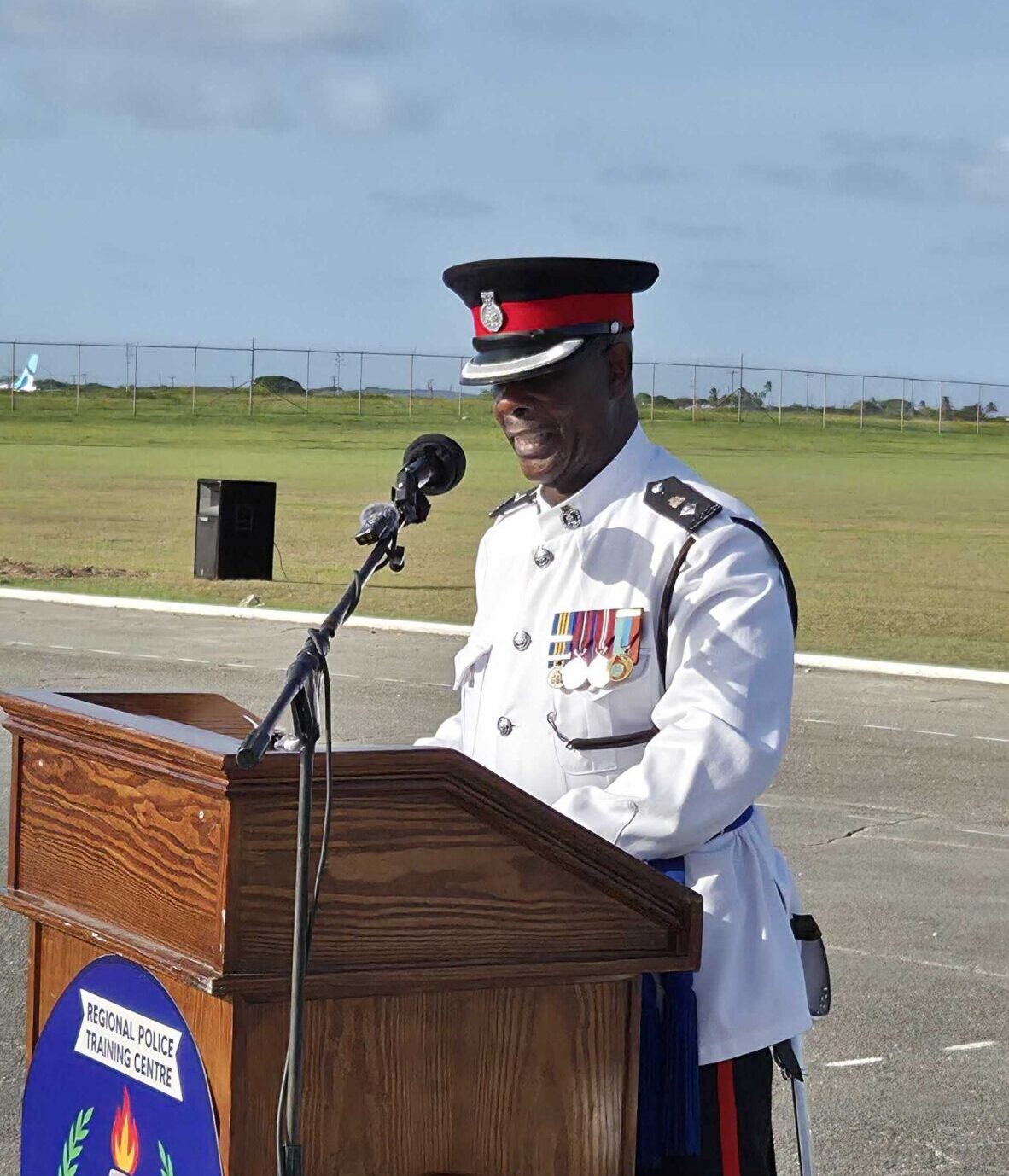
After nearly five decades of dedicated service spanning every rank within the institution, Commandant Rodney Archer of the Regional Police Training Centre (RPTC) formally announced his retirement on Thursday during a celebratory passing-out parade for the centre’s 150th recruit course. The momentous occasion drew crowds of dignitaries, fellow officers, family members, and media to the RPTC’s Sewell Christ Church campus, where graduating recruits entertained attendees with novelty performances during their ceremonial march past.
Archer’s career journey at the training centre began as a new recruit back in 1978, and he climbed the organisation’s ranks steadily over the decades: progressing from recruit to entry-level instructor, then chief instructor, deputy commandant, and ultimately the post of commandant. He will officially step down and hand leadership of the centre to incoming Commandant Roderic Walcott on July 29, closing out 28 years and three months of full service at the institution.
In a reflective address to attendees, Archer described his decades at the RPTC as a deeply fulfilling and rewarding experience. “My attachments at the Regional Police Training Centre… have been mostly enjoyable. No doubt I will miss the training centre, its ambience, and everything that goes with it. My time has come,” he said, earning a standing ovation from the assembled crowd for his decades of service. Over the course of his career, Archer took part in 36 of the RPTC’s 150 total passing-out parades, a legacy unmatched by any other officer in the institution’s 70-year history.
Archer’s retirement announcement coincided with the graduation of Recruit Course 150, which ran from January to July 2026 and delivered a historic milestone for the 70-year-old training centre. When the course kicked off, 52 recruits were enrolled, 27 of whom were women and 25 men. This marked the first time in RPTC history that female enlistment outnumbered male enlistment, part of a growing four-year trend of increasing female participation in police training across the region. The unexpected demographic shift required quick logistical creativity: one of the centre’s existing male dormitories had to be converted to female housing to accommodate the larger-than-usual intake of women recruits.
By the end of the grueling six-month training programme, two female recruits had withdrawn, leaving 50 graduating officers split evenly between 25 women and 25 men. The RPTC’s foundational recruit curriculum is famously rigorous, requiring recruits to complete 70 distinct modules covering subjects from the sociology of crime and criminal psychology to English language proficiency, officer safety protocols, and road policing. Training days start as early as 4:30 a.m. and often run past 8 p.m., with additional coursework required on weekends to meet programme requirements. Despite the intense physical and mental demands of the course, every graduating recruit met the mandatory 60 percent minimum pass mark. In a first for Archer’s tenure as commandant, every recruit also passed the course’s critical firearms qualification module. The top honour of Best Recruit was awarded to Police Constable 2574 Arika Parsons, who earned an aggregate score of 85.47 percent across all modules.
Beyond training new Barbadian police recruits, the RPTC fulfills a critical regional security mission, hosting 24 advanced leadership courses and skills workshops that have trained 497 law enforcement personnel from neighboring Caribbean nations and territories including Saint Lucia, Grenada, Montserrat, and the Turks and Caicos Islands.
As the centre marks its 70th anniversary, long-planned major infrastructure upgrades are currently underway to expand capacity and modernize the aging campus. Though construction of two new dormitories has experienced minor delays, the projects are on track to be completed by September 2026. Once finished, the expansion will boost the centre’s maximum training capacity to 152 students, helping regional police forces including the Barbados Police Service address persistent staffing deficits. “These upgrades will further transition the Regional Police Training Centre from the 1950s to somewhere in the 21st century,” Archer noted in his final training report.
In his final address to the 50 new graduating officers, the outgoing commandant offered a message of guidance and responsibility, urging each new officer to uphold the integrity of their profession. “Each of you graduated officers has an individual service number. It is your responsibility to guard that number. You will encounter good and bad examples during the course of your apprenticeship. Choose your mentors wisely… and take good care of your mental and physical health,” he advised.