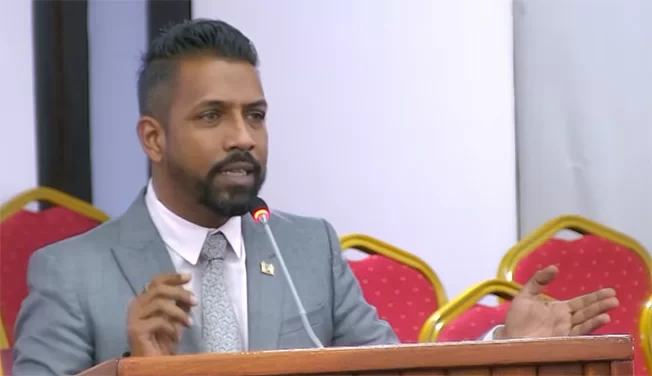
On Thursday, a pressing debate over the deteriorating internal security situation in Suriname dominated proceedings in the country’s National Assembly, drawing sharp concerns from both coalition and opposition lawmakers over three core threats: the proliferation of heavily armed groups operating in remote interior regions, the destabilizing influence of the unregulated illegal gold sector, and critical gaps in the operational capacity of national security forces. The immediate trigger for the high-stakes discussion was the recent arrest of 16 Chinese nationals in the Sarakreek interior area, but the conversation quickly expanded to address broader systemic risks to national security and sovereignty.
Multiple lawmakers from across party lines painted a grim picture of the status quo in Suriname’s largest district, Sipaliwini, which covers roughly 80 percent of the country’s total territory. Dew Sharman, a legislator from the ruling VHP party, warned that the unfolding crisis has now escalated to a question of national sovereignty. He pointed out that armed factions currently operate freely in swathes of the interior, while police and military forces are unable to maintain a consistent, effective presence due to chronic shortages of personnel and funding. Sharman also called for a formal investigation into historical allegations that past politicians were involved in securing mining concession areas, a role that has since been taken over by unregulated private security companies.
Poetini Atompai, a lawmaker from the opposition NPS, offered an even more alarming assessment, stating that the armed group detained in Sarakreek is far from an isolated case. “We are only talking about one group here, but dozens of similar small armed factions are active across the interior,” Atompai told the assembly. He added that many suspects who have been wanted by police and justice authorities for years are now being protected by heavily armed foreign operatives, emphasizing that no meaningful progress can be made until policymakers acknowledge the full scale of the problem.
Rabin Parmessar, leader of the opposition NDP faction, noted that the public is waiting for tangible security measures, not just reassuring rhetoric. As he pointed out, the Ministry of Justice and Police is already one of the largest budget items for the Surinamese government, so the public has a reasonable expectation of visible improvements to public safety. Parmessar added that public confidence in security is far lower than the picture presented by the ministry, and called for a dedicated thematic debate focused on concrete, actionable solutions.
Fellow NDP lawmaker Raymond Sapoen argued that the recent revocation of a firearms license for the security firm linked to the Sarakreek case only addresses symptoms, not root causes. He called on the government and parliament to collaboratively develop a phased national plan to dismantle the illegal gold industry and the associated organized criminal networks. Sapoen also demanded clarity over reports that a seized low-profile vessel carrying more than 1,800 kilograms of cocaine had previously been docked at a state-owned facility.
VHP legislator Krishna Mathoera highlighted a clear mismatch between the scale of Suriname’s security challenges and the capacity of the state institutions tasked with addressing them. She argued that the government must accelerate investments in police, military and other security agencies to actually guarantee protection for ordinary citizens. Mathoera also called on Justice Minister Harish Monorath to clarify earlier comments about the arrest of the 16 Chinese nationals, stressing that communication gaps cannot be used as a legal justification for pre-trial detention.
VHP’s Mahinder Jogi directly pressed the government on widespread public fears that Suriname is gradually losing control over large parts of its territory. He questioned whether the minister is still fully able to carry out his statutory responsibilities, and called on President Jennifer Simons to order a full re-evaluation of the national security situation. VHP faction leader Asis Gajadien echoed these concerns, confirming that multiple armed groups currently dominate large swathes of the interior.
ABOP legislator Edgar Sampie shifted the discussion to structural weaknesses within the Ministry of Justice and Police itself, arguing that the public cannot expect the ministry to resolve deep-rooted security problems without first fixing its own internal gaps. He described the department as weak financially, materially and organizationally, noting: “We cannot ask a mosquito to catch an elephant.” Sampie did, however, express appreciation for the ongoing efforts of Minister Monorath and frontline security personnel, who he said work to the best of their abilities despite severe resource constraints. For this reason, Sampie argued that parliament must not only demand better security outcomes, but also allocate funding to strengthen the ministry and equip security services properly.
Responding to questions from lawmakers, Minister Monorath, who heads the Ministry of Justice and Police, pushed back against claims that Suriname is losing control of parts of its territory. “All areas of the country still remain under the authority of the Surinamese state. There is one government, one administration, and one national police force,” he emphasized. Monorath explained that the 16 Chinese detainees were originally identified as suspects due to reasonable suspicion of criminal activity, but were subsequently released after the Public Prosecution Service determined there was insufficient evidence to pursue further charges. The prosecution still plans to revoke the general firearms license of the linked security company, however, as the weapons found were being carried by individuals who did not hold valid authorization to carry them.
The minister acknowledged that security forces face significant, growing challenges and that capacity strengthening is an urgent priority. He confirmed that thousands of ministry staff work daily to protect national security under difficult conditions, but added that expanded funding and sustained investment remain necessary to effectively counter rising criminal activity across the country.
Following the debate, National Assembly Speaker Ashwin Adhin confirmed that lawmakers had agreed to hold a dedicated thematic session on national security. The planning process will begin with a procedural meeting next week to formally establish a new standing committee on security, which will oversee the upcoming focused discussion.