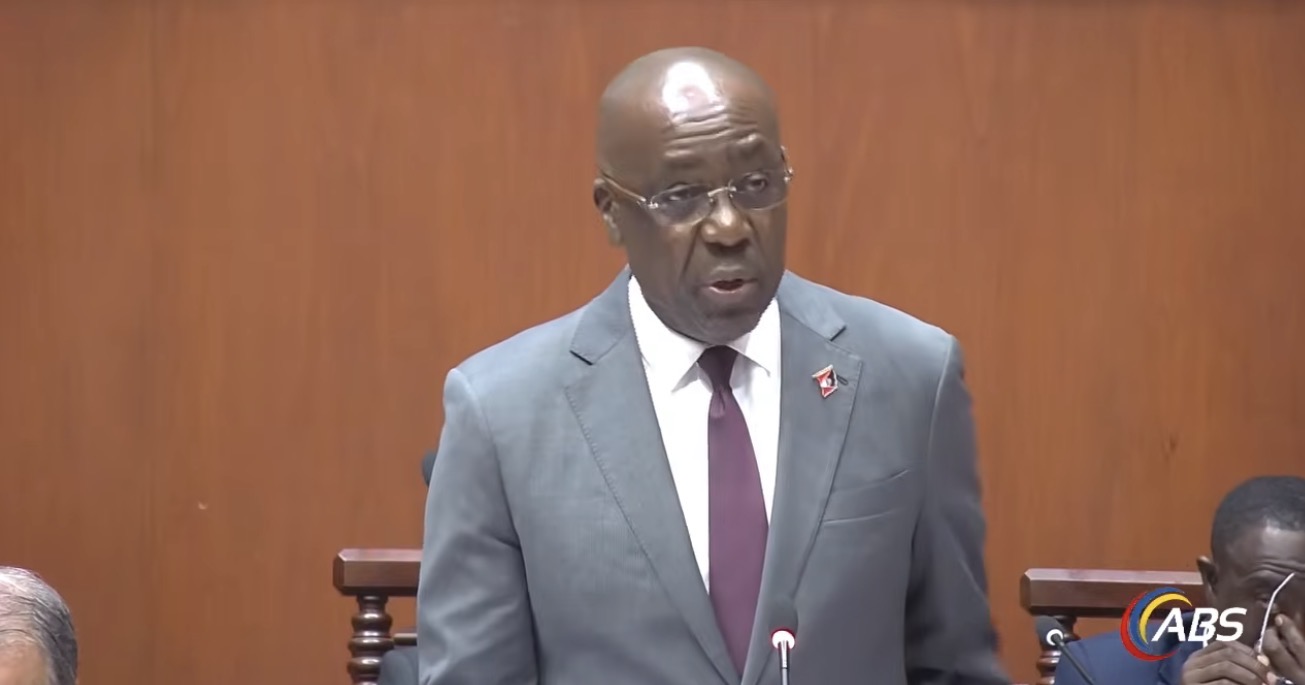
On Tuesday, Antigua and Barbuda’s Foreign Affairs Minister E.P. Chet Greene stood before Parliament to push back against growing domestic criticism of the Caribbean nation’s ongoing negotiations with the United States over a potential third-country national transfer agreement, framing the diplomatic process as an act of proactive sovereignty protection rather than a surrender of national independence.
The minister’s address came during parliamentary debate over a government resolution laying out core guiding principles for any final deal with Washington. Greene emphasized that responsible governing demands full assessment of proposals before rendering judgment, rejecting calls for the administration to dismiss the U.S. initiative outright before any talks had concluded. “We engage because responsible governments do,” Greene stated. “They do not make important decisions in ignorance. They do not refuse to listen before they know what is being proposed. And they do not confuse engagement with agreement.”
Greene stressed that the negotiations carry stakes far beyond routine immigration policy, framing the discussions as a defining test of how a small, independent state navigates proposals from a major global ally that touch on core national interests. “This debate is not simply about immigration. Neither is it about the United States of America. It’s about something fundamentally much bigger,” he told lawmakers. “It’s about how Antigua and Barbuda, as a small independent nation, responds when a close and powerful neighbour and friend asks something that raises serious questions for our own sovereignty, our laws, our security and our future.”
In a push to build cross-parliamentary consensus, Greene urged legislators to set aside partisan divides, arguing that matters of national sovereignty and foreign policy transcend party politics. “When questions arise that touch the sovereignty of our country, our immigration policy, international obligations and the welfare of our people, our first duty is not to any political party. It must be to Antigua and Barbuda,” he said.
Rejecting repeated claims that talks have already eroded the nation’s independence, Greene reaffirmed Antigua and Barbuda’s status as a fully sovereign equal in the global community, regardless of its small geographic size. “We are a sovereign nation,” he declared. “Small in size, equal in dignity. Our flag carries exactly the same worth and legal standing in the community of nations as does the flag of any larger state.”
At the same time, Greene acknowledged the structural inequalities that shape global diplomacy, noting that small states must navigate uneven economic and political influence while prioritizing national interests. “The responsibility of government is not to complain about that reality. It is to navigate it wisely,” he explained. “That means protecting our sovereignty without isolating ourselves, maintaining our friendships without compromising our principles, working with our partners without surrendering our judgment.”
Against criticism that the government should have publicly rejected the proposal from the start, Greene argued that substantive diplomacy relies on quiet negotiation rather than performative political rhetoric. “Leadership is not measured by how loudly a government speaks. It is measured by how well it protects the interests of its people,” he said. Outlining the government’s process to date, he added: “We listened, we examined every proposal, we took legal advice, we consulted officials, we assessed the implications, and when we concluded that important parts of the proposal were not in Antigua and Barbuda’s best interest, we simply rejected them.”
Throughout all discussions with U.S. officials, Greene confirmed the government has held firm to five non-negotiable core principles designed to protect national interests: rejecting any permanent standing transfer program, retaining full sovereign discretion to approve or reject each individual case, shielding the country from all legal, financial, and security risks, ensuring Antigua and Barbuda taxpayers never bear costs stemming from U.S. immigration policy, and securing reciprocal benefits from any final arrangement.
Greene also moved to dispel widespread public misconceptions about a non-binding memorandum of understanding signed with the U.S. in December 2025. “The memorandum did not commit Antigua and Barbuda to receive a single person. It did not establish a programme. It did not create a legal obligation,” he stressed, noting the document only opens the door for further discussion and preserves the nation’s full right to decide each case independently.
According to Greene, the administration already rejected the original U.S. draft operating procedures because they failed to meet the cabinet’s core requirements. The initial U.S. proposal included expedited removal processes for transfers, allowed for up to 10 transfers per month, and failed to adequately resolve questions of legal liability and financial responsibility. Rather than ending diplomatic discussions entirely, the government responded with its own detailed counterproposals that enforce stronger protections for Antigua and Barbuda. “We did not simply criticise. We did not simply complain. We put forward our own proposals,” Greene said. “We said instead, if this matter is to go any further, these are the conditions that must protect Antigua and Barbuda.”
The minister also praised the work of Antigua and Barbuda’s Ambassador to the U.S., Sir Ronald Sanders, who has led negotiations in Washington under the direction of Prime Minister Gaston Browne. Greene noted that Sanders systematically reviewed every U.S. proposal, flagged unresolved legal and security concerns, and consistently defended the nation’s interests in talks with senior American officials. “He did not yield where the national interest required firmness,” Greene said.
Among the key adjustments the government has demanded are strict eligibility limits: only individuals with final removal orders would be considered, people with criminal records beyond minor immigration offenses would be excluded, unaccompanied minors and asylum seekers with pending claims would be barred, full documentation must be provided before any decision is made, and the U.S. must assume all financial obligations in writing before any transfer can proceed. Additionally, the government rejected the U.S. proposal of up to 10 transfers per month, countering with a cap of no more than 10 total transfers across the entire 2026 calendar year, with any extension requiring a full national review of the arrangement.
Greene emphasized that these revisions make clear the government has negotiated from a position of principle, not weakness. “We changed the framework. We set safeguards. We narrowed the categories. We reduced the numbers. We insisted upon complete information. We insisted upon complete funding,” he said. “That is not capitulation. That is negotiation. That is the essence, the true form, of diplomacy.”
Closing his address to Parliament, Greene reaffirmed that while Antigua and Barbuda deeply values its longstanding bilateral relationship with the United States, the nation will never compromise its core sovereignty. “Antigua and Barbuda’s sovereignty is not negotiable. It never has been. It never will be,” he said. “Our friendships are valuable and will be cherished, but genuine friendship is built on mutual respect.”