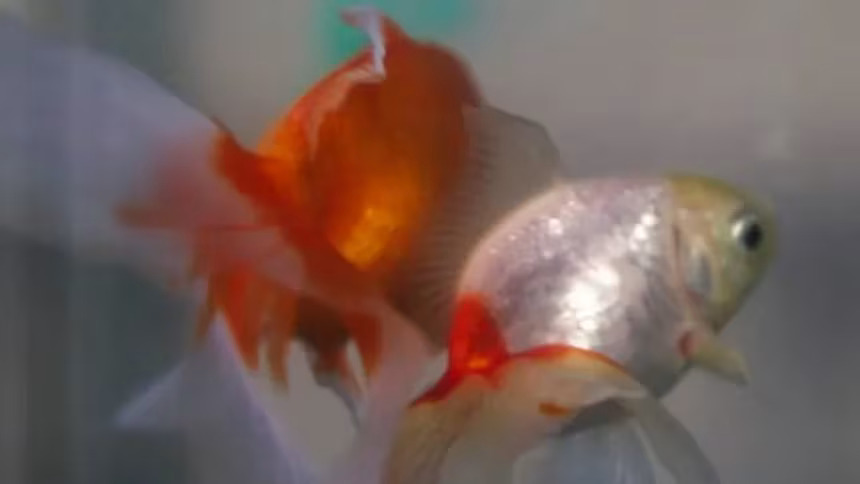
On the storefront of a sushi restaurant tucked in one of Buenos Aires’ most stylish neighborhoods, two small goldfish named Fede and Magui lived in a glass display tank, largely ignored by passersby—only catching the occasional curious tap from a passing child. That unremarkable existence changed forever when a closer look at their substandard living conditions, exposed to unregulated direct sunlight and constant street noise, sparked a legal battle that would make history for animal rights across Argentina and beyond.
It did not take a trained specialist to see the enclosure was unfit for the two fish, explained Matías Trufero, legal representative for Jaulas Vacías (Empty Cages), an anti-speciesism animal sanctuary that cares for more than 200 rescued animals across the country. After documenting the poor conditions, the NGO made the decision to file a legal complaint under Argentina’s existing Law 14.346, which criminalizes animal abuse across the nation.
Working alongside veterinary and animal welfare specialists, the organization built a robust legal case that quickly convinced the court to order the fish’s transfer to a more appropriate habitat. Trufero noted that restaurant staff did not push back against the court’s ruling, and CNN has reached out to the business for additional comment on the case.
Carlos José Aga, a animal welfare specialist who assisted with the rescue and ultimately agreed to adopt Fede and Magui, drew a striking comparison to illustrate how unsuitable their original enclosure was: keeping two goldfish in a small 40-liter display tank, he argued, is morally and functionally equivalent to keeping two polar bears confined in a cage inside a sauna. After the court order, the pair were moved to a spacious 2,500-liter custom tank in Aga’s home, where the court ruled they will remain in permanent, caring custody.
Aga, who has expertise in aquatic animal care, explained that maintaining healthy conditions for fish requires precise regulation of environmental parameters, much like monitoring life support systems for astronauts in space. When moving fish to a new habitat, these conditions must be carefully replicated to prevent stress that could suppress their immune systems and lead to illness or death. As of the latest update, he confirmed, both Fede and Magui are thriving in their new, expanded home.
But the physical rescue of the two fish was only the first step in the legal process. From the opening of the case, legal advocates pushed for an additional, groundbreaking ruling: beyond moving the fish to safety, they asked the court to formally recognize Fede and Magui as “subjects of law” — or legally defined sentient beings. This reclassification would strip goldfish of their previous status as mere legal objects, granting them inherent rights to dignified living conditions.
The historic ruling sets a critical new precedent for all animals held in inadequate environments across Argentina, opening the door for future legal action to protect other animals from abuse and neglect. Trufero clarified that the ruling does not ban private ownership of goldfish entirely: keeping pet fish in a home aquarium is not inherently illegal under Argentine law, but it becomes a criminal offense if the conditions constitute mistreatment or cruelty, such as insufficient space, inadequate nutrition, or other harmful practices. He added that exotic fish species may also be fully banned from private ownership if they fall under local wildlife protection regulations, a policy mirrored in many countries around the world.
This ruling for Fede and Magui is the latest in a growing line of landmark animal rights cases across Latin America. The first major habeas corpus petition filed on behalf of a non-human animal was brought in 2005 for Suiza, a captive chimpanzee in Brazil, who died before she could be transferred to a permanent sanctuary. In the years that followed, similar cases emerged across the region, including in Argentina.
One of the most famous of these prior cases centered on Sandra, an orangutan born in Germany who spent 20 years living in Buenos Aires’ city zoo. In 2014, a judge ruled in favor of environmental advocates, declaring Sandra a “non-human person” with inherent legal rights. The ruling found that her captivity and forced public exhibition violated those rights, even though Sandra was well-fed and not actively abused. Following the ruling, the Buenos Aires Zoo was redeveloped into an eco-park in 2016, ending public animal displays and relocating most captive animals to accredited sanctuaries. Sandra was transferred to the Center for Great Apes in Wauchula, Florida, in 2019, where she lived out her remaining years in a naturalistic habitat.
Trufero emphasized that the core significance of granting animals legal personhood lies in ending their classification as disposable objects under the law. When animals are recognized as sentient beings with rights, they can be officially recognized as victims of cruelty, rather than classified as damaged property — a shift that fundamentally redefines how society approaches animal welfare and shapes future animal protection policy.
For Fede and Magui specifically, the ruling opens a new era of legal protection for one of the most commonly kept types of animals in homes and commercial businesses around the world. Aga stressed that legal rights mean little for non-human animals without human advocates willing to enforce the law on their behalf. “We have to speak up for those who cannot speak for themselves,” he noted, confirming that the two goldfish have already fully settled into their new home.