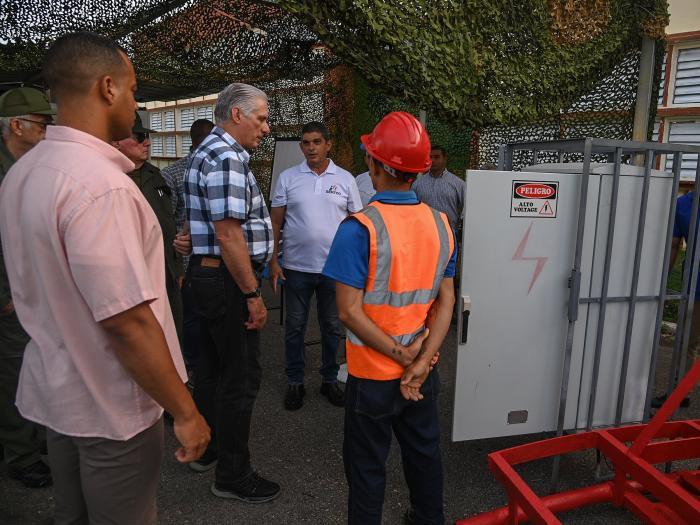
On Wednesday, July 9, 2026, Miguel Díaz-Canel Bermúdez, First Secretary of the Central Committee of the Communist Party of Cuba and President of the Republic of Cuba, led an inspection tour of domestic industrial entities based in Havana, accompanied by senior members of the Cuban government. The tour, part of Díaz-Canel’s ongoing regular outreach to working groups across the country, focused on facilities developing key solutions for national energy security, construction innovation, and long-term sustainable development, a core priority for Cuba amid prolonged external economic pressure.
Joining the president during the visit were Prime Minister Manuel Marrero Cruz and Minister of the Revolutionary Armed Forces Army Corps General Álvaro López Miera — both senior members of the Political Bureau of the Communist Party — alongside multiple members of the Council of Ministers. The group’s first stop was a manufacturing workshop producing expanded polystyrene panels reinforced with electro-welded mesh, a cutting-edge prefabricated construction system designed primarily for structural wall assembly.
Industry representatives detailed the transformative benefits of this building technology: the prefabricated panel system cuts cement consumption by 20 to 30 percent and reduces steel usage by more than 50 percent, delivering a cost-effective, time-efficient, and high-performance solution for large-scale housing development across Cuba. As of the tour, construction teams had already completed foundation work for two models of comfortable residential buildings using the system, with projects underway in Havana as well as central and eastern regions of the country. Beyond traditional housing, the panel technology has also proven highly effective for cladding repurposed shipping container homes and insulated refrigerated containers, examples of which Díaz-Canel examined in person during the tour.
The second key stop on the presidential itinerary was a solar panel assembly plant, where facility leaders reported that more than 3,200 panels had already been manufactured in 2026 to date. This domestic production achievement has not only created new commercial opportunities for the Cuban renewable energy sector but has also allowed the facility to begin installing on-site photovoltaic power systems to operate independently of the national electric grid. This self-sufficiency measure is critical to avoiding production shutdowns amid the ongoing national energy crisis, which has stretched into its sixth month and been exacerbated by the tightening U.S. economic blockade and oil embargo against Cuba.
Looking ahead, facility officials announced that the plant will be able to scale up production dramatically once a shipment of new inverters and energy storage batteries for the photovoltaic sector arrives. The expanded supply will allow the facility to transition to a double-shift production schedule, ramping up output to 120 solar panels per day to meet growing domestic demand for renewable energy infrastructure.
Following the tour, President Díaz-Canel praised both facilities for developing modern, efficient, and practical solutions that address pressing national challenges. He called for the successful production models and innovative practices showcased during the visit to be replicated across other regions and industrial entities throughout Cuba to drive broader national development.