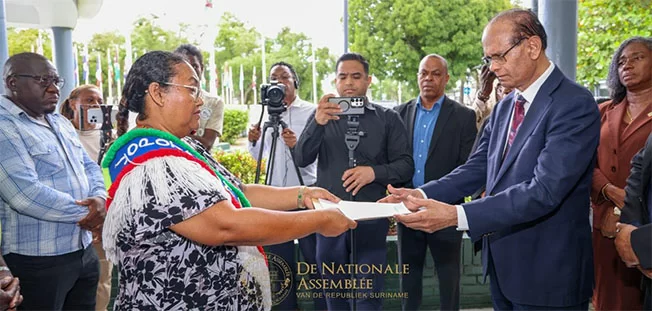
In a urgent call for environmental justice and government accountability, Indigenous and Tribal communities living along Suriname’s Saramacca River have submitted a formal petition to the country’s national legislature, De Nationale Assemblée (DNA), demanding an independent investigation into the recent mass fish die-off that has upended their way of life. The communities are also calling for immediate government action to protect their health, living environment, and economic livelihoods, which are deeply tied to the river’s health.
The petition was formally presented to DNA leadership by Captain Joan van der Bosch of the Pikin Poika community, who framed the mass fish mortality as a critical warning sign of broader ecological decline. For the Indigenous and Tribal groups that have called the Saramacca River basin home for generations, the waterway is far more than a natural resource: it provides drinking water for daily use, a primary food source in the form of fish, and the foundation of local fishing livelihoods, while also holding deep cultural and social significance that underpins their entire way of life.
Since the fish die-off was first recorded, local fishermen have been left without any source of income for weeks. Community representatives also highlight a persistent lack of transparent, clear information from government authorities. When updates are provided, they say, the information often raises more unaddressed questions than it answers, leaving communities in the dark about potential risks to their health and safety.
In the text of the petition, community leaders laid out a series of pressing, unresolved questions: “How long can this situation continue? Are we meant to be poisoned in silence? Why are no immediate emergency measures being implemented? Who will investigate this environmental disaster through an independent, expert-led process? And can we be guaranteed this will never happen again?”
The communities emphasize that they hold inherent legal and human rights to a healthy living environment, accessible healthcare, protection of their lands, meaningful participation in decisions that affect them, and respect for their traditional territories. They also note that Suriname has already been cited multiple times in international forums for failing to uphold the territorial and environmental rights of Indigenous and Tribal peoples, yet no long-term structural solutions have been implemented to address these ongoing gaps.
Beyond the core demand for an independent probe into the cause, scale, and impacts of suspected river contamination, the petition outlines five key additional demands: full public transparency of all investigation findings, fair compensation for affected riverfront communities, concrete policy and regulatory measures to prevent similar ecological disasters in the future, and sustained, structural inclusion of Indigenous and Tribal representatives in all decision-making processes related to their traditional lands and waterways.
Van der Bosch described the mass fish die-off as “a distress signal from nature.” She stressed that the crisis is not an isolated environmental incident or a routine political debate: it is fundamentally an issue of human rights, justice, equity, and the fundamental right to live in a safe, healthy environment.
The petition was received on behalf of DNA Speaker Ashwin Adhin by Rabin Parmessar, leader of the National Democratic Party (NDP) parliamentary faction. Parmessar affirmed that both the national legislature and the Surinamese government take the crisis and community demands seriously. He noted that parliament had already previously called on the administration to conduct a thorough investigation into the cause of the fish die-off and implement measures to prevent recurrence.
Parmessar also shared an update with the community representatives: water samples and other environmental specimens have already been sent to overseas laboratories for detailed analysis, as local testing capacity is limited. Once the investigation results are finalized, he said, parliamentary leaders and relevant government agencies will collaborate to determine what next steps are needed to address the crisis and meet community concerns.