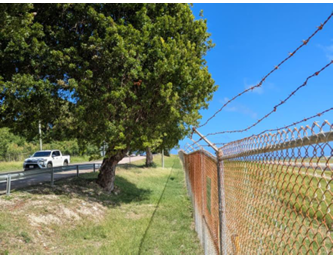
The Antigua and Barbuda Airport Authority (ABAA) is set to oversee the removal of three mature mahogany trees along Sir George Walter Highway this Sunday, a decision reached after months of cross-stakeholder consultation and rigorous safety assessments tied to the final phase of the island’s $50 million VC Bird International Airport runway rehabilitation project.
As the major infrastructure upgrade nears completion, the full length of the refurbished runway will soon open for regular aircraft operations. However, survey teams identified the three mahogany trees as a critical barrier to unobstructed line-of-sight between the Air Traffic Control (ATC) Tower and the western end of the airfield – a non-negotiable requirement for safe air navigation, per International Civil Aviation Organization (ICAO) standards.
For years, ABAA attempted to manage the risk through regular pruning and ongoing maintenance. Airport officials explored every feasible alternative before settling on removal as the only remaining solution to eliminate the hazard. Joseph Samuel, ABAA’s Director of Operations, explained that the trees prevent air traffic controllers from carrying out full, effective visual surveillance of all aircraft movements along the runway. “Unobstructed visibility is essential for the safe and efficient management of aircraft operations on and around the runway,” Samuel noted.
Eugene Silcott, Acting Chief of Air Traffic Services, emphasized that even minor reductions in visibility create a severe safety risk that can raise the likelihood of aircraft incidents or accidents. “One of the primary responsibilities of an air traffic controller is to prevent collisions between aircraft and other aircraft, vehicles, personnel, or obstacles on the maneuvering area,” Silcott said. Beyond tracking aircraft movements, controllers also rely on a clear view of the entire airfield to spot wildlife incursions, which pose another major threat to flight safety. Early detection of these hazards before clearing aircraft for landing or takeoff is foundational to a secure operating environment, he added. “Safety remains, and must always remain, our highest priority.”
ABAA officials acknowledged that mahogany trees hold deep sentimental value for many residents of Antigua and Barbuda, and stress that the decision to remove the three specimens was not made hastily. Before finalizing the plan, the authority brought in key partners including the Forestry Unit under the Ministry of Agriculture and the national Environment Division to conduct a comprehensive ecological and structural assessment.
The assessment, confirmed by Senior Forestry Officer Adriel Thibou, found clear evidence of termite infestation and widespread structural deterioration that has severely weakened the trees, making them far more likely to topple during storm events. Beyond the aviation visibility issue, the assessment determined that the trees’ location, height, and wide canopy encroach on protected aviation safety zones, creating unacceptable risk for aircraft operations, highway users, airport staff, and traveling passengers. That risk is amplified by the trees’ position just meters from the highway, where a falling tree could cause catastrophic road accidents during severe weather.
“ Their removal is necessary to eliminate unacceptable hazards, protect human life, and preserve the operational integrity of VC Bird International Airport,” the assessment report concluded. “This approach aligns with both international aviation safety standards and local forestry best practices, reflecting a precautionary principle that prioritizes safety, visibility, and unobstructed airspace.”
In a nod to the trees’ cultural and ecological value, ABAA has partnered with the Forestry Unit and Environment Division to offset the removal. The authority will fund the replanting of several new trees in pre-vetted, environmentally appropriate locations across the country. Additionally, the wood harvested from the removed mahogany trees will be repurposed into functional and commemorative public features that preserve the trees’ connection to the airport site’s natural history.
Samuel emphasized that the compensatory measures reflect ABAA’s long-standing commitment to environmental stewardship, even as aviation safety takes top priority. “While aviation safety is foremost, we also must ensure that our operations are guided by sustainable and proper environmental practices,” he said.
To minimize disruption to road traffic during Sunday’s removal operation, ABAA has coordinated with the Police Traffic Department, which will be on site from 6:30 a.m. to oversee traffic flow and avoid major delays along Sir George Walter Highway.