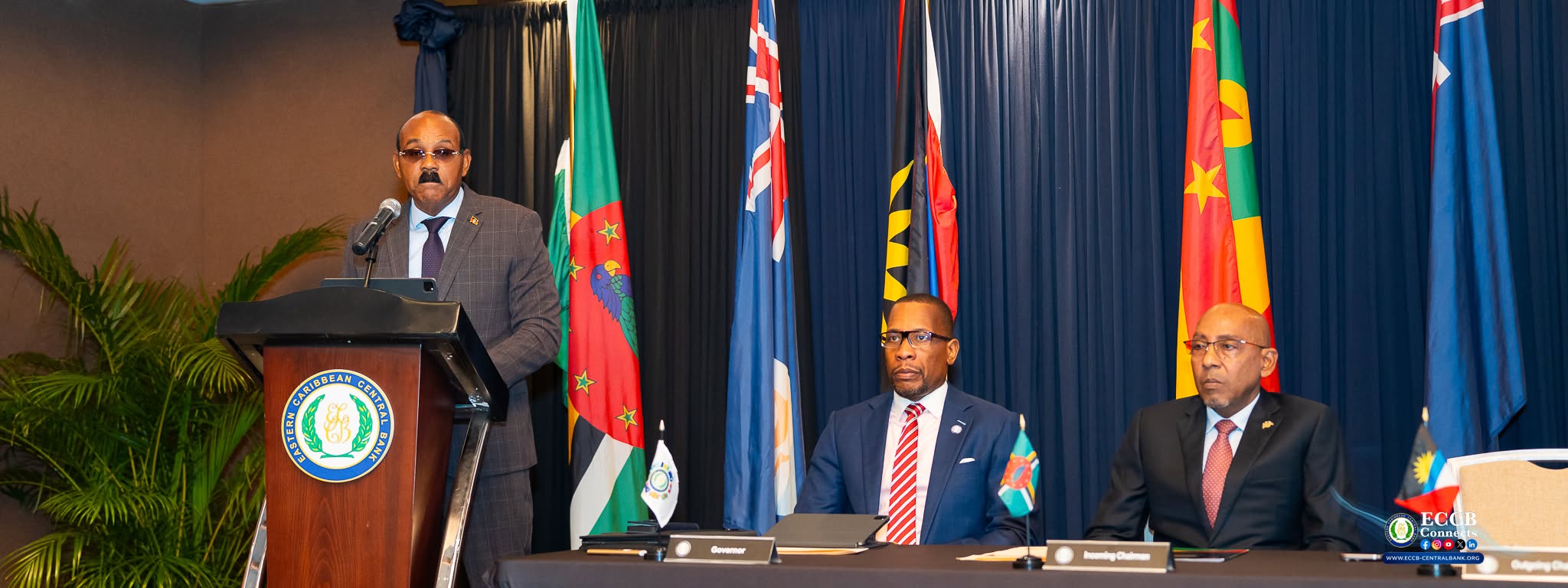
Against a backdrop of shifting global dynamics, the Monetary Council of the Eastern Caribbean Central Bank (ECCB) has sounded a cautious note on the Eastern Caribbean Currency Union’s (ECCU) economic trajectory, highlighting three major external headwinds that threaten to undermine regional expansion and tourism activity in the coming months. The official alert was published in a formal communiqué released Friday, at the conclusion of the Council’s 113th quarterly gathering hosted in Dominica, where senior finance officials from across the member nations gathered to assess the bloc’s current and projected economic health.
In the official statement, the Council emphasized that persistent global uncertainty has cast a long shadow over the region’s growth outlook. Rising geopolitical friction around the world, wild swings in global crude oil prices, and ongoing unpredictability in international trade flows have combined to create material downside risks that cannot be ignored by regional policymakers. Against this landscape, the Council revised the bloc’s growth projection bias to the downside, warning that a further deterioration of global conditions could cool demand for Caribbean getaways and pull back the pace of overall economic expansion across the ECCU.
Even as it flagged these external vulnerabilities, the Council struck a balanced tone, pointing to bright spots in the regional economy and ongoing efforts to build long-term stability. The body explicitly welcomed the steady flow of investment into large-scale strategic development projects and cross-regional renewable energy programs, noting that these initiatives are foundational to boosting the region’s ability to withstand external shocks and advance inclusive, sustainable development. It reaffirmed that energy security and resilience remain a top priority for accelerating shared growth, and called for urgent action to speed up the launch and full operationalization of the Caribbean Resilient Renewable Energy Infrastructure Investment Facility, a dedicated financing vehicle designed to support the region’s clean energy transition.
Council members also reached a consensus on the need to ramp up collective regional action under the ECCB’s flagship “Big Push” development strategy. Expanding the scale and speeding up the pace of coordinated initiatives under this framework, officials agreed, is critical to lifting the ECCU’s long-term global competitiveness and insulating its economies from future external disruptions.
Notably, the Council acknowledged that the region’s core economic engine — tourism — has continued to outperform expectations despite ongoing global headwinds. Data shared during the meeting showed that total visitor arrivals across the ECCU jumped 9% year-over-year to reach 2.5 million in the first quarter of 2026, while total visitor spending increased by 4% to hit EC$2.8 billion over the same period. The solid growth trend confirms that global traveler demand for the Eastern Caribbean as a top leisure destination remains sustained, even amid broader economic uncertainty.