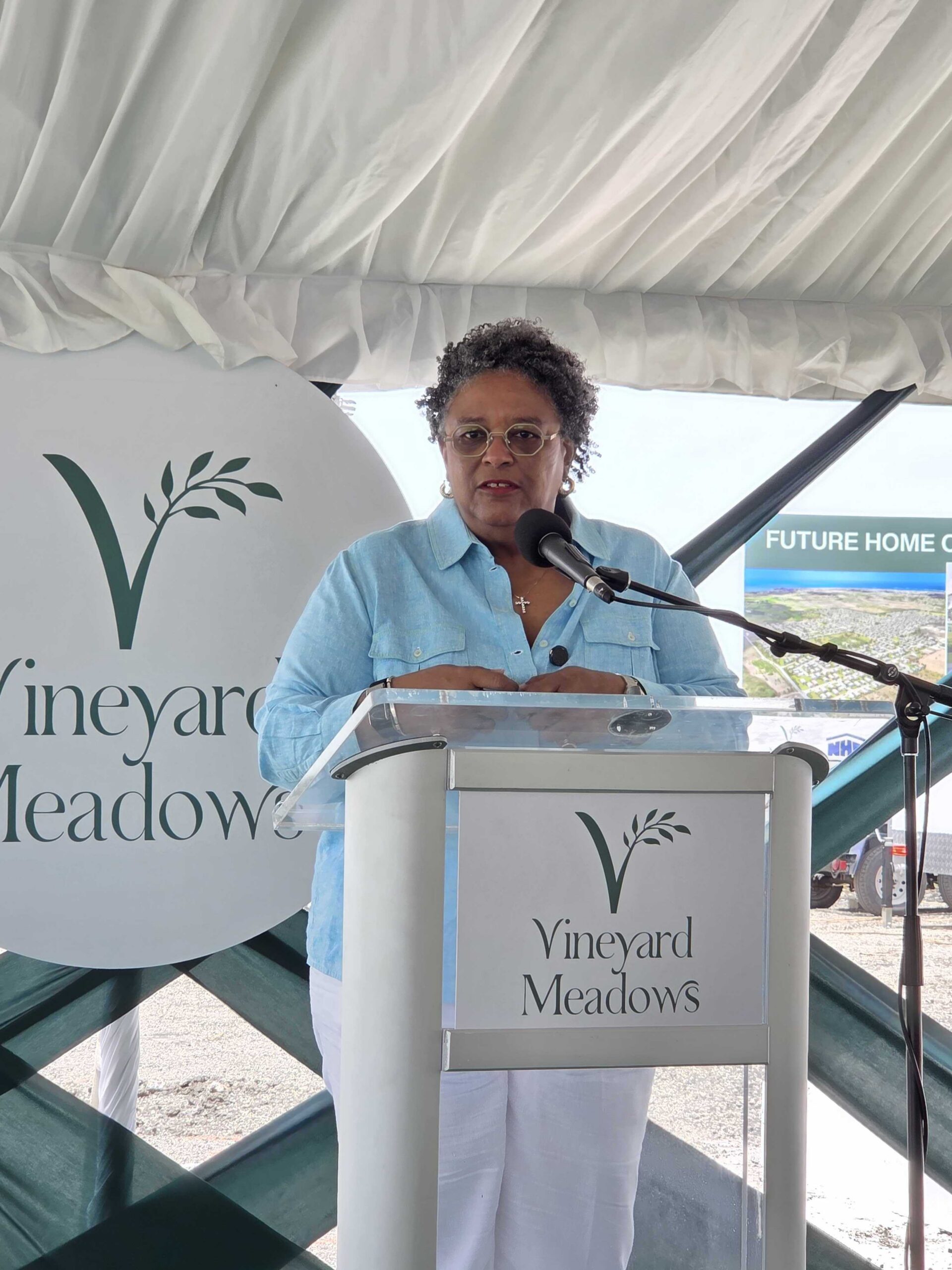
Barbadian Prime Minister Mia Mottley has announced a sweeping new national housing initiative designed to unlock thousands of derelict properties trapped in intergenerational family disputes, a move aimed at easing national housing shortages, cutting urban blight, and driving widespread homeownership across the island ahead of key national milestones.
Speaking at a groundbreaking ceremony for a new public-private joint venture housing project in Vineyard, St. Philip, Mottley explained that hundreds of unused properties across Barbados have sat abandoned for decades, frozen in limbo after the death of their original owners when surviving family members fail to reach a consensus on managing or developing the assets. What starts as a private family deadlock quickly becomes a public liability, she noted, dragging down neighborhood property values and contributing to urban decay. To break these logjams, the Prime Minister has tasked the Ministry of Housing with developing a comprehensive support framework that brings together a cross-disciplinary team of legal experts, architects, engineers, financiers and contractors to offer families a flexible “menu of options” to move forward with stalled properties.
Under the proposed scheme, the government will offer multiple pathways to unlock deadlocked assets. The state can enter into formal agreements to standardize legal documentation and pre-approved architectural plans for families, or even enter into long-term leases of up to 15 years, developing the property before returning full ownership to the family. The administration is also open to increasing housing density in established neighborhoods, allowing underused single-family derelict structures to be converted into duplexes, four-unit or six-unit multi-family dwellings to expand the total housing stock.
This initiative forms the centerpiece of a far-reaching restructuring of Barbados’s national housing policy, launched as the country prepares to mark its 60th anniversary of independence. Mottley outlined a clear strategic shift away from the traditional model of fully state-funded housing construction toward a model centered on public-private partnerships and joint ventures. The ambitious target of this new approach is to deliver at least 2,000 new housing units per year, generating an estimated $400 million in annual economic activity across the construction and real estate sectors.
“It is the ambition of this government to see and to create the opportunities for every Bajan to be homeowners rather than renters and tenants in their own land,” Mottley said. To scale up housing production to meet this goal, the administration is working to transform Barbados’s housing construction sector from a fragmented, artisanal activity into a streamlined industrial process. Key regulatory reforms planned in the coming months include expanding the scope of the Mortgage Indemnity Act to cover all commercial banks, a change designed to make mortgage lending more accessible to average citizens — including informal sector workers and self-employed people who can prove consistent income via digital records.
Mottley emphasized that revitalizing existing communities by repurposing abandoned and derelict properties carries major cost benefits compared to building new greenfield residential developments, as it avoids the heavy public expense of building entirely new roads, water, sewage and power infrastructure for undeveloped land. She also moved to reassure the public that the national urban renewal drive, which includes planned multi-storey residential developments across the greater Bridgetown area, will not come at the expense of Barbados’s agricultural sector or food security. This assurance came even as she presided over the groundbreaking of a new residential project that converts a former rural plantation into a large residential district. Mottley noted the country is already shifting toward vertical, climate-smart greenhouse agriculture to boost domestic food production and protect food security, freeing up low-lying urban and former agricultural land for residential use.
Looking ahead to the 400th anniversary of Bridgetown’s settlement in 2028, the Prime Minister laid out a two-year timeline to revitalize the capital city and bring it back to active life. She argued that a functioning capital city must be more than a hub for work and commerce; it must also be a vibrant residential community where people live year-round. To achieve this vision, the government is moving forward with new multi-storey condominium developments within Bridgetown’s city limits, with active planning already underway for central city districts including Exmouth and Greenfield. By building upward and expanding the range of housing options available in the urban core, the administration aims to modernize Bridgetown, reverse decades of urban blight, and make homeownership a reality for more Barbadians.