On the eve of France’s national Bastille Day on July 14, senior French diplomatic and defense officials issued a pressing public call for Suriname to ratify a long-pending 2021 border agreement, warning that the lack of a formal legal framework is crippling joint efforts to fight rampant illegal activity along their shared border rivers.
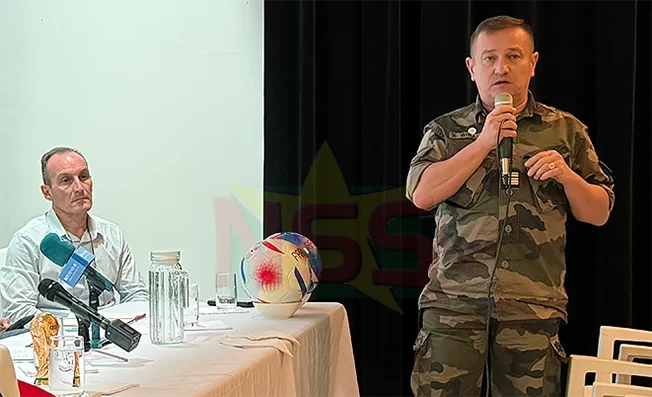
French officials, including Ambassador Nicolas de Lacoste, police attaché Commandant Jean-Michel Canestrier, and defense attaché Lieutenant Colonel Emmanuel Rigault, outlined the urgent need for the ratified protocol during a press briefing held Thursday. The Marowijne and Lawa rivers, which form the contested border between Suriname and France’s South American overseas territory of French Guiana, have seen a sharp surge in unlawful activity in recent years, ranging from unregulated illegal gold mining and severe mercury pollution to transnational organized crime, drug trafficking, human smuggling, and unlicensed fishing.
Canestrier emphasized that current ad-hoc cooperation between French and Surinamese law enforcement has delivered little meaningful progress, comparing efforts to crack down on cross-border crime without a formal legal base to “building a house on sand instead of solid stone.” Currently, security forces from both nations face major logistical and legal barriers to conducting routine patrols and vessel checks along the border river. The absence of a clearly demarcated border leaves it impossible to officially confirm which country unmarked river islands fall under, allowing illegal actors to escape enforcement by simply moving between French and Surinamese territory. “When offenders carry out illegal activity on the French side, they can easily flee to these unclaimed islands or straight into Suriname, and we lack the legal authority to pursue them effectively,” Rigault explained.
France has already waited five years for Suriname to formalize its approval of the border agreement signed by both governments in 2021. Today, roughly 400 French soldiers are deployed year-round alongside local police to conduct counter-mining operations, with additional permanent river patrol boats targeting smuggling and illegal fishing. Even with the nearly 500 total personnel committed to the region, operations remain largely ineffective because illegal gold miners regularly cross into Suriname to restock supplies and evade capture. “When they retreat across the border, all our efforts go to waste,” Ambassador de Lacoste stated.
While French and Surinamese military forces have carried out informal joint patrols since 2004, most recently just last month, the lack of a formal, ratified border agreement has left these operations deadlocked. French officials stressed that once the protocol is approved, the two nations can expand cooperation far beyond basic patrols, including opening a joint police operations center in the French Guiana town of Saint-Laurent-du-Maroni, where personnel from both countries can work side-by-side. Canestrier noted that the center could be operational within just one to two years *if* the legal framework is put in place first.
De Lacoste pointed to Suriname’s successful large-scale crackdown on illegal miners along the Marowijne River in 2022 as proof that targeted action can reverse the crisis, a step France publicly praised. However, the ambassador warned that conditions in the southern border region have deteriorated sharply in recent years. Local villages such as Anapaike now face an imminent public health and environmental disaster: mercury runoff from illegal mining has poisoned entire ecosystems, while armed Brazilian criminal gangs have terrorized local communities, destroying their traditional way of life.
The imbalance of harm from the illegal gold trade is stark, de Lacoste argued: “Gold is smuggled out of French Guiana into Suriname and global markets, but all we are left with is the mercury.” That toxic mercury will contaminate soil and water supplies for decades to come, he warned, putting entire local populations at severe risk of chronic illness and permanent environmental damage. Without immediate action to ratify the border protocol and establish a formal joint enforcement framework, the ambassador warned, the entire border region risks spiraling into full-blown crisis.