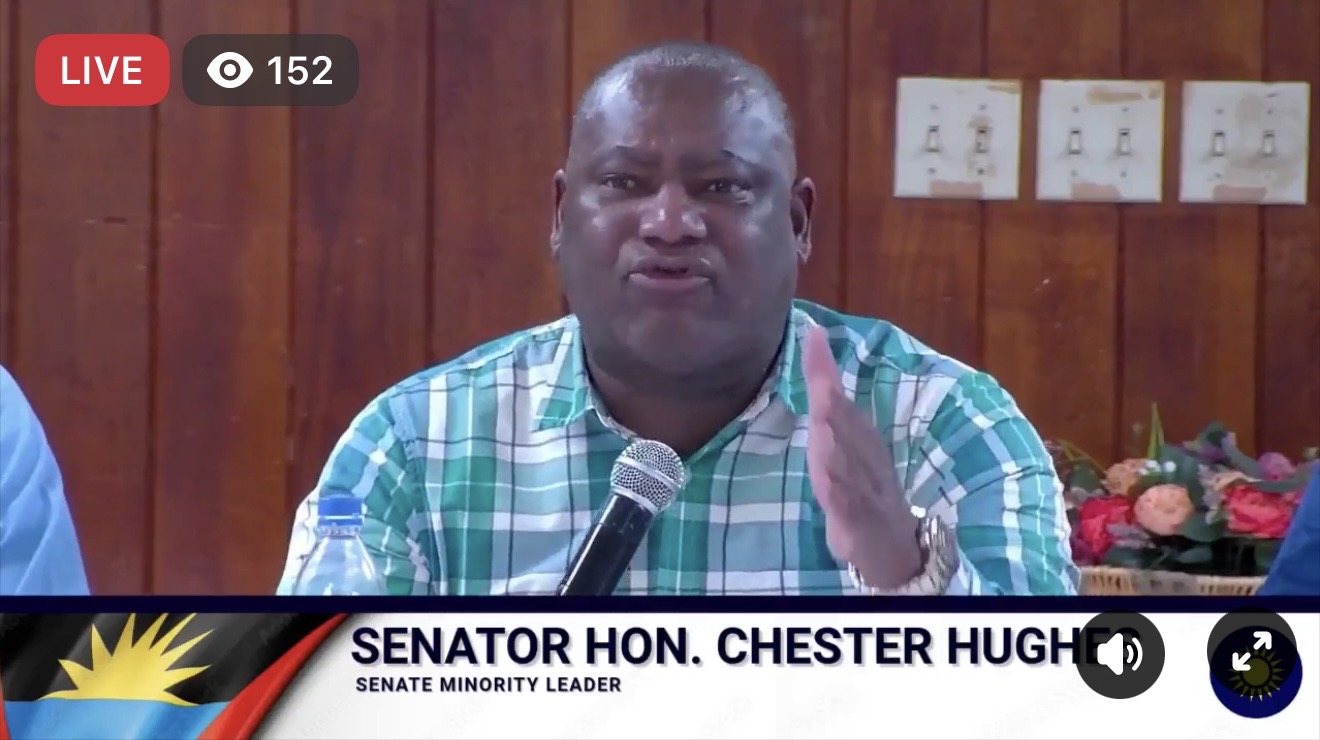
A heated political debate has erupted in Antigua and Barbuda over a proposed third-country deportee agreement with the United States, after opposition Senator Chester Hughes launched a scathing attack on the incumbent Gaston Browne administration, accusing leaders of accepting Washington’s terms outright rather than engaging in genuine bilateral negotiations.
Hughes laid out his criticisms during a United Progressive Party (UPP) town hall gathering focused on the government’s recently released White Paper detailing the agreement, pushing back hard against the ruling party’s framing of the process as a collaborative negotiation between the two nations.
According to Hughes, the Gaston Browne cabinet finalized a Memorandum of Understanding (MOU) with U.S. authorities months ago but has yet to provide any transparent, detailed explanation of the deal’s terms to Antigua and Barbuda citizens. The senator claimed that the agreement was not negotiated at all, but rather dictated to the local government by U.S. officials. “America did not negotiate with any of these governments. America told them, ‘You’re going to take these persons.’ And that’s it,” Hughes stated during the meeting.
A core point of Hughes’ criticism centers on the Prime Minister’s shifting public statements about the scope of the agreement, specifically the number of deportees that Antigua and Barbuda will be required to accept. Hughes said the Prime Minister has offered conflicting figures: first claiming the country would take no more than 10 people, then revising that number to 16 in recent remarks, before suggesting the country would accept whatever number of people arrives on any single deportation flight from the U.S. Hughes called these inconsistent claims “fanciful wordplay” meant to confuse the public.
The senator also highlighted a series of critical unanswered questions about the practical implementation of the deal, most notably where newly arrived deportees will be housed and how they will be integrated or managed once in the country. He questioned whether the government plans to place deportees in existing residential communities, underutilized state-owned housing, or another location entirely, noting that no official guidance has been shared with the public to date.
Another key grievance raised by Hughes is the administration’s decision to sign the MOU before launching any public consultation process. He emphasized that the White Paper outlining the agreement was only published after the deal was already finalized, meaning citizens had no opportunity to weigh in on a policy that will have significant social and economic impacts on the country.
Beyond domestic criticism of the Browne administration, Hughes also lashed out at Caribbean leaders more broadly, arguing that regional governments should have negotiated a unified collective position with the United States on the deportee issue, rather than negotiating separate deals individually. He echoed the Prime Minister’s own acknowledgement that regional collective action would have been preferable, but argued that the current crop of regional leaders are too arrogant and self-interested to prioritize the needs of their populations over political expediency.
Looking ahead, Hughes called on members of Antigua and Barbuda’s Parliament to use the upcoming debate on the government’s White Paper to hold the Browne administration accountable for its handling of the agreement. He urged lawmakers to demand clear, direct answers to outstanding questions on behalf of the Antiguan and Barbudan public, challenging the executive’s opaque approach to the controversial deal.