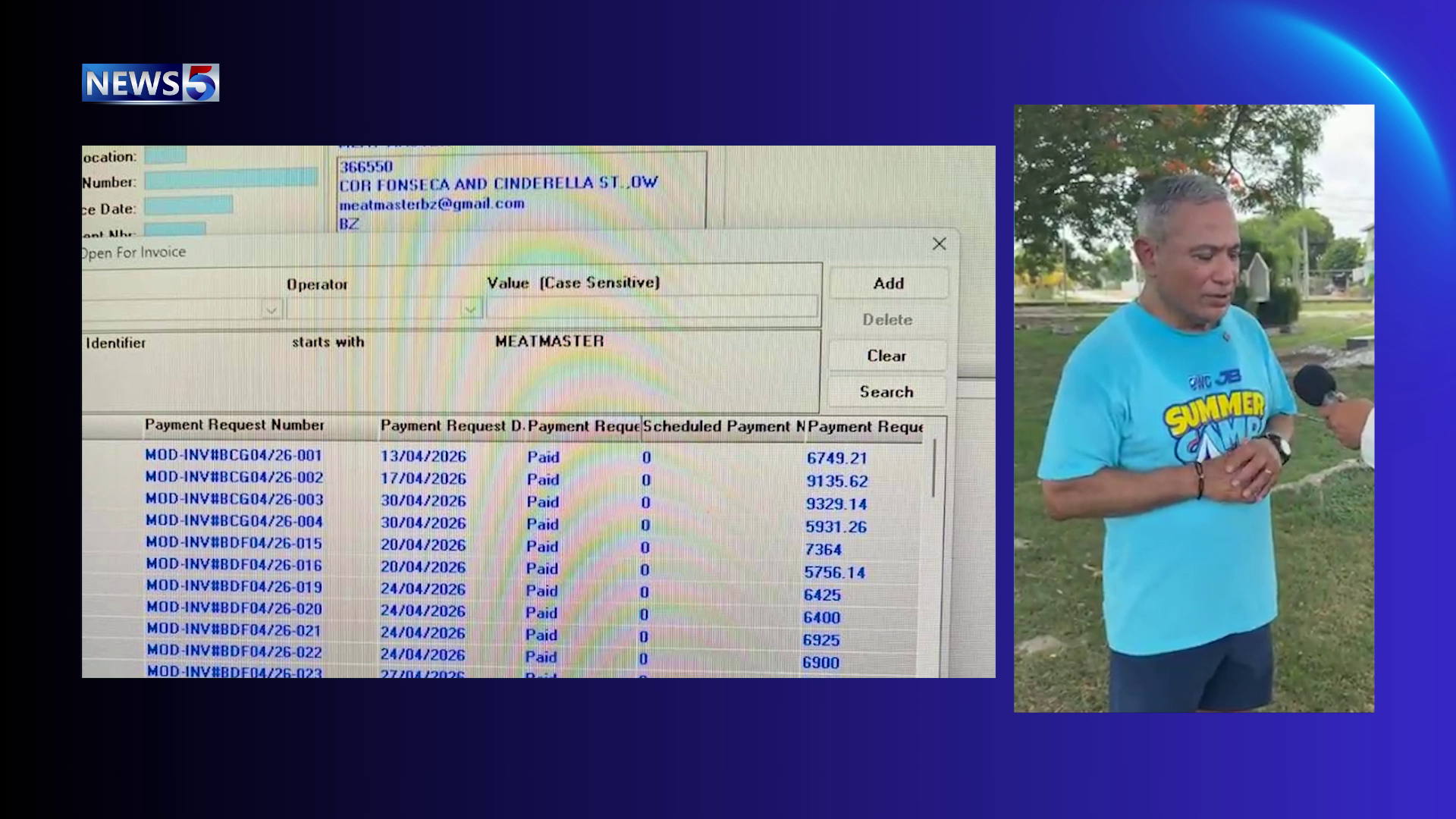
As a formal audit of Belize’s Ministry of Defense spending gets underway, a simmering controversy over a multi-hundred-thousand-dollar meat supply contract has put Prime Minister John Briceño on the defensive, after opposition figures linked him to the winning vendor, Meat Master. At the center of the allegations are reports that the land housing Meat Master’s processing operations belongs to Briceño’s oldest sibling, a connection the prime minister has forcefully and repeatedly rejected.
In a public address responding to the claims, Briceño pushed back hard against what he frames as a manufactured political smear campaign orchestrated by the opposition United Democratic Party (UDP). He explained that he is the eldest child of his branch of the Briceño family, and the owners of Meat Master belong to an unrelated Briceño clan with roots across several Belizean districts including Punta Gorda, Corozal, and Orange Walk. The prime minister said he had no prior knowledge that Meat Master was supplying meat to the Belize Defense Force (BDF), and argued that the divided, ineffective UDP is grasping at any last-minute narrative to manufacture a scandal where none exists. Briceño also noted that the ongoing audit has been formally handed over to the Auditor General, who recently outlined her general audit process to cabinet under an oath of secrecy that prohibits her from commenting on specific open investigations. Should any wrongdoing be uncovered, Briceño added, those responsible will be held accountable regardless of name.
Meat Master has joined the prime minister in rejecting all claims of improper connections, issuing a public statement to correct what it calls inaccurate characterizations of its operations. Founded and formally registered in 2022, the company specializes in producing fresh, smoked, and processed meat products for commercial and institutional clients. It firmly denied any familial or financial ties to the Briceño family, emphasizing that no member of the prime minister’s family owns either the business itself or the property where it operates. Meat Master also defended its contracting process, confirming that it secured supply agreements with both the BDF and the Belize Coast Guard through the government’s official competitive tender process, met all mandatory procurement requirements, and submitted all required bidding documentation. All invoicing, the company added, accurately reflects the volume and value of products delivered to the military entities.
The controversy has kept questions alive around Ministry of Defense CEO Francis Usher, who acknowledges a distant family connection to Meat Master’s owner through his wife. Usher has stated that he played no role in the procurement process for the contract, and only became aware that Meat Master was an approved supplier when payment requests crossed his desk for processing. Despite growing calls from critics to remove Usher from his post while the audit proceeds, Prime Minister Briceño has announced he will retain the CEO for the time being. Briceño praised Usher for his diligent work stabilizing the ministry’s operations, arguing that removing him now would be a disservice to the uniformed men and women serving in the BDF and Coast Guard. The prime minister noted that Usher genuinely cares for the well-being of service members and is actively working to improve ministry operations, and no evidence of improper conduct has been presented to justify his removal.
This controversy stems from a broader audit into Ministry of Defense contracting practices, where multiple suppliers have reportedly received a total of more than $400,000 in contracts split into invoices kept deliberately under the $10,000 threshold—an apparent tactic to avoid the stricter oversight and competitive bidding requirements that apply to larger government contracts. As the Auditor General’s review continues, all sides are awaiting the final audit report to clarify whether any rules were broken or improper influence was exerted.