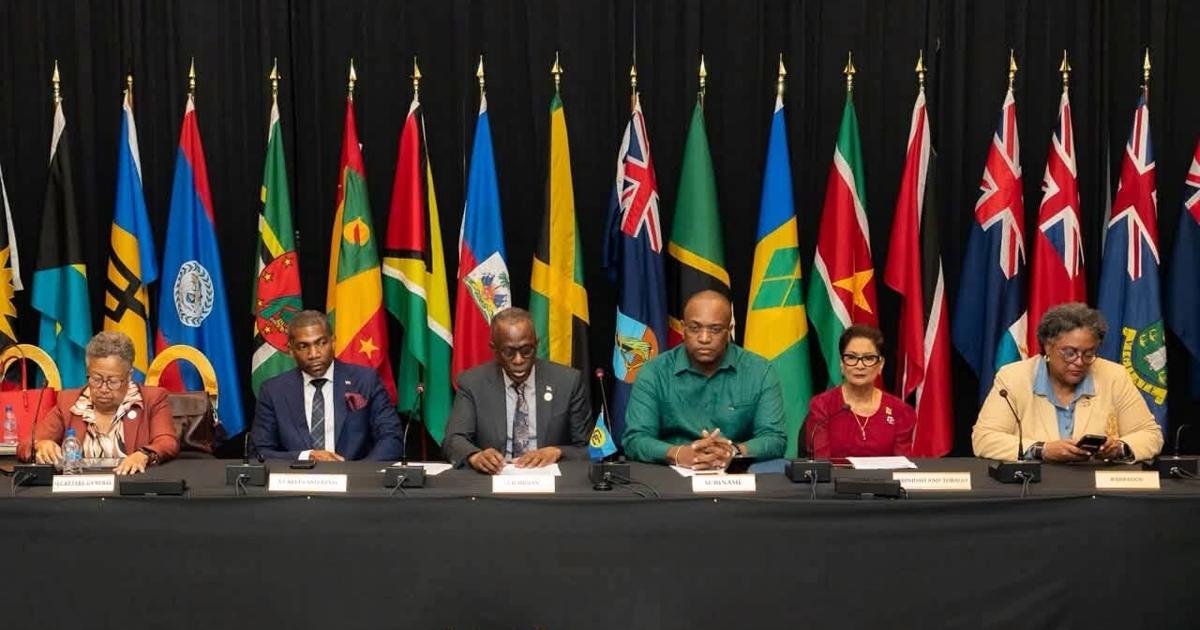
In the final press briefing of the 51st Regular Meeting of the Conference of Heads of Government of the Caribbean Community (Caricom) held in St. Lucia, regional leaders announced a coordinated, collective humanitarian response to support two neighboring nations, earthquake-stricken Venezuela and economically strained Cuba.
Trinidad and Tobago Prime Minister Kamla Persad-Bissessar, one of the key figures leading the relief coordination, emphasized the deep interconnectedness of the Caribbean region that drives this collective action. Just seven nautical miles separate Trinidad from Venezuela, meaning any crisis unfolding across the border directly shapes social and economic conditions in Trinidad and Tobago, she explained. Persad-Bissessar added that she, alongside Barbados Prime Minister Mia Mottley and other regional heads, held extensive talks on the relief effort during a late-night session on the Tuesday of the conference.
Following a series of destructive earthquakes that hit Venezuela, Caricom member states moved rapidly to launch assistance efforts, with regional governments aligning logistics to dispatch both essential supplies and emergency response personnel. Persad-Bissessar confirmed that immediately after the conference, a fully loaded cargo ferry would depart her country for Venezuela carrying tons of relief goods for affected communities. She noted that Guyana and Barbados had already deployed their own shipments of aid to Venezuela, aligning with the community-wide collective effort.
Expanding on the Venezuela relief operation, Mottley shared that a single vessel coordinated by the Guyanese government is currently transporting 88 containers of aid donated by the vast majority of Caricom member states. Barbados, for its part, mobilized emergency response personnel through the Regional Security System (RSS) within 72 hours of the earthquakes to support search and rescue operations, she added.
Additionally, Barbados has redirected a certified pre-deployed field hospital to Venezuela. The mobile medical unit was originally staged for response to Hurricane Melissa in Jamaica, and will now address the critical gap in medical care left by the earthquake, which has left thousands injured and stretched Venezuela’s already strained public health system to breaking point. Mottley emphasized that the regional bloc has maintained open communication with Venezuelan President throughout the response, noting that the Caribbean community shares a moral obligation to support neighbors in crisis: “as we said, there but for the grace of God goes any of us, and we believe that we have a responsibility morally to help the people of Venezuela.”
Beyond the response to Venezuela’s earthquake, Caricom has also prioritized delivering life-saving humanitarian assistance to Cuba, which faces ongoing international trade restrictions that have limited access to essential goods. Mottley revealed that Barbados’ initial attempts to transfer funds earmarked for the purchase of baby formula were blocked twice, with the full amount being returned to regional authorities on two separate occasions. Acknowledging that political and economic external factors have complicated aid delivery to Cuba, Mottley said Caricom remains committed to advancing purely humanitarian goals, and is ready to facilitate dialogue between the United States and Cuba to resolve logistical and political barriers. “When you live in a neighbourhood, what happens in the neighbourhood affects everyone,” Mottley said, framing the entire Caribbean basin – stretching from Florida in the north to Suriname and Guyana in the south – as a single interconnected community.
Caricom Chairman and St. Lucia Prime Minister Philip J Pierre brought a last-minute update on the Cuban aid effort, confirming that after three failed attempts to transfer the funds, the payment was successfully processed on the fourth attempt. The first shipment of baby milk is now cleared for delivery to Cuban communities in need. Pierre added that Caricom leaders also held preliminary discussions on establishing a dedicated permanent regional humanitarian relief fund to streamline future cross-community crisis response efforts.