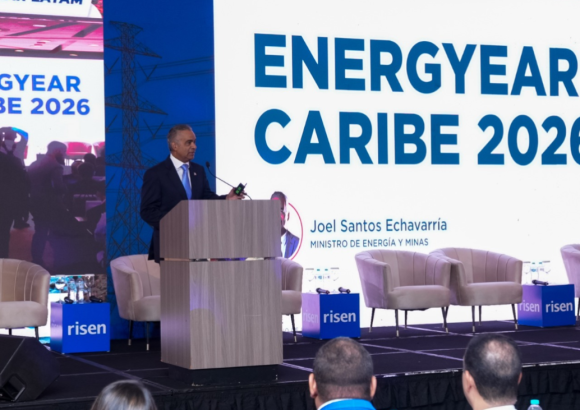
Santo Domingo — When Energy Minister Joel Santos took the stage to open Energyear Caribe 2026 in the nation’s capital this week, he laid out a clear, urgent long-term vision for the Dominican Republic’s energy future: act now to upgrade the country’s power infrastructure, or risk being unable to meet growing electricity demand by the 2030s.
Addressing a crowd of more than 600 senior energy industry leaders, technical experts, and policymakers gathered at Hotel El Embajador, Santos framed current investment as the foundation of the country’s energy security for the next 15 years. He emphasized that developments in power generation, cross-country transmission infrastructure, and last-mile distribution systems built in the coming years will directly shape how well the Dominican Republic can serve households, businesses, and industrial operations into the 2030s. A key warning accompanied his presentation: if critical infrastructure projects are pushed past 2028, future national governments will not have the capacity to keep up with rising demand.
The government’s official strategic roadmap centers on five core priorities: scaling up total energy generation capacity to meet growing needs, updating aging transmission and distribution networks, streamlining and improving regulatory frameworks, expanding access to electricity for underserved rural communities, and rolling out widespread energy efficiency initiatives across all sectors. Santos explained that the strategy was specifically crafted to adapt to three shifting global and domestic trends: the Dominican Republic’s accelerating economic expansion, rapid technological change in the energy space, and the ongoing global transition away from fossil fuels to lower-carbon energy sources.
Santos also highlighted the critical role of cross-sector collaboration, calling for far stronger coordination between the Dominican Republic’s public institutions and private energy companies. He argued that closer public-private partnership paired with forward-thinking, adaptive regulation is the only way to build an electricity system that is reliable in day-to-day operations, resilient to external shocks such as price volatility and extreme weather, and sustainable aligned with global climate and development goals.
Energyear Caribe 2026, the regional energy conference that drew officials, utility leaders and experts from across the Caribbean and beyond, focused its 2026 agenda on the Dominican Republic’s long-term electricity outlook. Key topics of discussion included integrating higher shares of variable renewable energy into the national grid, modernizing outdated grid infrastructure, advancing much-needed regulatory reforms, and aligning short-term projects with long-term national energy planning goals.