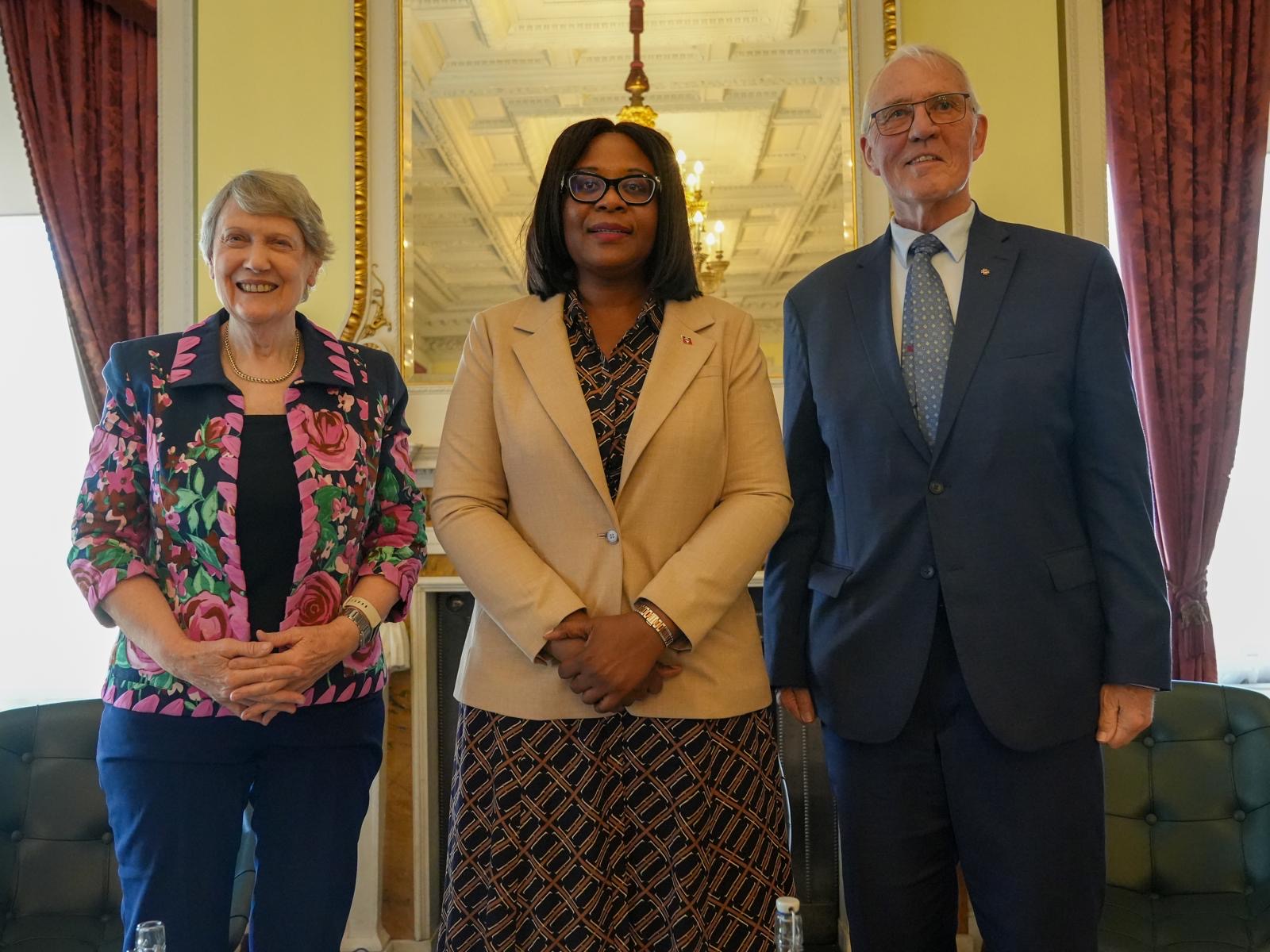
In a pre-summit dialogue hosted by the Commonwealth Secretariat at Marlborough House ahead of the 2026 Commonwealth Heads of Government Meeting (CHOGM) in Antigua and Barbuda, top global and Commonwealth leaders have issued a unified call to center small states in the transformation of the strained global multilateral order. The event, titled “What space is there for Commonwealth small states in a multipolar world where middle powers are also increasingly assertive?”, gathered prominent figures to address the long-standing marginalization of small nations in global decision-making, and outline a path forward rooted in the Commonwealth’s core values of equal representation.
Opening the conversation, Commonwealth Secretary-General Shirley Botchwey set the tone for the discussion, framing the gathering as a critical step to reframe global narratives around small state capacity. “We must change the narrative around small states. We cannot speak only of vulnerability,” Botchwey emphasized, noting that small Commonwealth nations consistently emerge as some of the clearest, most principled voices in global governance. “They understand interdependence because they live it,” she added. Botchwey went on to highlight the unique foundational structure of the 56-nation bloc, where every country – regardless of size, economic output, or geographic status – holds an equal voice in discussions. “That is not a procedural detail; it is a political principle. Our task now is to turn that principle into influence, and I am determined that the Commonwealth will be an instrument for the transformation of its small states.”
Small states make up a majority of the Commonwealth’s membership, accounting for 33 of the bloc’s 56 member countries, giving the dialogue unique stakes for the organization. During the panel, speakers collectively acknowledged that the post-WWII multilateral system, which has anchored global cooperation for nearly 80 years, is facing unprecedented strain. Institutions designed for a vastly different global power dynamic are struggling to adapt to 21st century challenges, cross-border cooperation is declining, and the worst impacts of climate change fall disproportionately on small nations that have contributed the least to global emissions. Most notably, speakers pointed out that small states are often shut out of key decision-making processes that shape their economic, social, and environmental futures. Despite these barriers, the panel highlighted that small states punch far above their weight in multilateral action, particularly when it comes to climate action, ocean conservation, and environmental stewardship.
The core of the discussion explored how the Commonwealth’s long-standing model of consensus-based decision-making – which grants equal voice to all 56 diverse member nations – can serve as a blueprint for building a revitalized, values-led global order rooted in international law. Under this model, small and vulnerable nations would act as active shapers of global policy, rather than passive bystanders to decisions made by large and middle powers.
Rt Hon Helen Clark, former New Zealand Prime Minister, Chair of the Global Leadership Foundation, and former UNDP Administrator, was the panel’s lead speaker. She argued that the original promise of multilateralism – that every nation, no matter its size, holds a stake and a say in the shared global future – is fraying amid shifting global power dynamics. “As power shifts and middle powers rightly seek a greater role, we must ensure the answer is not simply a slightly larger club of the powerful,” Clark stated. She went on to highlight the unique value small states bring to global governance: “Small states bring moral clarity, hard-won experience and outsized leadership on climate, on oceans and on peace. A revitalised multilateralism must make room for them, not as an act of charity, but because the system will be stronger and more legitimate for it.”
Joining Clark as a guest of the Commonwealth Secretariat was Hon Bill Blair, Canada’s High Commissioner to the United Kingdom. He echoed Clark’s call for inclusive collaboration, noting that middle powers carry a unique responsibility to advance equity in global governance. “Canada believes that a rules-based international order only works if it works for everyone,” Blair said. “Middle powers have a responsibility not to replicate the patterns of dominance we seek to change, but to open doors and build coalitions with small states as genuine partners. The Commonwealth shows what that partnership can look like in practice.”
The conversation was moderated by HE Karen-Mae Hill OBE, Antigua and Barbuda’s High Commissioner to the United Kingdom. Antigua and Barbuda is set to host the 2026 CHOGM this coming November, where the nation will also assume the role of Commonwealth Chair-in-Office. The summit will carry the official theme “Accelerating Partnerships and Investment for a Prosperous Commonwealth”, and will bring together leaders from across the bloc to advance shared prosperity for the Commonwealth’s 2.7 billion people. Hill emphasized that the dialogue was particularly timely given the upcoming summit. “As Antigua and Barbuda prepares to welcome Commonwealth leaders to CHOGM 2026, this conversation could not be more timely,” Hill said. “Small states are not asking for a seat at the margins of a new world order; we are asserting our place at its heart. I look forward to a time when the contribution of small states to multilateralism is fully recognised and supported, building on the Commonwealth’s decades of championing the voices of small states.”
The Marlborough House Conversation is just one part of the Commonwealth Secretariat’s broader pre-CHOGM dialogue series, designed to surface key priorities from member states ahead of the 2026 summit.