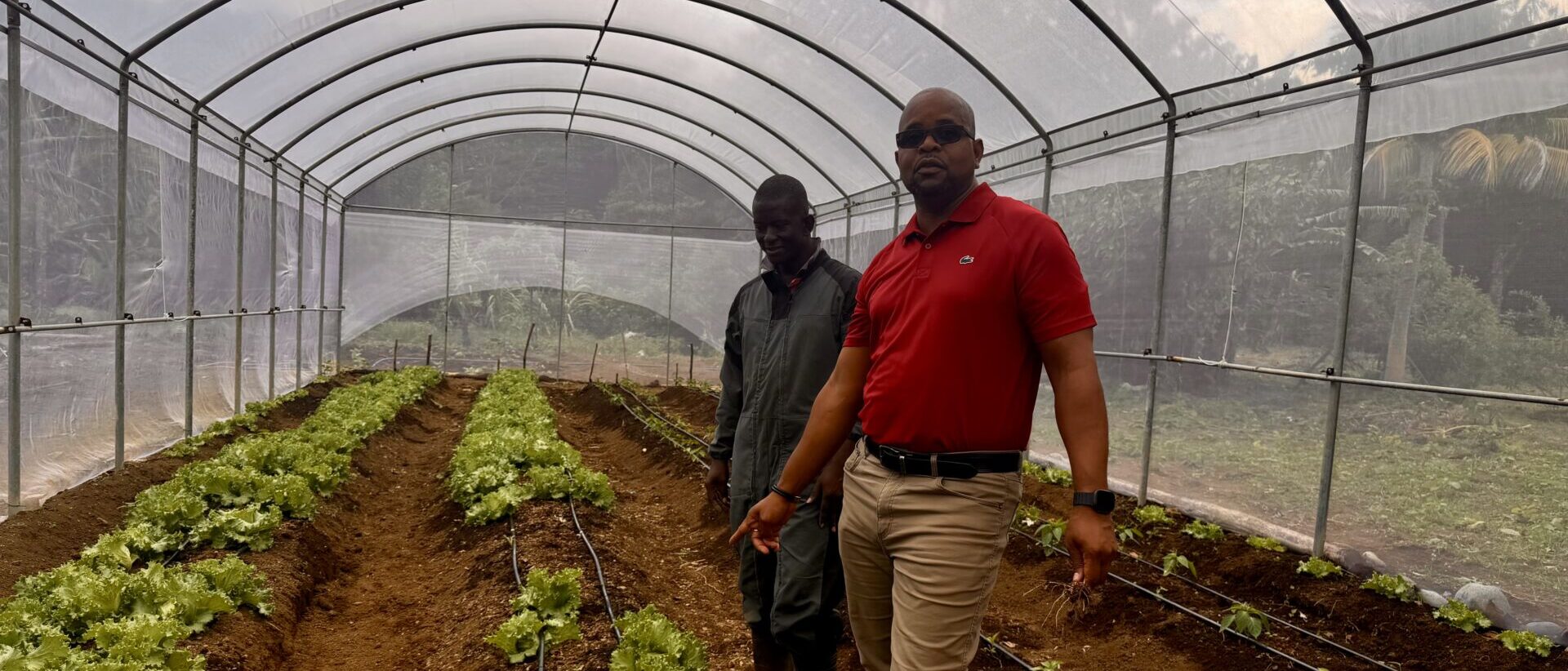
Perched on a sunlit hillside in Cochrane, neat rows of lush lettuce, vibrant bell peppers, plump tomatoes, golden corn and starchy plantains spread across rolling terrain, framed by bright green commercial greenhouses. This working farm is more than just a production site—it is the proving ground for Dominica’s approach to agricultural transformation, where the island nation’s Minister of Agriculture, Fisheries, Blue and Green Economy, Honourable Roland Royer, embodies the “leadership by example” philosophy that anchors the country’s national agricultural agenda.
“I practice what I preach,” Royer states plainly as he navigates between crop rows on the farm he still actively manages while holding public office. “If you’re going to stand before farmers and advocate for new policies, you need to live the challenges they face every day. You can’t craft effective solutions from behind a desk.”
This on-the-ground perspective has shaped a wave of targeted policy interventions designed to tackle three of Dominica’s most pressing agricultural priorities: strengthening national food sovereignty, lifting overall sector productivity, and solving the crippling, long-standing crisis of agricultural labour shortages.
At the forefront of these efforts is the Farm Labour Programme, a structured initiative developed in partnership with the International Organization for Migration (IOM) that creates a regulated, legal pathway for migrant workers to fill critical gaps in Dominica’s agricultural workforce. For Royer, the programme grew directly from observations he made while visiting farms across the island—including his own.
“Labour scarcity was the single largest barrier to growth we identified,” he explains. “If we are serious about hitting our 2030 target of growing agriculture’s contribution to national GDP to EC$700 million, we need a workforce that can support that expansion. There was no way around solving this problem first.”
Since launching in mid-2025, the programme has already streamlined legal entry for more than 200 migrant agricultural workers, supporting the operations of more than 60 small and medium-scale farmers across the country. The application process is designed to ensure transparency and legitimacy: farmers submit formal workforce requests to the Ministry of Agriculture, which conducts on-site assessments to confirm the operational need for additional labour. Approved applications are then reviewed by a cross-government Migrant Farm Labour Committee, with representatives from the ministries of Agriculture, Labour, National Security, and Foreign Affairs, before work visas are issued.
This structured framework was built to meet a dual core goal: strengthening national governance of labour migration while opening sustainable pathways that drive inclusive economic growth and long-term sector resilience. Early results have already exceeded initial expectations, Royer says.
“Farmers are already reaching out to share success stories—photos of expanded harvests, accounts of consistent production that they couldn’t maintain before, and clear proof of how these workers have lifted their productivity,” he reports.
One of the clearest success stories plays out every day on Royer’s own Cochrane farm, where Jean Louis Maxi, a Haitian national with 24 years of residency in Dominica, manages crops and oversees daily production alongside his wife. For Maxi, farming is not just employment—it is a lifelong passion rooted in his upbringing.
“My father was a farmer back in Haiti,” he says. “I grew up working the land. It’s part of who I am. If I couldn’t come to the farm every day, I would feel unwell—this is what I love.” Maxi has worked with Royer for two years, and says the opportunity through the programme has allowed him to continue doing the work that has defined his life. His wife works alongside him every day, sharing his commitment to farming.
“She’s my right hand,” Maxi says with pride. “She loves this work just as much as I do.”
The Maxis’ contribution underscores a critical reality: as local farmers across Dominica struggle to find consistent, committed domestic labour, migrant workers have become foundational to sustaining steady agricultural production. Royer is open about the challenges of recruiting local workers for farm work.
“Finding local people who are willing to commit to consistent, full-time farm work is very difficult,” he acknowledges. “That’s one of the core reasons we moved forward with this programme.”
The Farm Labour Programme is just one piece of a far broader national strategy to position Dominica’s agricultural sector for robust, long-term growth. As the country advances major infrastructure projects—including a new international airport, luxury marina developments, and expanded tourism facilities—demand for locally grown food is projected to rise sharply. In response, the Dominican government has invested more than EC$160 million in the agricultural sector since 2019, funding a wide range of projects including post-hurricane farm rehabilitation following Hurricane Maria, input subsidies for thousands of smallholder farmers, improved farm access roads, modern plant propagation facilities, upgraded livestock infrastructure, and expanded digital and physical market access systems.
The strategy’s dual end goals are strengthening national food security while positioning local agriculture to capitalize on growing domestic and international export opportunities. “We know that every investment in tourism creates new opportunities for agriculture,” Royer explains. “The more visitors we welcome to Dominica, the more local food we need to produce to meet that demand.”
Alongside addressing labour shortages and expanding production, the Ministry of Agriculture is also tackling another long-term systemic challenge: an aging national farming population. To draw young Dominicans into the sector, the government has rolled out a suite of targeted initiatives, including a revitalized National Association of Youth in Agriculture, expanded access to modern greenhouse technology, formal agribusiness skills training, and a new land lease programme that offers agricultural land to new young farmers for just EC$1 per acre. Already, nearly 1,000 young people have submitted applications for the low-cost land programme.
For Royer, building long-term food security depends on a balance of three core elements: innovative policy, targeted public investment, and centering people to meet current and future needs. “When older farmers retire, if we don’t have a new generation ready to take over their land and their operations, we will face a major crisis,” he says. That gap is exactly where partnerships like the IOM-supported “Development of the Agricultural Sector in Dominica by Strengthening Migration” project deliver outsized value. By building evidence-based labour migration policies and creating formal legal pathways for migrant workers to contribute to a critical economic sector, the initiative addresses immediate workforce needs while building long-term resilience for the entire country.
Back on his Cochrane farm, Royer pauses to survey the healthy crops stretching out around him. As a minister, a policymaker, and an active working farmer, he experiences firsthand the daily challenges that Dominican agricultural producers face—a perspective that adds unique credibility to the policies he champions.
In Dominica’s ongoing push to expand food security and drive inclusive agricultural growth, the Farm Labour Programme is far more than a quick fix for labour shortages. It is a model for how practical, experience-informed policy, strengthened by cross-sector and international partnerships, can deliver tangible, shared benefits for local farmers, migrant workers, and the country’s broader sustainable development goals.