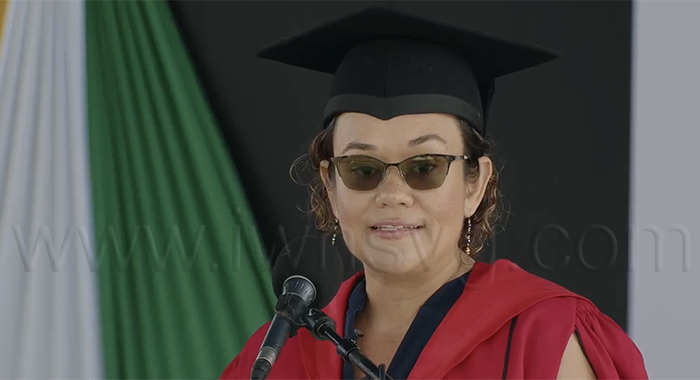
At the recent commencement ceremony for over 900 graduates of the St. Vincent and the Grenadines Community College (SVGCC), featured speaker Dr. Andrea Veira delivered a compelling call to action, challenging young graduates to rethink how they engage with digital technology and social media. Held under the theme “Tomorrow’s Leaders, Empowered Minds, Limitless Possibilities”, the event became a platform for Veira — a seasoned scholar, educator, researcher and consultant — to reframe digital access not as an entitlement for young people, but as a responsibility tied to collective progress.
Veira opened by highlighting the unprecedented opportunities that today’s digital landscape offers young Vincentians and Caribbean people, opportunities that previous generations could barely have dreamed of. From massive open online learning platforms and global professional networks to digital entrepreneurship infrastructure, and cutting-edge emerging tools including artificial intelligence, automation, drone technology, robotics, and big data systems, Veira framed these resources as power-building assets for purpose-driven young people. “These are tools for empowered minds,” she told the assembled graduates. “And when used with discipline and purpose, they open limitless possibilities.”
Against this backdrop of opportunity, Veira pushed back against the trivial, unproductive uses of technology that have become common for many users. She pointed out that far too many people spend their connected time on mindless scrolling, unhealthy social comparison, and spreading online gossip and drama — a habit she described as wasting a once-in-a-generation gift. Rather than accepting passive digital consumption as the norm, Veira urged graduates to regularly pause and reflect on their digital habits, asking the critical question: How am I using these tools to build something meaningful?
Veira laid out a clear, constructive vision for digital engagement that redefines social media as more than a space for personal display or drama. She encouraged graduates to leverage these platforms to lift up their communities: promoting local small businesses, sharing educational resources with public audiences, celebrating Caribbean culture, and organizing collective action for local issues. This framing positions young internet users not just as passive consumers of online content, but as intentional digital citizens whose online activity can strengthen local economies, build public awareness, and deepen community solidarity.
Turning to one of the most debated modern technological shifts, Veira addressed the growing integration of artificial intelligence into education and the workforce, urging graduates to approach AI with both ethical awareness and intentionality. She advised that AI should be used to sharpen, not replace, independent critical thinking — a guideline that balances embracing innovation with retaining individual intellectual agency. Beyond AI, Veira encouraged graduates to apply all types of digital technology creatively across key local sectors, from designing climate-resilient agricultural solutions to improving access to healthcare, expanding educational opportunities, boosting sustainable tourism, and supporting community development more broadly.
Throughout her address, Veira returned to a core principle: digital tools themselves are neutral, but the choices people make about how to use them carry real weight. The key question for young people, she argued, is not whether they engage with the internet, but what purpose that engagement serves. Without a foundation of clear values and purpose, Veira warned, even advanced technical skills can amount to shallow, unproductive output. “The world does not need more qualified people who lack compassion,” she emphasized. “It needs graduates who can combine knowledge with kindness, confidence with humility, and creativity with responsibility.”
While Veira celebrated the inherent resilience and creativity of Gen Z and millennial generations, she closed by reinforcing that digital tools only deliver true empowerment when they are tied to service, stewardship, and solving real community problems. In her vision, graduates have the power to shape online spaces for good: choosing to move beyond mindless scrolling and comparison, and instead build meaningful, brighter futures for themselves and their entire communities.