A simmering regional dispute over the reappointment of Caricom’s Secretary-General has taken a formal turn, with the bloc’s heads of government agreeing to seek a legal ruling from the Caribbean Court of Justice (CCJ) to resolve the controversy, following persistent advocacy from Trinidad and Tobago Prime Minister Kamla Persad-Bissessar.
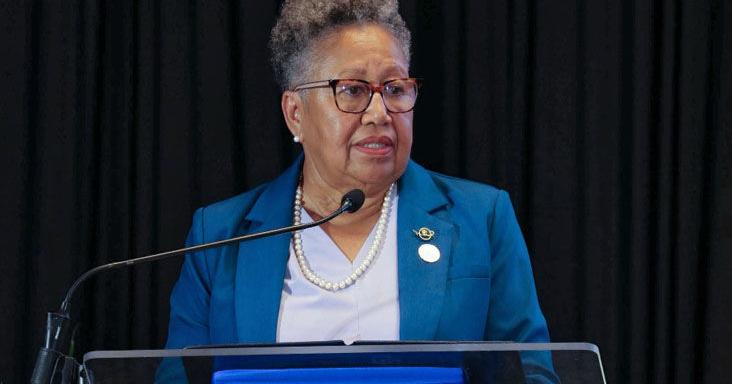
After hours of closed-door deliberations at Monday’s annual retreat of Caricom leaders, the regional bloc announced it would officially initiate proceedings under Article 21(2) of the Revised Treaty of Chaguaramas to obtain an impartial advisory opinion on the contested reappointment of Dr. Carla Barnett. The move greenlights Persad-Bissessar’s proposal, which she had spent weeks building diplomatic support for ahead of the retreat.
Trinidad and Tobago has stood firm in its objection to the process that led to Barnett’s reappointment, but Persad-Bissessar has repeatedly emphasized that the challenge is rooted in upholding legal standards and institutional governance, not a personal opposition to Barnett herself. Ahead of the retreat, the prime minister laid out her concerns in a detailed 22-page letter dated July 3, addressed to Caricom chair and St. Lucia Prime Minister Philip J Pierre, as well as every head of government and state across the bloc. In the correspondence, she detailed what she framed as major procedural and constitutional irregularities in the reappointment process, framing the CCJ referral as a principled step to clarify the rules rather than an attack on any individual or member state.
In its official statement issued Tuesday, Caricom noted that the step aligns with the core purpose for which the CCJ was founded: to provide authoritative interpretation of the bloc’s founding treaty. “This is the very purpose for which the CCJ was created—to be a treaty interpretation body,” the statement read.
Pending the court’s advisory opinion, Caricom has agreed to maintain the status quo, with no changes made to Barnett’s current position as Secretary-General. “The status quo with respect to the reappointment of the Secretary General shall remain unless and until the Community considers the said Advisory Opinion from the CCJ,” the agreement states.
Leaders stressed that the agreed pathway is designed to resolve the impasse amicably, while allowing the bloc’s core work to continue without disruption. The approach preserves the Community’s ability to conduct its day-to-day affairs without prejudice to any side of the dispute, they added.
The decision is also tied to a broader ongoing effort to strengthen Caricom’s institutional framework, a mandate approved at the previous Caricom conference held in St. Kitts and Nevis. Leaders underscored that the legal referral process does not call into question the integrity of any member state or individual involved. Instead, it reflects the bloc’s collective commitment to upholding the highest standards of good governance and continuous institutional improvement, the statement said.
In closing, heads of government reaffirmed their unwavering commitment to regional unity, noting that the bloc faces a wide range of complex shared challenges in the current global context. “The Heads have reaffirmed their commitment to the ideals and objectives of the Community and will continue to move forward in unity to advance the interests of the Region during these difficult times,” the statement concluded.