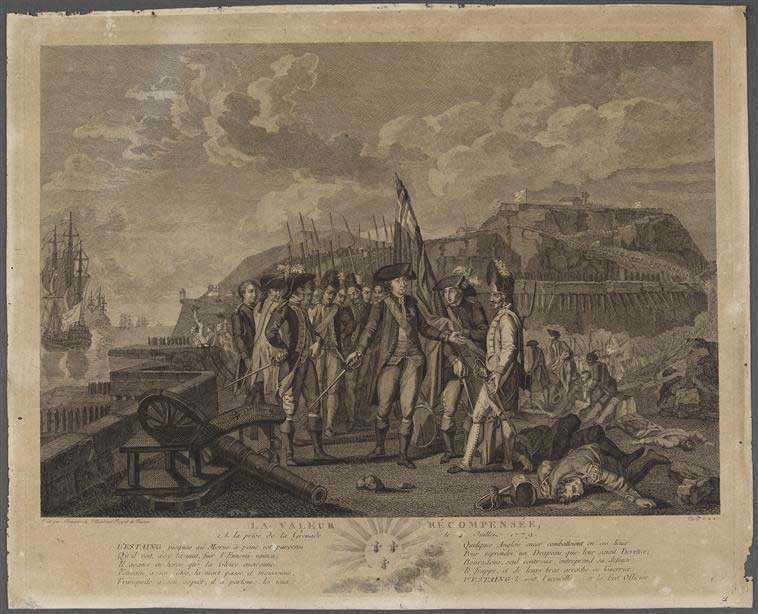
Two and a half centuries ago, on July 4, 1779, a decisive colonial military campaign shifted control of the Caribbean island of Grenada from Britain to France, a victory that reshaped regional power dynamics and left lasting physical and cultural traces across the island.
The operation grew out of a broader sequence of French military moves in the Caribbean that summer. After successfully capturing the neighboring island of St. Vincent on June 18, French Vice-Admiral Charles-Henri comte d’Estaing sailed his fleet north on June 30. Originally planning to strike the British-held island of Barbados, persistent unfavorable winds made the assault unfeasible, forcing d’Estaing to redirect his massive force toward Grenada instead.
British colonial leaders on Grenada received advance warning of the impending attack, prompting Governor George Macartney to immediately declare martial law and rally all available defensive forces. His entire garrison amounted to just 101 regular soldiers from the 48th Regiment, 24 new artillery recruits, and between 300 and 400 local militiamen. Deeming the existing Fort George too weak to hold off a large-scale assault, Macartney chose to anchor his primary defense at the Hospital Hill Redoubts, a fortified position perched 400 feet above sea level with a direct vantage point over Fort George. He also dispatched an urgent request for reinforcements to the main British naval command in the Caribbean, holding out hope that Admiral John Byron’s fleet would arrive in time to repel the invasion.
By mid-afternoon on July 2, d’Estaing’s fleet—comprising 25 ships of the line, 12 frigates, and more than 6,500 soldiers and sailors—dropped anchor off Molinere Bay on Grenada’s western coast. By the end of the day, between 1,300 and 1,500 French troops had come ashore and secured the surrounding coastal area, with the outnumbered British forces unable to spare any men to oppose the landing.
That same night, French forces began a long flanking march around Hospital Hill to position for their assault. After leaving Molinere Bay, the column split into two groups near Grand Mal: the larger contingent moved toward the de Pradine estate, while a smaller detachment advanced toward Hospital Hill and took up a forward position on Cherry Hill. In a preliminary probe that night, the French sent one ship toward the main town to test British defenses. The vessel exchanged a small number of shots with the Hospital Hill garrison before withdrawing under fire. A secondary French attempt to advance along the St. John River around 2 a.m. also failed, after British defensive fire threw the advancing force into confusion, forcing a retreat when the troops became lost in the dark terrain.
D’Estaing’s final plan for storming Hospital Hill called for three main infantry columns to attack from the east and southeast, a maneuver that required a full day of marching across difficult terrain on July 3 to reach their attack positions by nightfall. A diversionary false attack from the west and north would draw British attention away from the main assault columns. Before launching the attack, d’Estaing sent a truce envoy to demand Macartney’s surrender, framing the demand as an act of mercy: “Humanity requires it and the personal consideration which the Count d’Estaing has for Lord Macartney induces him in the most solemn and pressing manner to summon his Lordship to surrender.” Macartney rejected the demand, clearing the way for the French assault.
Around 11 p.m. on July 3, French infantry silently began climbing the steep trails leading to the Hospital Hill summit. By midnight, the main force had gathered near William Lucas’ estate—now the site of Grenada’s Government House, roughly one mile from the redoubts—and spread into formation. At approximately 2 a.m. on July 4, the smaller diversionary force launched its planned false attack along the St. John River. Seizing the moment, the three main assault columns began their final push up Hospital Hill.
An advanced guard leading the left column, commanded by the Comte de Durat who would later become French governor of Grenada, successfully breached the palisade defenses and opened a path up the hill for the rest of the column. Overwhelmed by the French force’s superior numbers, British defenders were pushed out of every defensive position one by one. The entire assault on Hospital Hill took just over an hour for the French to secure. Macartney and a small contingent of remaining troops fled the redoubts before they fell and retreated to Fort George. In his later accounts, Macartney blamed the quick collapse on mass desertions, claiming most free colored fighters and local French militiamen abandoned their posts as soon as the attack began.
As dawn broke on July 4, the French turned the captured British artillery on Hospital Hill directly toward Fort George. In their hasty retreat, British troops had no time to disable the guns, leaving them fully operational for the French. After just a single shot was fired from the heights, the British garrison raised a white flag of surrender. Macartney was granted a few hours to draft surrender terms, and presented 17 articles of capitulation to d’Estaing. The French commander rejected all of Macartney’s terms outright and immediately presented his own 28 articles, which Macartney later described as “the most extraordinary and unexampled project that ever entered into the mind of a General or Politician.” With no remaining military leverage to negotiate, Macartney had no choice but to accept unconditional surrender, as local leaders concluded that trusting to the international laws of war was better than facing further bloodshed.
The 1779 capture of Grenada was one of only three times the island changed hands during its colonial history, and one of the only violent transfers of power. The British viewed the loss as a major strategic blow to their Caribbean holdings, while the French celebrated the victory as a major military triumph across the empire. Paris held public celebrations, commissioned commemorative paintings and satirical plays mocking the British defeat, and put captured British flags and prisoners of war (including Macartney) on public display. The victory even influenced French fashion, with commemorative designs becoming popular in Paris after the news arrived.
The capture also left lasting legacies that remain visible on Grenada today. The current location of Grenada’s Government House traces its origins directly to the 1779 seizure. After the victory, the French appropriated William Lucas’ Mt. George estate for new defensive entrenchments on Richmond Hill, and repurposed Lucas’ existing residence as the official residence for Governor Durat. By 1785, the Grenada colonial government purchased the full estate, and British governors took up residence there, with a new official residence constructed on the site in 1807 that remains in use today. Recognizing how easily the island had fallen, the French also prioritized building new fortifications on the high ground of Richmond Hill, a defensive network that remains a key historical site on the island.