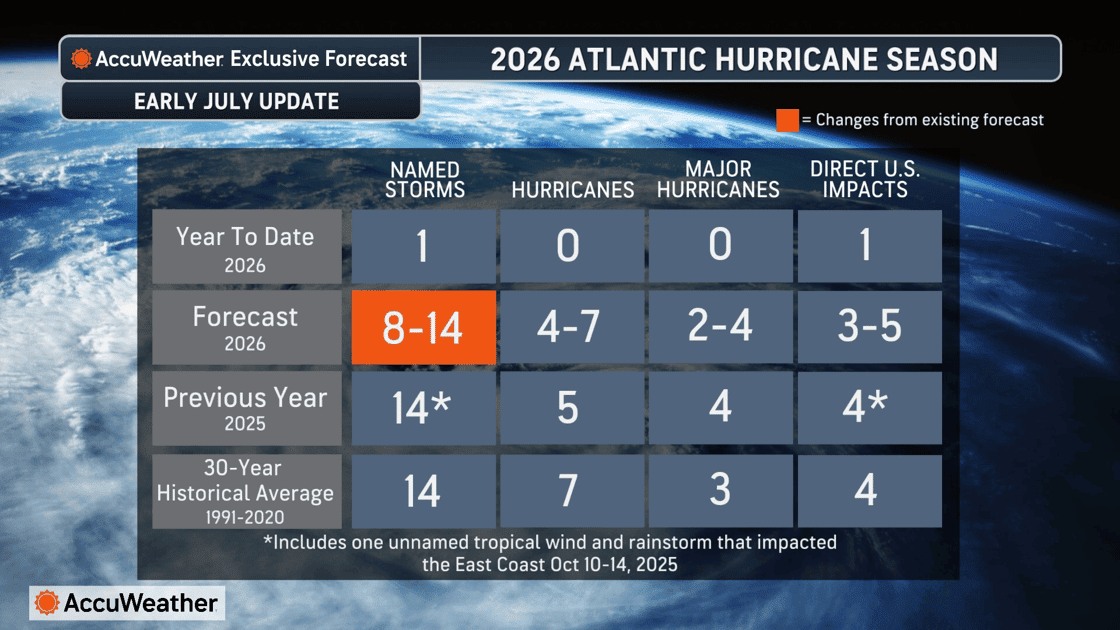
Less than three months after releasing its initial 2026 Atlantic hurricane season outlook, AccuWeather has issued a downward revision to its projected number of named storms, driven by an earlier-than-expected arrival of El Niño and growing forecasts that a powerful Super El Niño will develop through the peak of the season. The leading weather forecasting firm now projects between 8 and 14 named storms will form across the Atlantic basin this year, a modest drop from the 11 to 16 storm range published in its initial March 2026 forecast.
AccuWeather’s lead hurricane expert Alex DaSilva noted that El Niño conditions have long shaped the team’s projection that 2026 storm totals will land near or below the historical average. “The stronger the El Niño gets, the fewer named storms we’re likely to get,” DaSilva explained, pointing to the 2015 season, when a strong El Niño produced just 11 named storms – a number he says is the most likely outcome for 2026.
Unlike many other forecasting outlets, this updated outlook includes clear projections for the most likely range of hurricanes, major hurricanes, and direct storm impacts on the United States, a distinction that Dan DePodwin, AccuWeather Vice President of Forecasting Operations, highlighted as part of the firm’s commitment to data-driven, continuous forecast refinement. AccuWeather originally released its preliminary seasonal outlook on March 25, weeks earlier than most competing forecasting groups.
Unchanged from the initial March forecast are the projections for stronger storm activity: the firm still expects 4 to 7 hurricanes to develop, with 2 to 4 of those strengthening into Category 3 or higher major hurricanes. Between 3 and 5 storms are projected to make direct impacts on U.S. territory, with the northern and eastern Gulf Coast, the Carolinas, and the northeastern Caribbean continuing to face higher-than-average risk of rapid storm development.
DaSilva emphasized a key preparedness risk for these high-risk regions: unlike slow-developing storms that track across the open Atlantic from the African coast, storms that form close to shore leave residents with far less time to put emergency plans into action. “That’s why we stress having a hurricane plan in place before the season starts, rather than waiting until a storm is already offshore,” he added.
El Niño’s early June arrival is the core driver of this forecast adjustment. AccuWeather currently estimates a 70% probability that a Super El Niño will develop before the end of the hurricane season and persist into early 2027. The climate pattern drives increased wind shear across the entire Atlantic basin, a meteorological force that disrupts the organization and intensification of tropical systems, suppressing overall storm development.
Beyond the overall storm count, the current seasonal pattern points to a lower-than-average risk of major tropical impacts for the central and lower Texas coast. Even so, warm sea surface temperatures close to the U.S. Atlantic and Gulf coasts create conditions that can fuel rapid intensification of storms that form near shore, shrinking the window for public warnings. Impacts of these storms are not limited to coastal zones either: flooding rainfall and tornadoes often extend hundreds of miles inland, meaning even residents far from the coast should monitor forecasts closely throughout the season.
The 2026 season already saw its first named storm in mid-June, when Tropical Storm Arthur made landfall along the Texas coast on June 17, bringing catastrophic flooding across the Gulf region. Preliminary AccuWeather damage estimates put total economic losses from Arthur between $4 billion and $6 billion, with damage to private property and public infrastructure, widespread flight delays, extended power outages, and halted business operations all contributing to the massive economic toll. Some parts of the region recorded more than 20 inches of rain from the slow-moving storm.
DePodwin noted that Arthur serves as a critical reminder that tropical systems do not need to reach hurricane strength to cause severe, costly, and even deadly damage. “Flooding, travel disruptions, power outages and business interruptions can quickly add up to billions of dollars in impacts for families, businesses and communities,” he said.
To help the public better understand the full scope of potential storm impacts, AccuWeather uses its proprietary RealImpact™ Scale for hurricanes, which differs from the widely used Saffir-Simpson scale that categorizes storms solely by maximum wind speed. The RealImpact™ scale incorporates a broader set of factors that affect communities, including rainfall-driven flooding, storm surge, and projected economic damage, to provide a more complete picture of a storm’s potential threat to lives and livelihoods.
AccuWeather meteorologists are available 24/7 to provide ongoing updates and expert analysis as conditions develop through the 2026 hurricane season. Media outlets can request interviews with AccuWeather experts or access updated forecast graphics for print and broadcast through the company’s media relations team, reachable during regular business hours or via the 24/7 AccuWeather Media Hotline at (814)-235-8710. AccuWeather forecasts reach a wide audience across the United States, appearing in 700 print newspapers, broadcasting on more than 400 radio stations and 100 television outlets, and reaching over 125 million viewers through the AccuWeather Network and AccuWeather NOW® on cable and streaming platforms.