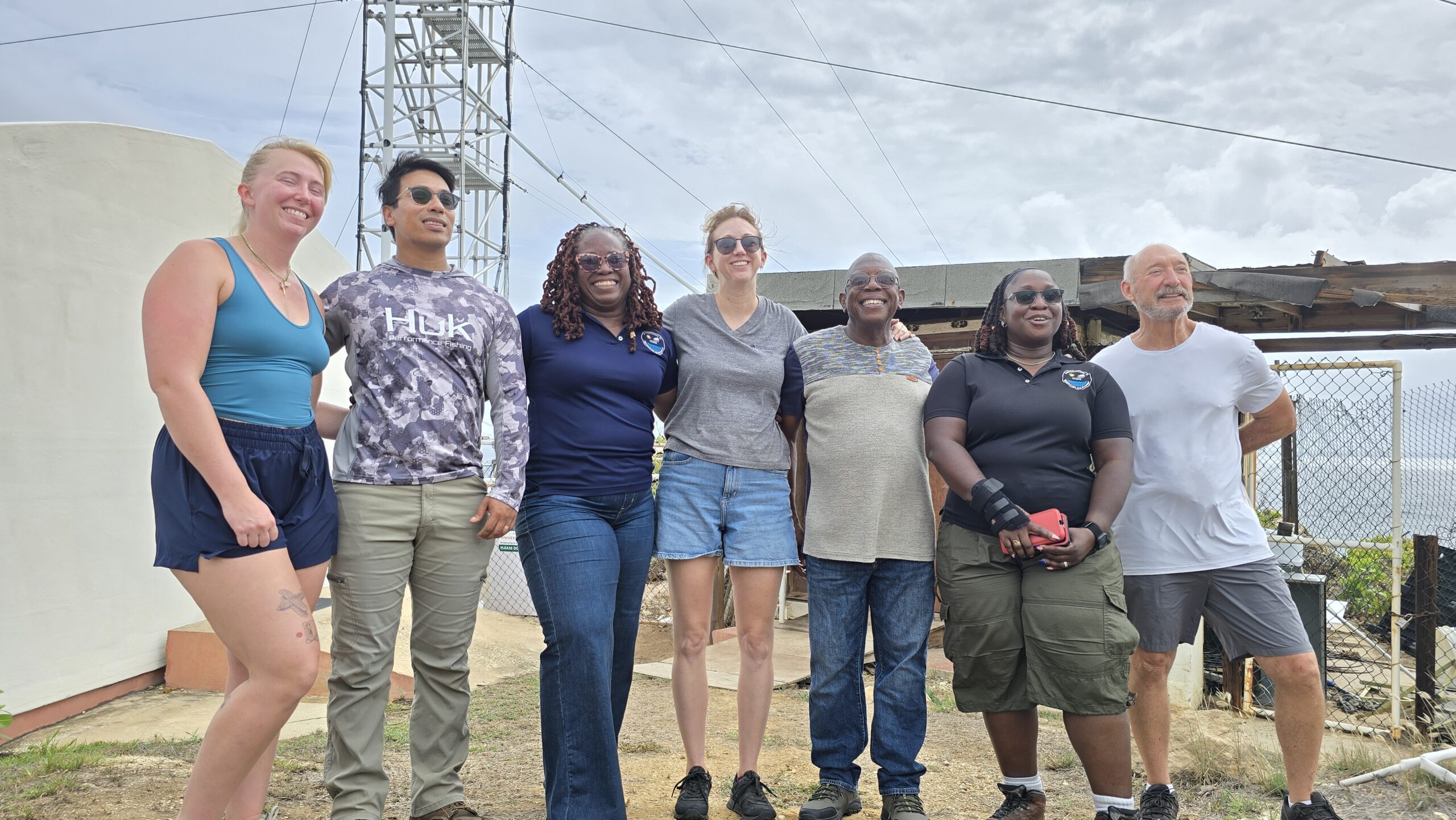
Six decades after it first began tracking atmospheric conditions, Barbados’ iconic Ragged Point atmospheric monitoring station is turning its long-running data collection toward a pressing regional ecological question: could nutrient-rich dust carried thousands of miles from the Sahara Desert be fueling the massive sargassum blooms that have plagued Caribbean coastlines in recent years?
The new research initiative was announced Monday during anniversary celebrations for the station, which is operated under the Barbados Atmospheric Chemistry Observatory (BACO) in partnership with the University of Miami. Now recognized as one of the world’s longest uninterrupted records of atmospheric aerosols and climate conditions, the site has transformed scientific understanding of how Saharan dust travels across the Atlantic to the Caribbean, North America and the Amazon Basin, researchers noted.
Cassandra Gaston, a University of Miami atmospheric sciences professor and principal investigator for the Ragged Point site, explained that while existing research has documented two well-known impacts of transatlantic Saharan dust—worsened respiratory illness for vulnerable populations and reduced hurricane intensity— the link between dust and sargassum growth remains an uncharted frontier. Massive accumulations of the brown seaweed have increasingly washed ashore on Barbados and other Caribbean islands in recent years, causing disruptions to fishing, tourism and coastal ecosystems, but the exact drivers of the blooms are still not fully understood.
“We’re curious if dust is part of what’s feeding these massive sargassum arrivals,” Gaston told reporters during the briefing. “We know dust carries critical nutrients that support marine life, and both dust and sargassum follow consistent transatlantic circulation patterns: dust moves with wind currents, while sargassum drifts with ocean currents. That overlap made us ask if there’s a causal connection.”
Gaston emphasized that the research is still in its early stages, and scientists have not yet confirmed if a meaningful relationship exists. Beyond answering a core ecological question, the team hopes the findings could open new pathways to mitigate sargassum blooms before they reach Caribbean coastlines.
The research also builds on a growing body of work that recognizes the dual role Saharan dust plays in global climate and ecosystems. Beyond its less desirable impacts, dust delivers essential nutrients that fertilize marine and terrestrial ecosystems, supporting natural carbon sequestration that helps regulate global atmospheric carbon dioxide levels. “Dust is a natural climate regulator,” Gaston explained. “The nutrients it carries feed photosynthesis in the ocean and biosphere, pulling carbon dioxide out of the atmosphere and sequestering it long-term. That’s a critical service we can’t ignore.”
For hurricanes, the effect is similarly well-documented: Saharan dust events create a layer of hot, dry air across the tropical Atlantic that strips hurricanes of the moisture they need to intensify, a trend that has been studied for years by researchers at the U.S. National Oceanic and Atmospheric Administration (NOAA) and other institutions.
But the 60 years of continuous data from Ragged Point has also revealed a worrying new trend: Saharan dust is now arriving in increasing volumes outside of its traditional peak season. “We’re seeing larger dust outbreaks in winter and spring, which were not historically peak periods,” Gaston said. “We’re also getting more wildfire smoke from African blazes during these off seasons, including an unprecedented large event last winter that we’ve never seen in our entire 60-year record.”
Researchers emphasized that the Ragged Point station’s long, uninterrupted dataset is irreplaceable for global climate science. “There’s no other site with a comparable long-term record of aerosols and climate conditions,” Gaston noted. “It’s been a pivotal site for the global scientific community, and its data has been instrumental in improving everything from climate models to air quality forecasting for the region.”
For the Caribbean Institute for Meteorology and Hydrology (CIMH), the long-term dust record from Ragged Point is critical for refining regional air quality forecasts. Andrea Sealy, a CIMH meteorologist and chair of the World Meteorological Organization’s Pan-American Sand and Dust Storm Warning Advisory and Assessment System, said regional agencies are now working more closely with public health sectors to develop targeted advisories for Saharan dust events.
“When dust outbreaks occur, we tailor advisories specifically for these events, bringing multiple sectors together to keep the public informed,” Sealy explained, adding that research into Saharan dust impacts has expanded dramatically in recent years to cover everything from renewable energy generation and public health to microbial ecosystems and hurricane development.
For people with pre-existing respiratory conditions, Gaston advised taking simple precautions during heavy dust events, similar to the health protocols widely adopted during the COVID-19 pandemic. “Wearing a well-fitting mask is very effective at blocking dust particles,” she said. “If you have a pre-existing condition, staying indoors as much as possible during major events is a good precaution.”
Edmund Blades, a retired microbiologist who collaborated with the Ragged Point facility for more than 30 years, praised the longstanding partnership between the University of Miami and Barbados, noting that sustained investment in equipment, staff and cross-sector collaboration has built a legacy that benefits the entire Barbadian public. “Over decades, that consistent commitment has allowed this work to grow and deliver real value, and that’s something the public here really appreciates,” Blades said.