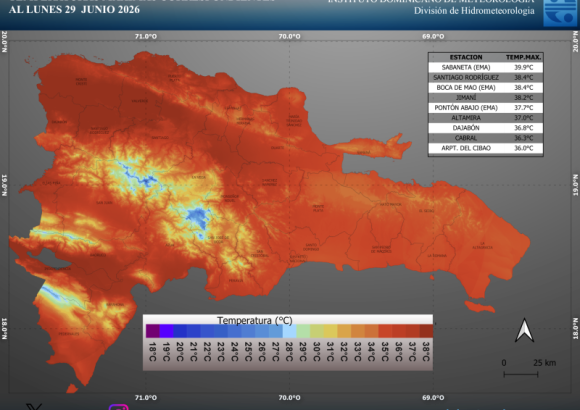
A prolonged period of dangerous extreme heat is set to grip the Dominican Republic for the next 14 days, joint projections from the Dominican Institute of Meteorology (Indomet) and the U.S. National Oceanic and Atmospheric Administration (NOAA) have confirmed. The sweltering conditions will be most severe across the country’s northwest, northern, and southwest regions, where peak daytime temperatures are expected to climb between 35°C and 39°C. When combined with the region’s characteristic high humidity, the real-feel heat index will push even higher, creating increased health risks for residents.
Meteorologists have traced the current heat pattern to a confluence of overlapping climate factors. As the country enters its climatologically hottest months of July and August, the event is being amplified by a persistent high-pressure system that draws warm east-southeast winds across the island. Low to moderate levels of Saharan dust covering the national territory, paired with a currently moderate-strength El Niño phenomenon, have further skewed conditions toward suppressed rainfall and well-above-average temperatures across the Caribbean basin.
The prolonged heat forecast comes on the heels of a record-breaking June 2026 for the Dominican Republic, which saw multiple all-time temperature records toppled across the country. The most dramatic new mark was set in Sabaneta, Santiago Rodríguez province, where a reading of 39.9°C on June 29 broke a 62-year-old previous record of 38.5°C that had stood since 1964. Other sites also saw historic highs: Mao in Valverde province hit 38.4°C, Jimaní in Independencia reached 38.2°C, and two separate weather stations in the capital region of Santo Domingo also broke long-standing records. Santo Domingo East recorded 36.6°C, beating the 2019 previous high of 36.0°C, while the Las Américas station hit 35.9°C, surpassing the 2020 record of 35.5°C.
In response to the ongoing threat, Indomet has issued a series of public health guidelines to help residents stay safe. The agency advises all citizens to maintain consistent hydration, wear loose, light-colored breathable clothing, regularly apply broad-spectrum sunscreen, and avoid any unnecessary outdoor exposure during the peak heat window of 11:00 a.m. to 4:00 p.m. Special emphasis has been placed on monitoring vulnerable groups, including young children, older adults, and people with pre-existing chronic health conditions, who face the highest risk of heat-related illness. Indomet says it will continue to track shifting conditions and issue regular updates through its official communications channels.
The Dominican Republic’s extreme heat event is part of a broader global pattern of dangerous heat waves that are currently disrupting life across North America and Europe. In the United States, an estimated 238 million people – roughly 70% of the total national population – are currently exposed to heat conditions classified as dangerous by the U.S. National Weather Service. To avoid widespread power outages driven by record air conditioning demand, large energy users including major data centers have been ordered to cut consumption to preserve grid stability in the eastern part of the country. Across the Atlantic, Europe is also reeling from the impacts of record heat: France’s public health agency reported that roughly 1,000 excess deaths occurred during last week’s peak heat, while eastern Germany recorded an unprecedented new record for warm overnight temperatures, with the mercury staying above 29.4°C (84.9°F) in Kubschütz, Saxony.