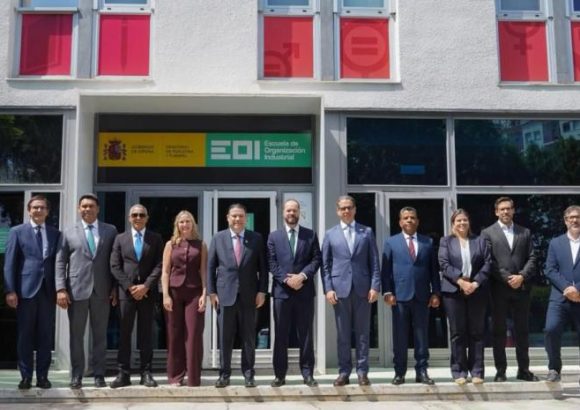
During a meeting with Spanish business leaders in Madrid, Dominican Republic’s Minister of Industry, Commerce, and SMEs Eduardo “Yayo” Sanz Lovatón delivered a confident response when asked whether the country has the skilled human capital required to build a sustainable semiconductor industry: “We do.”
This bold assertion, however, obscures a far more nuanced reality that Dominican government officials openly acknowledge. Current enrollment data from the country’s university system confirms that developing a workforce tailored to advanced high-tech sectors remains a work in progress, not a completed goal.
During his Madrid trade mission, Sanz Lovatón’s core objective was to court international investors and encourage them to diversify their holdings beyond the Dominican Republic’s dominant tourism sector. A centerpiece of this outreach was the announcement of a new collaboration agreement with Spain’s prestigious School of Industrial Organization (EOI), an institution that has partnered with Dominican higher education programs for years to deliver professional training. The new deal creates 150 specialized scholarships exclusively for Dominican women holding managerial roles in the industrial sector.
Developed in partnership with the Dominican Ministry of Women, the training program will use a blended learning model: seven core modules will be delivered online, with a final in-person capstone course hosted in Santo Domingo. The curriculum covers high-demand skills aligned with modern industrial evolution, including women’s leadership development, project management, digital transformation, Industry 4.0 framework adoption, quality management systems, and circular economy implementation.
“Through this alliance, the Dominican Republic and Spain reaffirm our longstanding cooperative ties, advancing female talent as a core driver of 4.0 industrial transformation,” Sanz Lovatón stated during the official signing ceremony.
The targeted focus on women in this partnership is no coincidence. Official data from the Dominican Ministry of Higher Education, Science and Technology (Mescyt) shows that while women make up the majority of total university enrollees across the country, they remain severely underrepresented in STEM (science, technology, engineering, and mathematics) fields. Of the 91,163 students enrolled in Dominican STEM programs in 2024, just 26,270 are women, compared to 64,893 male students.
The EOI scholarship initiative is just one component of the Dominican government’s broader push to expand its high-tech industrial base. Sanz Lovatón also highlighted ongoing progress on the National Strategy for the Promotion of the Semiconductor Industry (ENFIS), a national plan that has already secured partnerships with both local Dominican universities and leading higher education institutions based in the United States.
Despite these proactive steps, significant structural challenges remain. Semiconductors—the essential microchips that power everything from electric vehicles to cloud-based artificial intelligence data centers—require a specialized workforce of trained engineers, technicians, physicists, and mathematicians. These are exactly the skill profiles that the current Dominican university system produces in far lower numbers than needed to support a fully developed domestic semiconductor industry.
2024 Mescyt data illustrates the scale of the gap: total higher education enrollment across the Dominican Republic reached 520,524 students this year, but STEM fields account for only 91,163 enrollees, or roughly 17.5% of the total student body. The most popular fields of study for Dominican students remain traditional professions: medicine, law, and accounting. A separate analysis from the National Association of Young Entrepreneurs found that only 12% of young Dominican students enroll in high-growth, high-wage fields that include STEM and language studies.
This reality raises a critical question: can targeted scholarship programs and international partnerships alone close a foundational skills gap that originates long before students enter university?
For Sanz Lovatón, the government’s long-term strategy is rooted in market alignment. He argues that once semiconductor investments and advanced manufacturing operations take root in the country, the labor market will send clear signals to young people about which career paths offer the greatest opportunity. “The nature of these technologies is that they are constantly changing. So we continue to create opportunities to prepare our people,” he concluded.