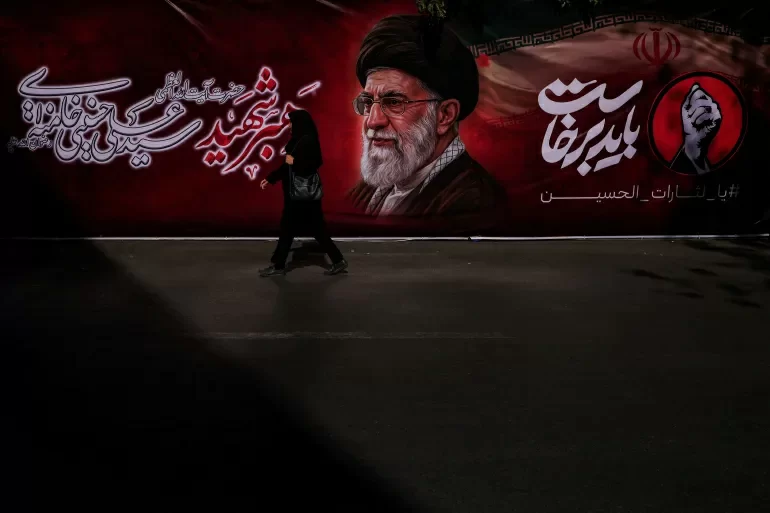
Seven days of official state funeral ceremonies for Iran’s former Supreme Leader Ayatollah Ali Khamenei have formally commenced in Tehran, drawing high-level foreign delegations from more than 100 nations to honor the leader who ruled the country for 37 years before his death in a US-Israeli airstrike earlier this year.
Khamenei, 86, was killed alongside multiple family members — including his daughter, son-in-law, and three-year-old granddaughter — in a February 28 airstrike carried out on the opening day of a joint US-Israeli military campaign against Iran. His coffin was first unveiled to crowds of weeping supporters late on the Thursday preceding the public lying-in-state, before being moved alongside the caskets of his fallen family members to Tehran’s Grand Mosalla, a massive prayer complex built to honor Khamenei’s predecessor, Ayatollah Ruhollah Khomeini, where it lay in repose on Friday.
The funeral had originally been scheduled for March, but the months of open conflict that followed Khamenei’s killing forced a delay until this week, following the conclusion of major combat operations. Weeks after Khamenei’s death, his son Mojtaba Khamenei formally succeeded him as Iran’s new Supreme Leader.
According to official statements released via Khamenei’s X account, his coffin is draped in a historic flag that previously flew over the Imam Hussein Shrine in Karbala, Iraq. Iranian government officials described the red banner, emblazoned with white text, as a lasting symbol of resistance, sacrifice, and ideological commitment to the Islamic Republic.
On Friday, Iranian President Masoud Pezeshkian was among the first senior domestic officials to pay his respects to Khamenei at the Grand Mosalla, alongside other top Iranian leaders including Parliament Speaker Mohammad Baqer Qalibaf, Expediency Council Chairman Ayatollah Sadeq Amoli Larijani, and Judiciary Chief Gholamhossein Mohseni Ejei.
Al Jazeera correspondent Mahmoud Abdelwahed, reporting on the ground from Tehran, confirmed that Friday’s ceremony was reserved for invited foreign dignitaries, which included sitting heads of state, prime ministers, parliamentary speakers, and other senior envoys from roughly 100 participating countries. Notably, no invitations were extended to European nations that publicly supported the US-Israeli military campaign against Iran, Abdelwahed added. Among the confirmed high-profile foreign attendees were Pakistani Prime Minister Shehbaz Sharif, Iraqi President Nizar Amidi, and Tajik President Emomali Rahmon. The foreign delegation’s arrival followed a closed-door reception held at the Grand Mosalla complex the previous evening, which was also attended by family members of other Iranian citizens killed in the ongoing conflict, as well as victims of a 12-day June 2025 war between Iran and Israel.
Security across the Iranian capital has been raised to the highest possible alert level ahead of the week of ceremonies, as authorities prepare for large crowds of public mourners when the public lying-in-state begins on Saturday morning, with a regional heatwave adding logistical challenges to crowd management.
One of the most notable appearances at Friday’s ceremony came from General Ahmad Vahidi, the newly appointed commander-in-chief of the Islamic Revolutionary Guard Corps (IRGC), who made his first public appearance since February 8 alongside Khamenei’s casket. Vahidi took over the IRGC’s top role after his predecessor Mohammad Pakpour was killed in the same opening-day US-Israeli airstrike that killed Khamenei, and he had not been seen publicly in the months following the attack. A former head of the IRGC’s elite Quds Force, Vahidi has long been one of the Islamic Republic’s most prominent hardline military figures.
Speaking on the sidelines of Friday’s ceremonies, Major General Amir Hatami, commander-in-chief of Iran’s regular armed forces, issued a public vow of revenge against the United States and Israel for Khamenei’s killing. “With even greater determination, we declare to the enemies of the Iranian nation — America and the criminal Zionist regime — that we will avenge the blood of our martyred leader Khamenei,” Hatami told reporters on Friday.
After the public mourning period begins on Saturday, the funeral procession will travel through Tehran and the holy city of Qom before making a brief crossing into Iraq on July 8. The final burial ceremony is scheduled for July 9 at the Holy Shrine of Imam Ali Reza in the northeastern Iranian city of Mashhad.