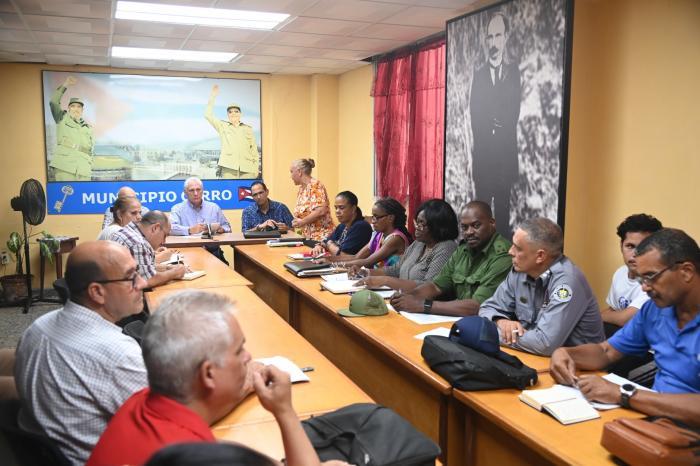
On July 3, 2026, Cuban President Miguel Díaz-Canel Bermúdez, who also serves as First Secretary of the Central Committee of the Communist Party of Cuba, launched an on-site inspection tour of two of Havana’s most densely populated municipalities, Cerro and Marianao, to hold direct discussions with local leadership over strategies to mitigate the country’s deepening economic and social challenges, which have been amplified by long-standing U.S. sanctions. The current crisis has been further worsened by a months-long U.S.-imposed oil embargo that has strained core public services across the island.
During closed-door and open dialogues with members of both municipalities’ Defense Councils, the head of state centered his conversations on the most pressing issues facing local communities. Top among these priorities were electricity generation, which has been crippled by the six-month-old oil embargo, consistent drinking water access, municipal waste management, local bread production output, and social support for the country’s most vulnerable populations. The dialogue also expanded to cover a range of other critical topics: coordination with the non-state economic sector and its community-facing obligations, the renovation of underused public sports and cultural venues, the operational performance of the national Family Support System (SAF), planned programming for the summer holiday season, and targeted support for young people who are neither enrolled in education nor formally employed.
Meeting with representatives from local party bodies, municipal government branches, the Young Communist League, and mass grassroots organizations, Díaz-Canel emphasized that sustained, direct engagement with ordinary citizens is non-negotiable. He noted that many practical, effective solutions to local problems already emerge from community organizing, and leaders should prioritize elevating these on-the-ground perspectives when crafting policy.
As part of his tour, the president also met with young participants in the Community Youth Network, a pioneering domestic initiative that empowers young Cubans to lead neighborhood-level problem-solving. He received briefings on the network’s ongoing work, which includes targeted outreach to low-income vulnerable families, isolated elderly residents, and expecting mothers, alongside a wide range of community-focused cultural, athletic, educational, and public health promotion activities.
Díaz-Canel outlined a forward-looking policy framework for local governance, stressing that municipalities must actively prepare to assume greater administrative autonomy, while local business entities must gear up for expanded operational independence. He urged local leaders to build capacity to manage public-private partnerships involving foreign direct investment, closed foreign currency financing schemes, and commercial collaborations with both Cuban residents abroad and domestic Cuban stakeholders.
The president further detailed plans to unlock mutually beneficial economic collaboration between the state and non-state sectors at the municipal level, put underutilized productive infrastructure back into operation, and test diverse adaptive business models across all sectors of the local economy. By implementing these changes, he argued, Cuba can unleash the full productive potential of municipal-level economies, rapidly improve the range and availability of goods for the general public, strengthen household purchasing power, rebalance the wage-price relationship, and put the country on a sustainable path toward broad-based prosperity.
Accompanying Díaz-Canel on the tour was Roberto Morales Ojeda, member of the Political Bureau and Secretary of Organization of the Party’s Central Committee. The municipal inspection series began earlier this week in Havana’s Playa municipality, and is scheduled to continue across all other municipalities of the Cuban capital in the coming days.