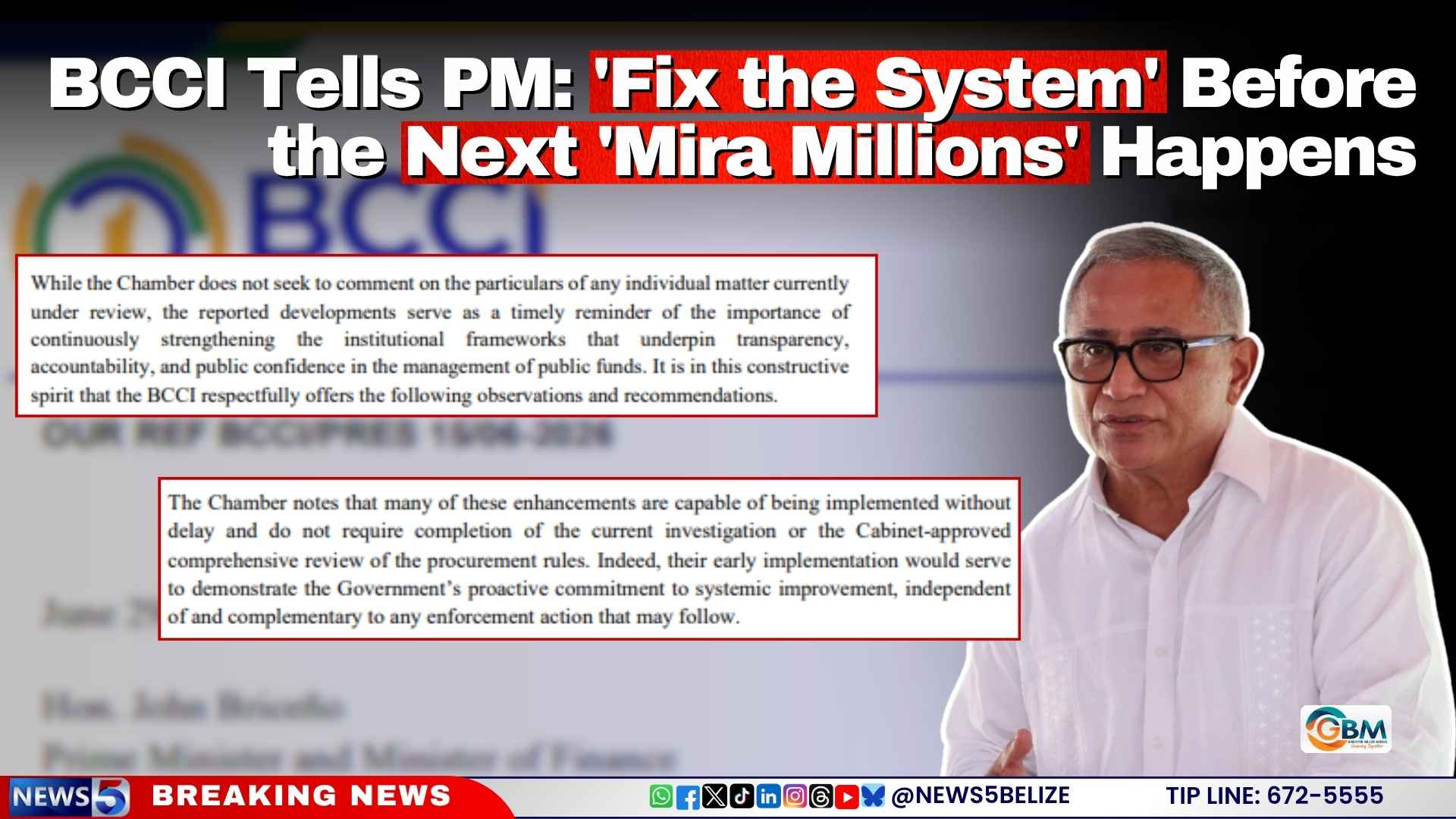
As the Briceño administration grapples with growing public scrutiny over the ‘Mira Millions’ procurement irregularities scandal, Belize’s leading business advocacy body has stepped forward with a concrete 10-point reform blueprint, calling on Prime Minister John Briceño to enact structural changes to the country’s public financial management systems before another high-profile scandal can emerge.
In an official letter dated June 29, 2026 addressed directly to the prime minister, BCCI President Giacomo Sanchez acknowledged the government’s move to launch a formal investigation into the ongoing controversy, framing that step as a visible demonstration of the administration’s commitment to accountability. However, Sanchez emphasized that the uncovered irregularities are more than an isolated incident: they serve as a urgent wake-up call that Belize’s existing financial oversight framework requires more than post-hoc enforcement – it needs foundational, systemic reform.
At the top of the Chamber’s priority recommendations is an overhaul of the government’s current SmartStream accounting platform. If a full replacement is not immediately feasible, the BCCI proposes adding a complementary automated monitoring and compliance system that would flag irregularities before transactions are finalized, rather than only identifying misconduct after public funds have already been misallocated or misused.
The 10-point reform plan lays out a series of specific, actionable safeguards to strengthen financial oversight. These include daily transaction limits for individual suppliers to cap the number of invoices that can be processed for a single vendor per business day, built-in automated anomaly detection to flag out-of-pattern cumulative payments, native duplicate payment tracking, and a mandatory maker-checker approval protocol that requires a second, independent public officer to sign off on all payments exceeding a pre-set threshold.
Additional measures laid out in the proposal include requirements for immutable, comprehensive audit trails for all financial transactions, role-based access controls to restrict system access to authorized personnel only, and mandatory periodic independent third-party assessments of all government financial management systems.
The BCCI stressed that most of these proposed improvements do not need to wait for the conclusion of the ongoing Mira Millions investigation or the completion of a Cabinet-approved comprehensive review of national procurement rules. “Many of these enhancements are capable of being implemented without delay,” the organization noted, making clear that reform can begin immediately to close existing oversight gaps.
In a key statement reinforcing the need for structural change, the Chamber reminded Prime Minister Briceño that strong public governance cannot be achieved through new legislation alone. Instead, lasting accountability relies on robust, independent institutions, modern, securely designed financial systems, and a widespread culture of accountability embedded at every level of public administration.
Shortly after the BCCI delivered its reform proposal, the prime minister addressed reporters on Wednesday, confirming that a large-scale overhaul of the government’s procurement system is already in progress, separate from the ongoing Mira Millions investigation. Briceño told reporters that his Cabinet will soon review plans for a new Central Procurement Unit, developed in collaboration with the Inter-American Development Bank.
Under the new framework, the unit will manage all government procurement through a centralized electronic portal, which every government ministry will be legally required to use for all purchases – including small-value acquisitions under $10,000, which have often fallen outside centralized oversight in the past.
“ There has to be openness and transparency and accountability. I think that that’s going to transform things,” Briceño said of the planned reform.
The new portal will also host a centralized registry of pre-qualified vendors, allowing ministries to source goods and services directly from approved suppliers at pre-negotiated government discounted rates. Briceño explained that the centralized system will eliminate the fragmented, siloed purchasing practices currently used across separate ministries, allowing the government to access volume discounts it has not been able to secure under the current fragmented structure.
The prime minister added that the new system will include three independent layers of oversight: a rule-setting committee to establish framework for procurement, a compliance monitoring committee to track adherence to rules, and a dedicated independent audit committee to review processes after transactions are completed.
Briceño framed the reform as “a game changer in the way government procures its goods and services”, noting that it will also enforce a requirement that at least 20% of all government goods and services are sourced from local micro and small enterprises, supporting small business growth across Belize.
The prime minister reiterated that the planned procurement overhaul “has nothing to do” with the ongoing investigation into the Mira Millions controversy, framing it as a long-planned improvement to public financial management.