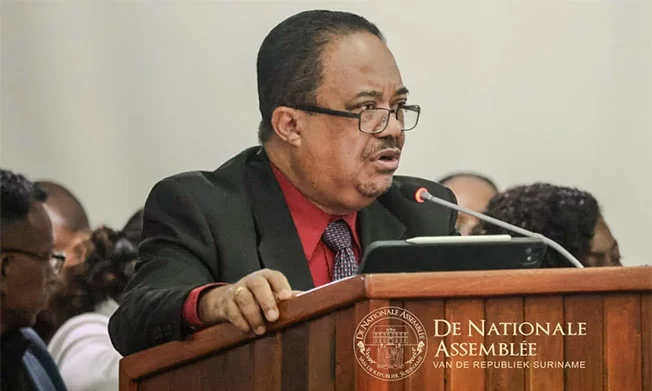
On July 1, during an evening budget debate session in Suriname’s National Assembly, Vice President Gregory Rusland laid out a clear new policy direction for his administration, marking a strategic shift after 12 months of foundational assessment, institutional repair, and systemic reorganization. Moving past the early-stage work of stabilizing governance structures, the government will now center its efforts on tangible, on-the-ground policy delivery, with a core goal of making national economic growth visible and beneficial in the daily lives of ordinary Surinamese citizens, Rusland confirmed.
Addressing a longstanding gap in governmental performance, the vice president announced the creation of a dedicated in-cabinet monitoring unit tasked with tracking the implementation of all executive decisions, identifying project delays at their earliest stages, and streamlining policy execution across government bodies. Rusland emphasized that the greatest challenge facing Suriname’s government is not drafting ambitious policy frameworks, but turning those plans into actionable, results-driven outcomes that serve the public.
For Rusland, meaningful national development can only be achieved when it improves core quality of life metrics: greater livelihood security for working families, clear long-term opportunity for young people, a supportive environment for local entrepreneurs to grow and invest, and a public sector that is reliable, accessible, and efficient for all. While Suriname’s emerging oil and gas sector represents an extraordinary economic opportunity, the vice president stressed that natural resources alone will not drive lasting national progress. Transformational growth, he argued, requires prudent fiscal management, targeted strategic investments in priority public sectors including education, healthcare, infrastructure, housing, public safety, and the strengthening of core governmental institutions.
Clarifying his own role within the administration, Rusland underlined that his mandate is not to replace cabinet ministers, but to strengthen cross-ministerial collaboration and oversee consistent execution of the government’s shared policy agenda. Many of the country’s most pressing challenges—from large-scale housing construction to social welfare expansion, infrastructure development, local content requirements for resource projects, and land use policy—cut across multiple governmental portfolios, making intentional, structured coordination a non-negotiable for progress, he explained.
Since the current administration took office, the Council of Ministers has held regular, intensive working sessions to address a wide range of pressing societal issues, including road traffic safety, flood management, local content regulation for the energy sector, the establishment of a national environmental authority, public housing expansion, and Suriname’s role within the Caribbean Community (CARICOM). Beyond these policy discussions, the administration has also processed hundreds of administrative decisions covering public sector appointments, new legislation, international agreements, and executive orders. This volume of work, Rusland noted, reflects the dual mandate the government inherited: clearing a backlog of unaddressed administrative tasks while building the foundation for new, forward-looking policy.
Housing remains one of the highest priorities on the administration’s governance agenda, Rusland confirmed. Acknowledging the severe national housing shortage that impacts thousands of Surinamese households, he announced the government is developing a new inclusive financing system through the National Housing Fund, that will allow all citizens to access affordable construction loans regardless of their political affiliation. The reform is designed to remove housing allocation from partisan politics and make homeownership accessible to all Surinamese.
Following Rusland’s policy presentation, members of the National Assembly raised critical questions on a range of topics, including the ongoing renovation of 58 public schools, official overseas travel by government officials, the mandate and structure of the proposed monitoring unit, the execution timeline for national housing projects, and budget priority allocation. In response, Rusland clarified that the new monitoring unit will not add an unnecessary additional layer of bureaucracy, but will instead function as a coordination and progress tracking body to speed up policy delivery and improve inter-ministerial alignment. He reaffirmed that the administration’s core immediate goals are securing long-term financial stability, improving governmental execution, and delivering visible, measurable results for the Surinamese public.
Closing his address to the National Assembly, Rusland emphasized that the country’s greatest current needs are stability, clear policy direction, and tangible results. Suriname’s public rightly expects faster, more effective performance from the government, he noted. “Good governance is never measured by beautiful speeches or ambitious plans alone. It is measured by the quality of the decisions we make, and the speed with which we deliver on those commitments to the people,” Rusland said.