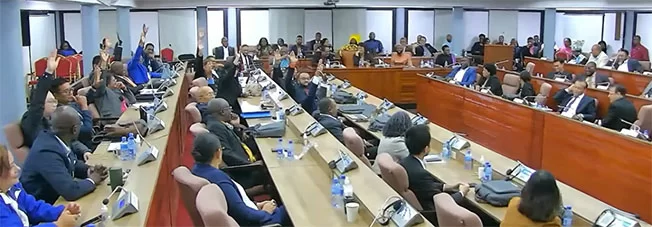
In a late-night parliamentary vote held Sunday, Suriname’s National Assembly has approved the government’s 2026 national state budget and accompanying state debt plan, capping off hours of heated debate between the ruling coalition and the main opposition party over the proposal’s financial credibility, transparency and policy priorities.\n\nJust ahead of the final vote, members of the parliamentary committee of rapporteurs laid out their competing stances on the budget, which comes as Suriname navigates a fragile economic transition period. For the ruling coalition, the 2026 budget is framed as a necessary bridge to steady the country through ongoing economic headwinds while laying groundwork for long-term sustainable growth.\n\nRabin Parmessar, faction leader of coalition partner NDP, described the proposal as a “bridge budget” designed to guide Suriname through its current economic challenges. He emphasized that continued fiscal discipline from the government is non-negotiable to prevent further expansion of the country’s fiscal deficit, adding that solid financial governance is critical to boosting domestic and investor confidence in Suriname’s economy. Parmessar also called for more efficient policy implementation, stronger oversight of state-owned enterprises, more rigorous monitoring of budget execution, and accelerated action to clear the backlog of closed budget audits that have piled up in recent years.\n\nOther coalition representatives noted that the current administration has only been in office for a short period, and that approving the budget is essential to unlock planned investments across key public sectors including education, healthcare, social welfare, infrastructure and broad economic development. Moving forward, the coalition said, its core focus will be delivering on the policy priorities laid out in the approved budget.\n\nHowever, the main opposition party VHP maintained firm objections to the proposal throughout the debate, announcing ahead of the vote that it would cast its full bloc against the budget. VHP faction leader Asis Gajadien argued that the budget lacks sufficient financial underpinning, with major unresolved uncertainties surrounding projected government revenue. He added that the plan fails to deliver meaningful prospects for improving household purchasing power, expanding employment opportunities, or lifting the overall economic well-being of the Surinamese public.\n\nVHP parliamentarian Kishan Ramsukul raised additional red flags, pointing to vague budget line items, questionable exchange rate assumptions, and overoptimistic projections for future revenue from the country’s key oil and gas sector. He also noted that the numerous last-minute amendments made during parliamentary review made it impossible to conduct a thorough, rigorous assessment of the full proposal.\n\nIn response to opposition criticism, Minister of Finance and Planning Adelien Wijnerman defended the exchange rate assumptions used to draft the budget. Wijnerman explained that the framework was built on a conservative estimate of 39 Surinamese dollars per U.S. dollar, while the current market exchange rate has already fallen below 38 Surinamese dollars per dollar. This deliberate conservative approach, she noted, was chosen to ensure the budget can withstand unexpected volatility in foreign currency markets and avoids relying on an overly optimistic growth scenario.\n\nOther opposition lawmakers echoed concerns that core priority sectors including education, healthcare and public safety do not receive sufficient allocated resources in the proposal, and said the government failed to provide adequate clarity on how multiple policy initiatives would be funded and implemented.\n\nFollowing closing statements from the committee of rapporteurs and the government’s response to questions, the National Assembly moved forward with the final vote. The 2026 state budget and state debt plan was ultimately adopted with a clear majority of 31 votes in favor, versus 16 votes opposed. The full ruling coalition supported the proposal, while all VHP members voted against it.
Coalitie en oppositie lijnrecht tegenover elkaar in slotdebat over begroting