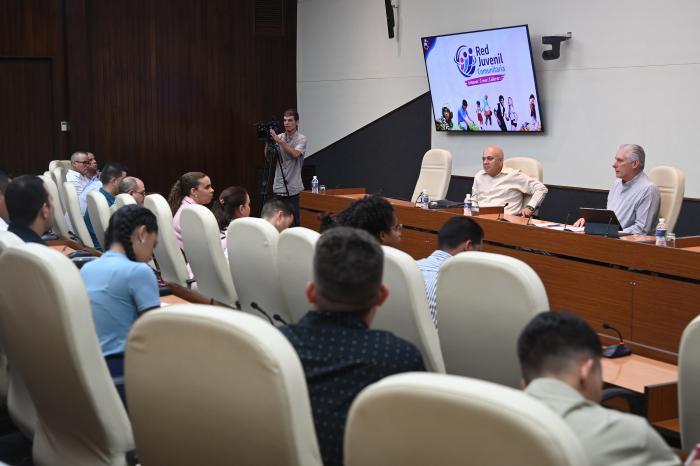
Two months after the launch of Cuba’s ambitious Community Youth Network initiative, the country’s top leader Miguel Díaz-Canel Bermúdez — who serves as First Secretary of the Central Committee of the Communist Party of Cuba and President of the Republic — gathered with senior leaders of the Union of Young Communists (UJC) at Havana’s Palace of the Revolution for a working meeting to assess the program’s early outcomes and outline next steps for its expansion.
The meeting brought together a cross-section of key stakeholders beyond national UJC leadership: Roberto Morales Ojeda, member of the Political Bureau and Secretary of Organization of the Communist Party Central Committee, student leaders, Havana-based UJC representatives, municipal network coordinators, and delegates from local People’s Councils all joined the discussion to share on-the-ground insights from the initiative’s rollout.
Opening the exchange, Díaz-Canel framed the current national moment as a defining test for Cuban revolutionaries, noting, “We are living through exceptional times in the country, and rising to the challenge of these times helps us grow as revolutionaries.” He emphasized that the Community Youth Network is far more than a routine administrative task, arguing that the program’s work carries long-term strategic importance for the future of the Cuban Revolution.
Addressing the core priorities of the initiative, Díaz-Canel reiterated the critical need to build consistent, structured support for the most vulnerable segments of Cuban society — particularly young people disconnected from formal education or employment. Rather than only providing direct aid, he stressed the importance of centering the participation of marginalized groups in designing solutions to their own challenges. To harness the untapped potential of workers currently out of employment amid the country’s ongoing economic pressures, he proposed forming specialized trade brigades that can respond directly to unmet local community needs.
Looking ahead, Díaz-Canel noted that the current generation of Cuban youth and leaders is facing unprecedented external pressure, including sustained psychological warfare, intimidation, and threats of aggression that create unique challenges. “When we achieve victory and emerge from this moment of suffocation to which we have been subjected, we will have for life the satisfaction that we were the generations that saved the Revolution,” he said, adding that the work of young people through the network is the foundation of the revolution’s ongoing continuity.
Meivys Estévez, First Secretary of the UJC National Committee, presented a comprehensive breakdown of the network’s early achievements two months post-launch. She outlined the seven interconnected projects that make up the initiative, which are rooted in goals of community transformation, innovation, and collective action. Early results include outreach and assistance to more than 4,000 elderly Cubans, placement of 9,000 young people into formal education or full-time employment through targeted job fairs, targeted support for more than 2,000 pregnant people, expansion of neighborhood recreational programming, and ongoing collaboration with local chapters of the Association of Combatants of the Cuban Revolution and municipal Defense Councils.
Estévez added that the first two months of implementation have helped strengthen the capacity of youth leaders, equipping them with new skills to coordinate across institutions and build sustainable local teams to systematize the network’s work. While progress has been made in appointing municipal coordinators across the country, she acknowledged that some local People’s Councils have lagged in implementation, noting that the strongest outcomes have been delivered in areas where local authorities have prioritized deep engagement with cross-sector stakeholders.
Political Bureau member Roberto Morales Ojeda emphasized the need for clear accountability in the network’s neighborhood outreach, calling for systematic tracking of outcomes from each community visit, clearer alignment of responsibilities across institutions, and transparent assessment of what progress has delivered tangible changes for residents.
First introduced to national leaders in April 2026, the Community Youth Network was designed from its inception to center local context: it coordinates seven core projects while adapting to the unique needs of each municipality, and prioritizes sustained resident engagement in problem-solving rather than one-off, symbolic community events. Dahniz Díaz Pereira, First Secretary of the UJC Provincial Committee in Havana, shared insights from the capital’s rollout, stressing that youth presence in local neighborhoods must deliver lasting change rather than temporary engagement. “The important thing is that young people participate and become involved in the dynamics of their communities,” he noted.