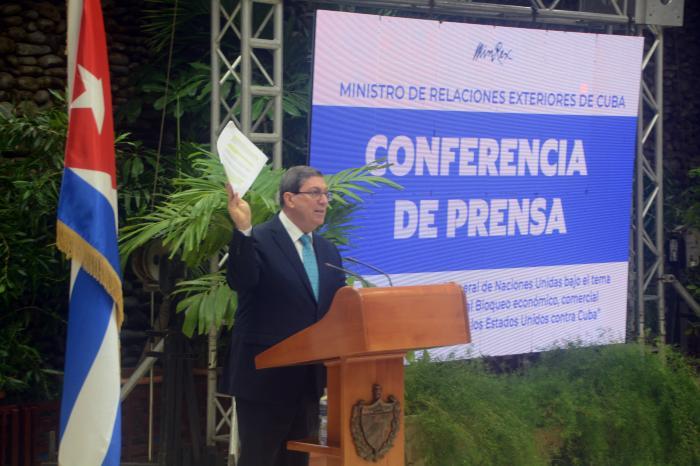
Almost six decades of unilateral U.S. hostility against Cuba will take center stage at the United Nations General Assembly (UNGA) on July 7, when Cuban officials will formally condemn Washington’s ongoing economic embargo and escalating aggressive actions — a gathering the U.S. has waged an extraordinary lobbying campaign to block, Cuba’s top diplomat confirmed Tuesday.
At a press briefing in Havana, Cuban Foreign Minister Bruno Rodríguez Parrilla, a member of the Communist Party of Cuba’s Political Bureau, laid out the scope of Cuba’s grievances ahead of the UNGA session, which will be held under Agenda Item 38: *The need to end the economic, commercial, and financial embargo imposed by the United States of America against Cuba*.
Rodríguez Parrilla framed the decades-long embargo as far more than a trade restriction: it is a systematic threat to Cuban national existence, the well-being of the Cuban people, and the fundamental human rights of all Cuban citizens, he said. The policy also undermines regional peace, security, and stability, and sets a dangerous precedent for any sovereign nation that could face similar extraterritorial aggressive measures from a global power in the future.
Alongside fellow UN member states, Cuba will use the session to call out multiple layers of U.S. aggression, including open threats of direct military intervention that violate international law and undermine global and regional security frameworks, the foreign minister added. Of particular urgency is the U.S. energy blockade, which Rodríguez Parrilla classified as an act of genocide, collective punishment, and a mass, systematic violation of both Cuban human rights and international humanitarian law when combined with other intensified embargo measures.
Rodríguez Parrilla emphasized that the UNGA is the appropriate forum to address this issue in line with the core purposes and principles of the UN Charter. This includes upholding respect for sovereign equality of all states, territorial integrity, political independence, the prohibition of the threat or use of force, the right to self-determination, non-interference in internal affairs, and the peaceful resolution of international disputes.
The foreign minister expressed confidence that the overwhelming majority of the international community will continue to stand with Cuba on this issue. He stressed that the urgency of the debate cannot be overstated: U.S. multidimensional aggression against Cuba is not a hypothetical future threat, but an ongoing crime against humanity that is accelerating by the day. Every 24 hours brings growing humanitarian harm, deeper suffering, and increased deprivation for the Cuban people, he insisted.
Beyond economic and military pressure, Rodríguez Parrilla denounced that U.S. systemic aggression is reinforced by the deployment of monopolized communications, digital, and media power to isolate Cuba, discredit its government, and fabricate justifications for the embargo. He confirmed that multiple independent and Cuban media investigations have documented that the U.S. State Department deliberately leverages American media outlets as tools of this aggressive campaign.
This information campaign is paired with a global diplomatic blitz: U.S. diplomatic missions at UN headquarters in New York, across other multilateral bodies, and in embassies worldwide are exerting brutal, unprecedented pressure on governments and diplomats to prevent the July 7 session from moving forward, the foreign minister alleged.
Rodríguez Parrilla pointed to three confidential U.S. policy documents currently circulating clandestinely among diplomatic circles that serve as the foundation for this pressure campaign. The first, titled “It’s time for change in Cuba,” frames Cuba as a direct threat to U.S. national security over unsubstantiated claims of supporting hostile actors, terrorism, and regional instability, and complements U.S. Executive Order 14404. The second document pressures foreign governments to reject the upcoming UNGA resolution on the embargo, urging states not to “vote for [Cuba’s] propaganda” — a years-long pattern of pressure that has failed to overcome the overwhelming majority support the resolution has received from UN member states for decades. The third document is a entirely baseless smear campaign falsely labeling Cuba as a belligerent party in the Ukraine war, containing no verifiable evidence or factual backing, Rodríguez Parrilla said.
In a forceful rebuke of U.S. claims, Rodríguez Parrilla rejected the military threats leveled by the world’s largest nuclear and military power against the small Caribbean Global South nation. He categorically denied false claims from U.S. Secretary of State that Cuba hosts foreign military bases, noting that the only foreign military base occupying Cuban territory is the illegally held U.S. base at Guantánamo Bay. “Cuba has been, is, and will be a country of peace,” he declared, pointing to Havana’s role as the birthplace of the 2014 proclamation designating Latin America and the Caribbean as a Zone of Peace.
The foreign minister also noted that despite decades of U.S. hostility, Cuba has consistently cooperated with Washington on law enforcement priorities, including counter-narcotics efforts, the fight against transnational organized crime, human trafficking, and counterterrorism. This cooperation continues even as Cuba faces repeated terrorist attacks and incitements to violence planned and financed from U.S. territory with complete impunity — evidence of which Cuba has repeatedly shared with the U.S. government and regularly updates, he said. He also referenced a recently foiled plot by a heavily armed terrorist commando team to infiltrate Cuba through the Corralillo region.
Rodríguez Parrilla reaffirmed Cuba’s neutral position on the war in Ukraine, emphasizing that Cuba does not participate in the conflict and prosecutes mercenary activity in line with its national constitution. He also called out recent U.S. efforts to block the United Nations World Food Programme from approving humanitarian food aid for the Cuban people, noting that Washington was completely isolated when the measure came to a democratic vote. He added that the small amounts of purported U.S. humanitarian aid promised to Cuba have never been fully delivered, underscoring the hollow nature of Washington’s claims of goodwill.
The human cost of the U.S. embargo is already severe and accelerating, Rodríguez Parrilla told reporters. Newborn babies are dying as a direct result of the strangulation policy, and life expectancy for children diagnosed with pediatric cancer has declined because Cuba cannot access critical medical devices, technology, equipment, and specialized treatments that are cut off by the embargo. Despite this severe humanitarian damage, which he emphasized is entirely deliberate, the foreign minister clarified that Cuba does not currently face a formal humanitarian crisis as defined by international frameworks, and stressed that the island poses no threat whatsoever to U.S. national security, U.S. foreign policy, or the U.S. economy under any circumstances.
On bilateral diplomatic efforts, Rodríguez Parrilla confirmed that talks between Cuba and the U.S. have made no progress to date. He said U.S. negotiating teams have paired discussions with repeated aggressive statements, new coercive measures, expanded embargo actions, threats of military aggression, and attempts to interfere in Cuba’s internal affairs, alongside coordinated leaks of misleading information to U.S. media and digital networks to push a false narrative about Cuba.
Despite all of this, Rodríguez Parrilla reaffirmed Cuba’s longstanding position: the country remains open to dialogue and the peaceful resolution of differences with the U.S., on the condition that talks are grounded in international law, conducted with equal respect and mutual benefit, and free from interference in Cuba’s internal affairs. “Cuba is a nation that loves peace and dialogue. We believe in multilateralism and the central role of the United Nations. We will persist in preserving Latin America and the Caribbean as a Zone of Peace,” he said. “For Cubans, the free, sovereign, dignified, and independent homeland is sacred. For this ideal, several generations of patriots have paid the ultimate price and endured every sacrifice. Now it will be no different: we will fight to the bitter end to defend our nation against this aggression.”