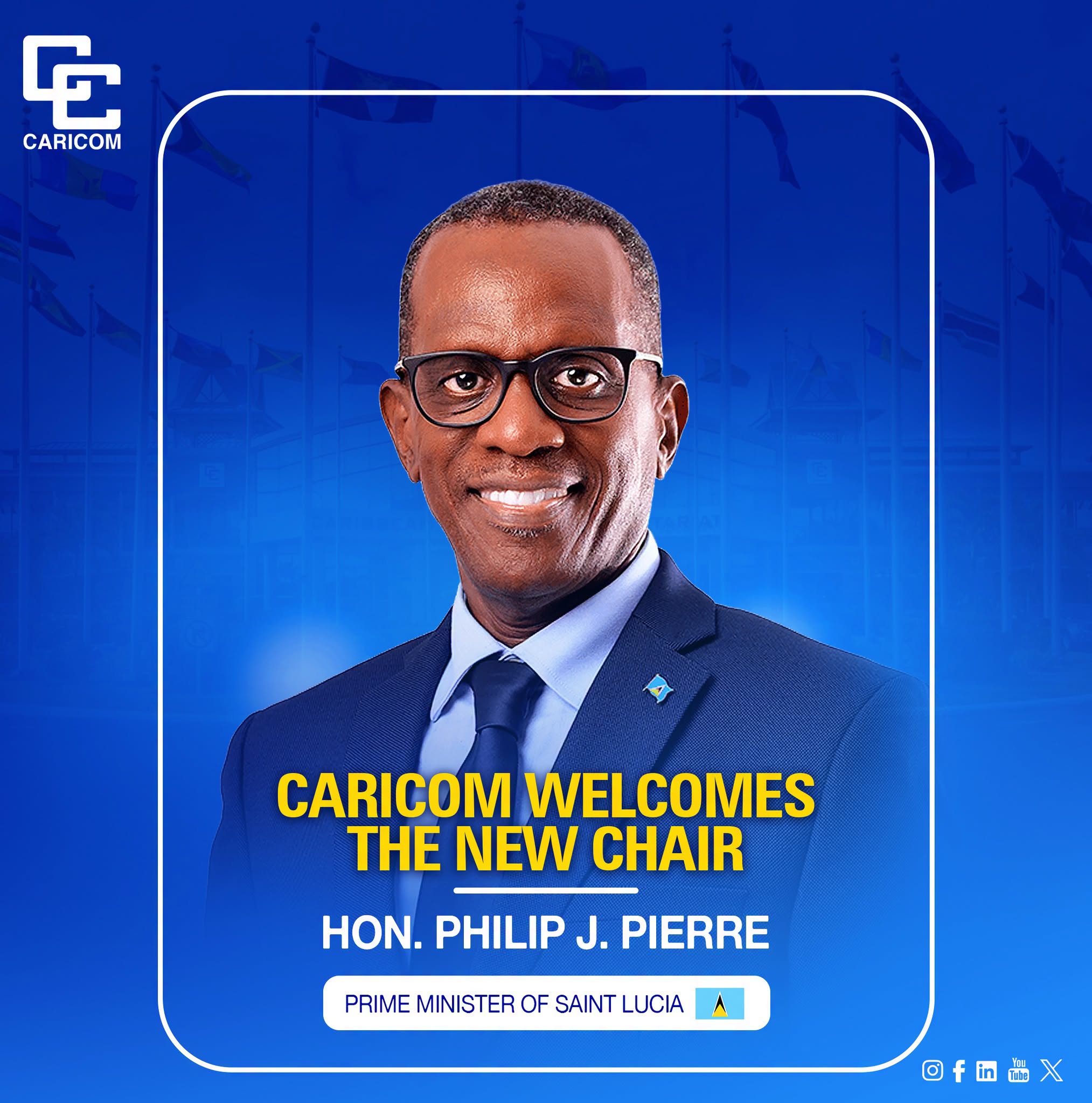
GEORGETOWN, GUYANA – 30 June 2026: With just hours remaining before he formally assumes the rotating leadership of the Caribbean Community (CARICOM), incoming Chair and Prime Minister of Saint Lucia Hon. Philip J. Pierre has laid out his vision for a people-centered six-month term, emphasizing collective action and tangible benefits for Caribbean citizens.
Pierre will officially take over the chairmanship on 1 July 2026, and will hold the post through the end of December 2026. In his pre-assumption statement released by the CARICOM Secretariat, headquartered in Turkeyen, Greater Georgetown, Pierre framed his acceptance of the role as a commitment rooted in service to the Caribbean region’s 16 million residents.
“CARICOM has always been built on a simple but powerful belief: that our countries can achieve more together than we ever could alone,” Pierre said, noting that this founding principle remains just as relevant today amid a period of profound global shifts. As Caribbean nations adapt their economies to new global realities and work to address evolving social challenges, Pierre argued that cross-border cooperation, innovation, and shared purpose are non-negotiable for progress.
At the core of his incoming agenda is a focus on answering a critical question on the minds of ordinary residents across the region: How can CARICOM deliver more visible, meaningful improvements to everyday life? This question, Pierre stressed, will guide every policy and initiative pursued during his term.
First on his priority list is strengthening regional solidarity. “The Caribbean is strongest when we work together, speak with purpose, and respect the voices and contributions of every Member State,” he noted, pointing to the region’s rich diversity of cultures, languages, and traditions as one of its greatest competitive and collaborative assets, not a barrier to unity.
Pierre also highlighted the interconnected nature of development and public safety, pledging to advance collective work to build safer, more secure communities where all residents have the space to live, work, learn, and thrive with dignity. For the regional bloc, he emphasized, success can only be measured by whether ordinary people actually feel the benefits of integration in their daily lives. “Integration that our people cannot feel will not last,” he said.
Looking ahead to his six-month tenure, Pierre called for collective action to build a CARICOM that is more united, inclusive, resilient, and future-ready, framing the next chapter of the bloc’s work as a journey “from resilience to renewal and revival.”
Established in 1973 via the Treaty of Chaguaramas and revised in 2001 to launch a single market and economy, CARICOM stands as one of the most successful examples of regional integration in the developing world. The bloc comprises 15 full Member States and six Associate Members, with 60% of its combined population under the age of 30. Its work is organized around four core pillars: economic integration, coordinated foreign policy, human and social development, and security cooperation, with the overarching goal of building a unified, competitive global bloc where all citizens can access opportunity, enjoy guaranteed human rights and social justice, and share in shared economic, social, and cultural prosperity.