For far too long, commercial property owners have treated on-site security as a reactive measure — a problem that only gets attention after a break-in, theft, act of vandalism, missing inventory or unauthorized access incident already causes damage. But a shifting security technology landscape is making proactive, intelligent protection far more accessible than ever before, extending cutting-edge capabilities beyond the reach of only large multinational corporations with deep pockets. Today, small and medium-sized business owners and residential property users alike can access affordable, reliable, user-friendly smart security solutions that were unthinkable just 10 years ago.
One of the most transformative innovations in modern security is the integration of artificial intelligence into video camera systems. Traditional security setups relied on passive recording: if an incident occurred, security teams or business owners would be forced to sift through hours of raw footage to piece together what happened. AI-powered cameras flip this model on its head, enabling a fully proactive approach to threat detection.
Contemporary AI-enabled systems can automatically identify people, vehicles, and anomalous activity that falls outside expected patterns. They push instant alerts directly to a user’s mobile device, delivering real-time visibility into any on-site event from anywhere in the world. Most modern systems are also trained to distinguish between human intruders and animals, drastically cutting down on the number of false alarms that waste time and desensitize users to genuine threats.
A growing number of modern security cameras also come equipped with built-in speakers and microphones, supporting two-way audio communication between remote users and on-site visitors. For example, if a business owner receives an after-hours alert of an unauthorized person on their property, they can pull up a live feed on their phone and speak directly to the individual through the camera. In most scenarios, simply making a remote presence known is enough to deter criminal or mischievous activity before it escalates into damage or loss.
Remote monitoring capabilities have also opened up new flexibility for business owners managing multiple locations or who spend significant time off-site. Whether a manager is at home, traveling for work, or overseeing a chain of storefronts spread across a region, they can access live feeds and receive critical alerts from virtually any internet-connected location.
Storage is another key consideration when evaluating modern security camera systems, with two primary options: local and cloud storage, each with distinct benefits. Local storage saves all footage to on-site hardware, most commonly a Network Video Recorder (NVR). This setup typically offers large storage capacities at a lower long-term cost, since it does not require recurring monthly subscription fees for cloud hosting. Cloud storage, by contrast, saves encrypted footage to secure remote online servers. The core advantage of this model is that footage remains intact and accessible even if on-site hardware is damaged or stolen during a break-in. Cloud storage also simplifies remote access to footage and makes sharing recordings with law enforcement or insurance providers far easier.
While smart cameras are a foundational component of any comprehensive security strategy, they only address part of a property’s protection needs. That is where modern access control systems enter the picture. Put simply: cameras record what happened after an event occurs, while access control prevents unauthorized access from happening in the first place.
Traditional physical key systems carry a long list of inherent limitations. Keys can be easily lost, copied, or shared with unauthorized individuals without management knowledge. When an employee leaves the company, rekeying or replacing all facility locks is a costly, time-consuming inconvenience. Modern access control systems replace physical keys with secure digital credentials, which can come in many forms: keycards, mobile phone-based credentials, PIN codes, fingerprint scans, or facial recognition. This digital model allows business owners to granularly control who can access specific areas of a facility, and during what times access is permitted.
For example, a warehouse employee can be restricted to only access the facility during their scheduled working hours, while a general manager can be granted 24/7 access across the entire property. If an employee leaves the organization, their access credentials can be revoked immediately with no need to change locks or reissue keys to the entire team. Many modern access control systems also automatically generate entry logs, creating a clear audit trail that shows which individual entered a restricted space and at what time. This builds greater accountability among staff and helps business owners refine operational security protocols over time.
Like smart cameras, access control systems are also leveraging AI to become more proactive. Newer AI-powered access solutions can automatically flag unusual entry patterns, detect repeated attempts to access restricted areas, and alert management if an individual attempts to enter outside of their pre-approved schedule.
The greatest security benefit, however, comes from integrating AI-powered cameras and access control systems into a single connected ecosystem. For instance: if a door is opened after hours, the access control system automatically logs who opened it, while the connected security camera instantly triggers recording to capture live footage of the event. Instead of sorting through hours of recordings to identify the individual and what occurred, management gets a complete, contextual report in seconds.
For businesses, this integrated combination of technologies delivers measurable benefits: enhanced overall security, reduced inventory and property loss, clearer staff accountability, and invaluable peace of mind for owners and managers. The advantages are just as compelling for residential users: smart integrated systems protect household members, track visitor activity, send alerts for package deliveries, and provide reassurance when homeowners are away on vacation or travel.
Before investing in a new camera or access control solution, industry experts recommend walking through a few simple assessment questions to narrow down the right fit for your needs: which specific areas of my property require monitoring and protection? Do I need remote access to live feeds and instant alerts? Should I store footage locally, in the cloud, or use a hybrid model that combines both? What access restrictions do I need for different people across different areas of my property? Can my chosen camera and access control systems integrate with one another?
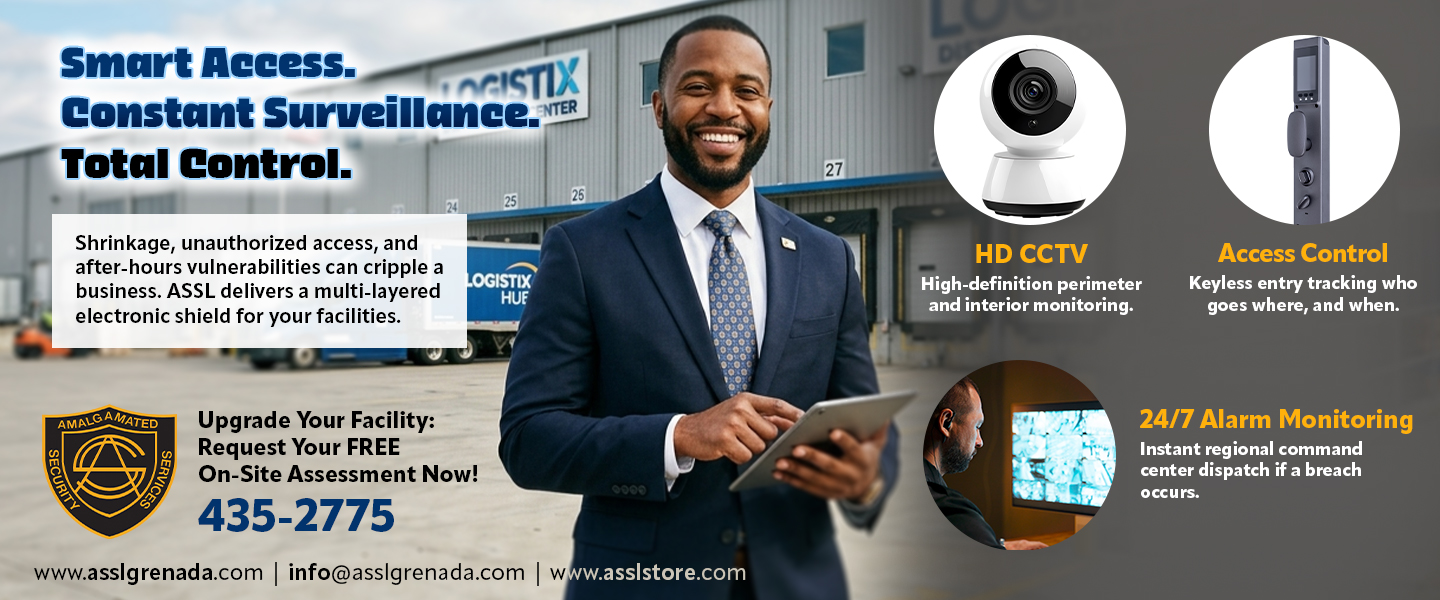
For business owners in Grenada looking to explore modern security options, Amalgamated Security Services Ltd. (ASSL) offers tailored support to match security solutions to unique business needs and budget constraints. The ASSL team provides complimentary on-site assessments to evaluate a property’s current security posture, demonstrate the latest AI-powered camera and access control technologies, and deliver customized recommendations with no obligation. To schedule a free site assessment and technology demonstration, contact ASSL at 435-ASSL (2775) or [email protected] to protect your people, property, and business with modern, accessible security.
*Disclaimer: NOW Grenada is not responsible for the opinions, statements or media content presented by third-party contributors. To report abusive content, follow the official reporting channel on the NOW Grenada platform.