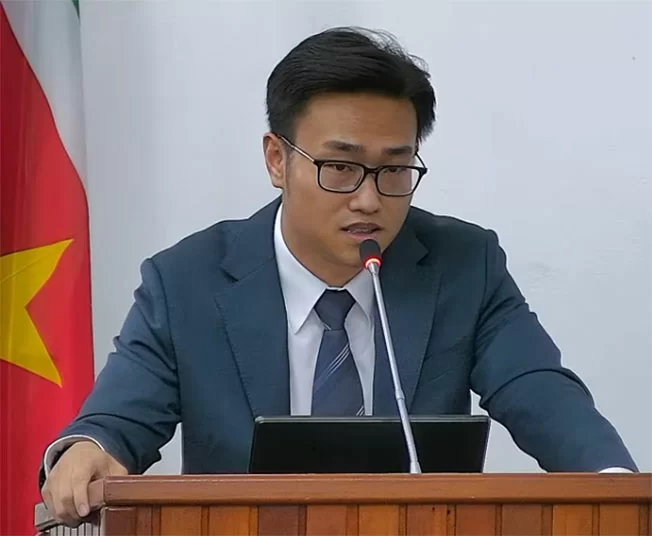
As Suriname’s national assembly continues debate over the country’s upcoming national budget, a ruling Progressive People’s Party (PL) legislator Xiaobao Zheng has put forward a sweeping set of economic policy proposals designed to shore up household purchasing power eroded by inflation and position the South American nation as a competitive regional trade and investment hub.
At the core of Zheng’s domestic policy recommendations is a dramatic increase in the monthly tax-free income threshold, a change he says will put more disposable income directly into workers’ pockets to counter years of rising prices. Currently set at just 9,000 Surinamese dollars (SRD) per month, Zheng is calling for the threshold to be raised to a minimum of 30,000 SRD, with a further increase to 50,000 SRD on the table if government fiscal conditions allow for the expansion.
Zheng’s calculations show that a jump to 30,000 SRD would leave the average worker with an extra 1,890 SRD in disposable income each month. This additional spending power would not only ease immediate financial pressures on working households, he argues, but would also stimulate broader domestic economic activity by increasing consumer demand for local goods and services.
The legislator emphasized that Suriname’s current tax framework is misaligned with the country’s long-term growth goals. In his view, the government has become overly reliant on taxing labor and imports, a structure that discourages job creation and deters foreign capital. Instead, Zheng says fiscal policy should shift to incentivize private investment and entrepreneurship, laying the groundwork for more diversified and sustainable economic expansion.
To advance that goal, Zheng is also pushing for the creation of dedicated free trade zones and free ports across Suriname, drawing on lessons from global success stories. He notes that jurisdictions such as Singapore, Hong Kong (China), and the United Arab Emirates have used these specialized economic zones to attract billions in foreign direct investment, strengthen domestic logistics networks, and generate thousands of new local jobs.
With the rapid development of Suriname’s emerging oil and gas sector on the horizon, Zheng argues the country has a unique opportunity to reinvent itself as a regional trade and logistics hub. Reaching that potential, however, requires major policy shifts: upgraded modern infrastructure, a more welcoming investment climate, and the gradual reduction of existing import barriers. He advocates for a phased reduction of import duties, noting that as Suriname diversifies its economy and develops new streams of economic activity, the government will be able to reduce its dependence on import revenue over time.
Zheng stressed that the coming years will be a defining period for Suriname’s economic future. He urged policymakers to leverage the economic opportunities presented by the growing oil and gas industry to drive sustainable development across other sectors of the economy, ultimately lifting overall prosperity for all Surinamese citizens.
Budget debate is scheduled to continue on the same day of Zheng’s proposal, with the sitting government set to deliver its response in the second round of parliamentary discussion.