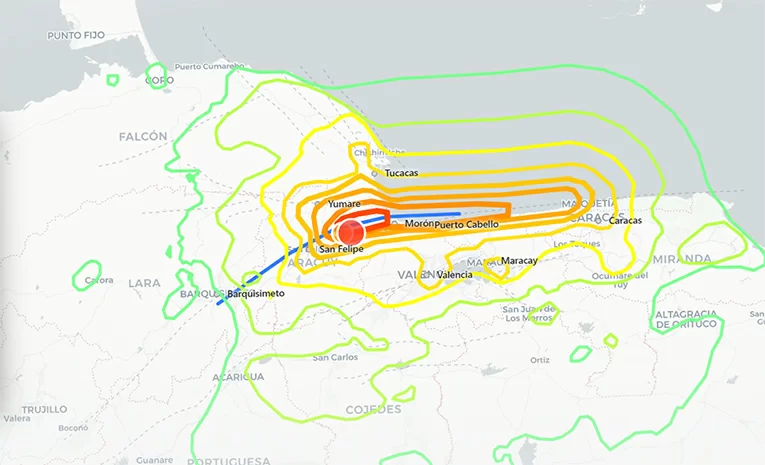
Four days after a pair of devastating back-to-back earthquakes struck Venezuela’s coastal La Guaira region, hopes of pulling more trapped survivors from the rubble are beginning to dim, even as a handful of dramatic last-minute rescues have offered fleeting moments of optimism amid widespread destruction.
The two powerful quakes, registering magnitudes 7.2 and 7.5 respectively, hit the coastal area on Wednesday. As of Saturday, official confirmation put the confirmed death toll at 1,430, with no updated casualty figures released by authorities on Sunday. More than 50,000 people remain unaccounted for, a number that has left disaster response teams and local communities bracing for a grim final count. Late Saturday marked the 72-hour window that emergency responders widely consider the threshold for survival for people trapped without food, water or warmth, leaving little optimism for new finds after this milestone.
Even so, small acts of rescue on Sunday kept a spark of hope alive for grieving and waiting families. One of the most remarkable rescues was that of a 60-year-old woman pulled from the rubble of a collapsed building in the Carabaylda coastal area, after she spent 86 hours trapped under debris. In a post on the social platform X, El Salvadoran President Nayib Bukele said search-and-rescue teams from his country and Peru spent 11 grueling hours working nonstop through the night and early morning to extract her. The woman was transported to a hospital in Caracas for urgent care, and Bukele confirmed her condition remained critical as of Sunday. Bukele credited the relentless effort and determination of cross-border rescue teams for the successful operation.
Multiple other international teams also pulled survivors to safety over the weekend. A U.S. rescue team based in Virginia extracted a man and his son from collapsed infrastructure Sunday morning, carrying them on a tarp to waiting ambulances. On Saturday evening, U.S. officials confirmed a baby had been rescued from a fallen building, while teams from Colombia and Mexico pulled two separate 11-year-old boys from rubble in independent operations. Venezuelan interim President Delcy Rodríguez confirmed Sunday that at least 33 people had been rescued across affected zones over the weekend, while the United Nations reported that more than 2,200 foreign rescue personnel are now active across the country.
To date, more than 1,600 responders from roughly 30 international urban search and rescue teams spanning 18 countries across North America, South America, Europe and the Middle East have deployed to Venezuela, supported by more than 100 search-and-rescue dogs. The UN has released $15 million from its emergency response fund to fund life-saving aid, while the World Food Programme and UNICEF are on the ground distributing food, emergency shelter and medical care. Washington has deployed its own rescue teams and pledged $150 million to support UN and non-governmental humanitarian response efforts, while the European Union has mobilized €5 million in emergency aid, using its Copernicus satellite system to map damage and direct support to the hardest-hit zones. Pope Leo addressed worshippers in Rome on Saturday, offering prayers for eternal rest for those killed and praising the generosity of all responders involved in search and rescue operations.
Despite this massive international deployment, the response effort faces significant obstacles, and growing criticism of the Venezuelan government’s handling of the disaster is mounting. Rodríguez confirmed that more than 14,000 military and police personnel are patrolling the La Guaira region, which has restricted entry that requires special permits for access. In one widely reported incident, local residents blocked an excavator at a collapsed building and pulled the operator from his cabin after state workers took selfies at the disaster site before leaving without conducting any rescue work. Al Jazeera correspondent Noris Soto, reporting from outside a collapsed building in Caracas’ Los Palos Grandes neighborhood, noted that only international responders and civilian volunteers were actively leading search operations, with at least 20 people still remaining trapped under the rubble at that location alone. In Catia La Mar, another hard-hit community in La Guaira, fellow Al Jazeera correspondent Teresa Bo reported that family members have marked collapsed homes where they cannot recover the bodies of their loved ones, waiting for days outside the wreckage for remains to be extracted.
Basic aid distribution, including water and food, is only just beginning to reach the most affected regions, and many residents are still camping outdoors in the open after their homes were destroyed. Many hard-hit areas still lack heavy excavation equipment, forcing desperate residents and volunteer workers to dig through rubble by hand or with simple hand tools. Aftershocks continue to rock the region, including a 4.9-magnitude quake on June 26, that have further complicated search efforts and put responders at risk.
The scale of the disaster is one of the worst to hit Latin America in more than a century. The United Nations estimates that up to 6.7 million people have been directly or indirectly impacted by the quakes, with total infrastructure damage estimated at $6.7 billion, equal to roughly 6% of Venezuela’s entire gross domestic product. The U.S. Geological Survey has warned that based on current modeling, the final death toll could rise above 10,000, a figure that would make this one of the deadliest seismic events in the region in modern history. For Venezuela, a nation already grappling with years of overlapping economic and humanitarian crises, the disaster represents an unprecedented test for Rodríguez’s interim government, which took power after the reported detention of former president Nicolás Maduro by U.S. forces in January, and now works closely with the U.S. administration of Donald Trump.