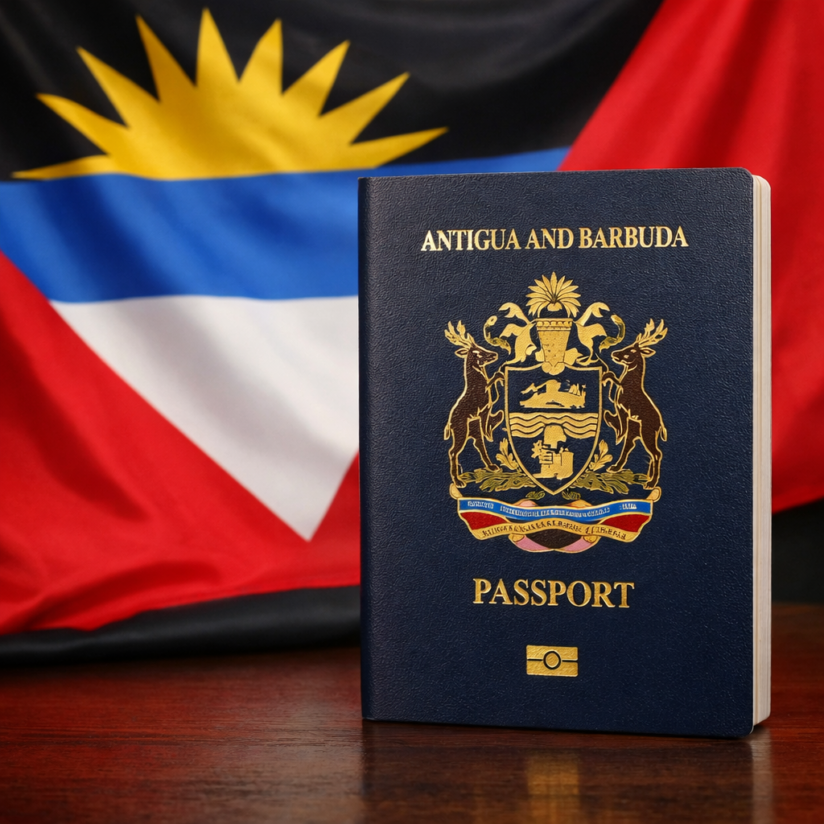
During a weekly radio address on Pointe FM Saturday, Gaston Browne, the Prime Minister of Antigua and Barbuda, made clear that the island nation will not abandon its high-stakes Citizenship by Investment Programme (CIP) even if the European Union follows through on its threat to revoke visa-free travel privileges for Antigua and Barbuda passport holders.
While the government remains cautiously optimistic that ongoing high-level negotiations with European officials will preserve the current visa-free travel arrangement, Browne confirmed that the country is actively preparing for the worst-case scenario, which could see the privilege withdrawn before the end of 2024.
“We can anticipate that, despite our best efforts, these visa-free arrangements may be discontinued,” Browne told listeners. “What I will say here, under my leadership and certainly under the Labour Party’s governance of this country, with or without those visa-free arrangements, our CIP programme continues. It is too important a source of non-tax revenue to give it up.”
The European Union has flagged citizenship by investment programmes across a handful of small nations as a potential security concern, and has publicly warned that it could suspend visa-free access for countries that maintain these schemes. No final ruling on the measure has been issued to date, but Browne acknowledged the risk of action before year’s end. To de-escalate tensions, Antigua and Barbuda has put forward a compromise proposal: instead of scrapping visa-free access entirely, the EU could implement a pre-travel electronic authorization system for visitors from CIP-operating countries, a framework Browne calls a balanced, sensible alternative that preserves long-standing positive relations between the two sides.
“We have the view that an electronic travel authorization should be sufficient,” Browne said. “We think that it’s a sensible thing to do to maintain the good relations that we’ve had over the years and not to throw the baby out with the bath water.”
Already, one EU member state – Ireland – has moved to end its visa-free arrangement with Antigua and Barbuda, prompting the Browne administration to push for urgent dialogue with EU leadership before broader restrictions are enacted.
In a robust defense of the CIP, Browne emphasized that Antigua and Barbuda has enacted sweeping reforms to strengthen its programme in recent years, directly refuting European claims that the scheme poses unacceptable security risks to the bloc. He acknowledged that no immigration programme can eliminate all residual risk, noting that even well-established schemes in large nations have occasionally admitted bad actors. Specifically, he called out the United States’ EB-5 investor visa programme and Canada’s former investor immigration initiative, both of which have faced high-profile scandals involving criminal exploitation.
“Even the EB-5 programme in the United States, they’ve had a lot of crooks. I mean the one in Canada too. But they keep pointing fingers at us as though they are not fallible and as though their programmes have not attracted crooks too,” Browne argued.
The prime minister also stressed the independent governance of Antigua and Barbuda’s CIP, noting that political officials, including himself, never interfere with due diligence processes carried out by the country’s Citizenship by Investment Unit (CIU). Over his 12 years in office, Browne said he has never overturned a rejection decision made by the CIU or its governing board, allowing the body to operate with full autonomy.
He added that Antigua and Barbuda’s due diligence standards match or exceed those of much larger nations, and the country’s small geographic size and close-knit governance actually make it far harder for criminals to evade detection and enforcement.
“In our countries, I can say definitively in the case of Antigua and Barbuda, our programme is run with integrity,” Browne said. “I would say better integrity than those large countries who are pointing fingers at us.”
Reaffirming the government’s commitment to collaboration, Browne said Antigua and Barbuda stands ready to address all of the EU’s outstanding concerns and implement additional safeguards – including mandatory biometric screening – if required to reach a resolution. The only major outstanding issue between the two sides currently centers on the implementation of biometrics, he added. “We have said to them, you run investment immigration programmes; any initiative that you have in place, we’ll put in place,” Browne said.