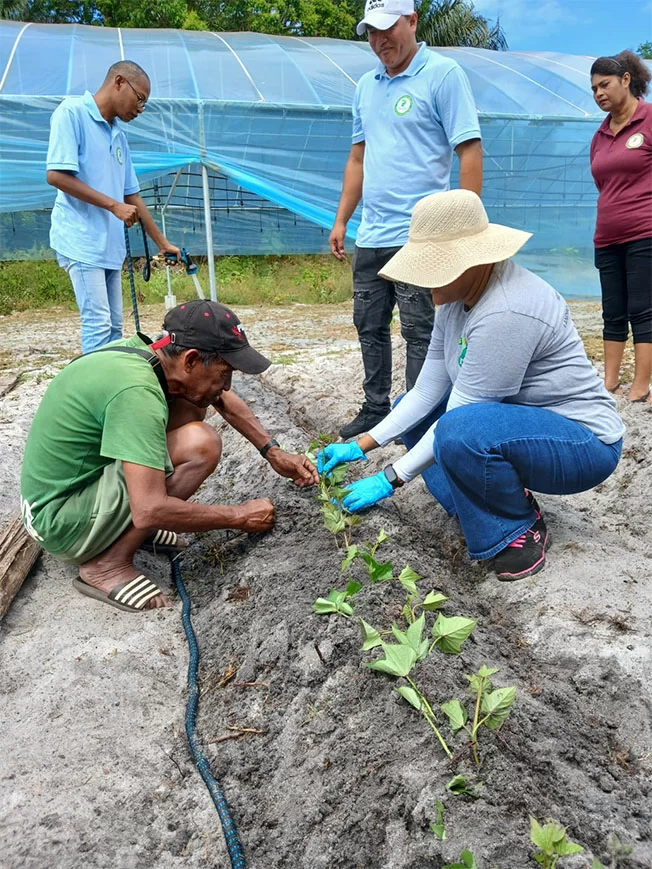
Against the backdrop of a growing threat from devastating crop disease, the indigenous community of Matta is embracing agricultural diversification to shore up its long-term food security and strengthen the resilience of local farming systems. For generations, cassava has stood as one of the village’s most critical staple crops, feeding hundreds of households and forming the backbone of local food production. But the rapid spread of Cassava Witches’ Broom Disease, a pathogen that cripples cassava yields and devastates entire harvests, has pushed community leaders and agricultural authorities to pursue a new, more sustainable approach: integrating sweet potato cultivation into existing farming systems.
The initiative is led by the Directorate of Agricultural Research, Marketing and Processing under Suriname’s Ministry of Agriculture, Livestock and Fisheries (LVV), in partnership with regional agricultural authorities covering the Para district and Matta rayon. To equip local farmers with the skills needed to adopt this new model, government experts delivered a hands-on practical training program focused on modern sweet potato growing techniques tailored to the region’s climate and soil conditions.
At the core of the strategy is intercropping, the practice of growing sweet potato alongside cassava in the same fields. Agricultural experts leading the training explain that this diversified planting system delivers two key benefits: it reduces overall disease pressure from Cassava Witches’ Broom Disease, lowering the risk of total crop failure, and creates a more balanced farming ecosystem that is far less vulnerable to widespread pest and disease outbreaks than single-crop monocultures.
Trainers emphasized that integrated, diversified cropping systems do more than just combat existing disease threats. By combining complementary crops that support one another’s growth, smallholder farmers build greater long-term agricultural resilience, equipping them to absorb unexpected shocks ranging from disease outbreaks to shifting weather patterns linked to climate change. This approach also directly strengthens community food security by expanding the range of staple crops produced locally, reducing reliance on a single at-risk crop.
The training program forms a core component of the LVV/IDB Open Field Project, a broader initiative funded in partnership with the Inter-American Development Bank that aims to boost productivity of open-field staple crops including sweet potato, cassava, and other key produce. Beyond yield improvements, the project also works to help local farmers meet international and national standards for food safety and Good Agricultural Practices (GAP), opening up potential new market opportunities for small-scale producers while ensuring the food reaching local households meets strict safety requirements.
For the Matta community, the project represents more than just a response to an immediate crop crisis. It is a long-term investment in building a more sustainable, resilient local agricultural model that centers knowledge sharing, cross-sector collaboration, and community-led development. By equipping local farmers with practical skills and ongoing technical support, project organizers are working to embed sweet potato as a permanent, valuable component of a diverse, robust farming system that can support the community for generations.