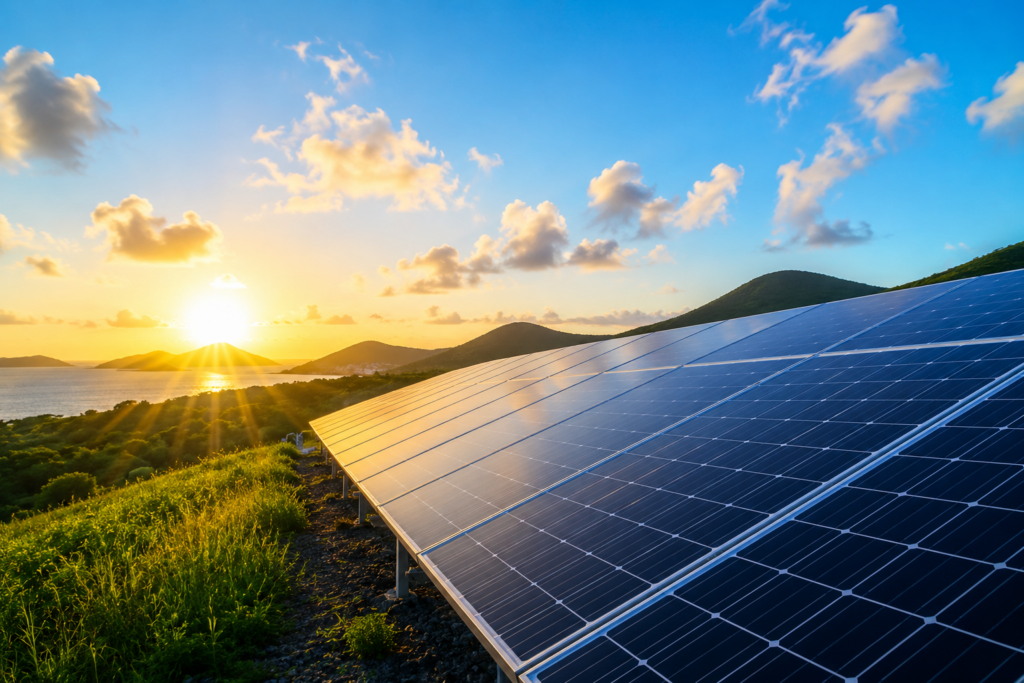
In a landmark announcement made during his weekly broadcast on Pointe FM this past Saturday, Prime Minister Gaston Browne laid out an ambitious new energy strategy for Antigua and Barbuda that places both decarbonization and broad public economic participation at its core. Over the coming 24 months, the government will move forward with the development of a utility-scale solar generation facility, projected to produce between 15 and 20 gigawatt hours of clean electricity annually, and open up future renewable energy projects to direct investment from ordinary Antiguans and Barbudans.
The initiative marks a deliberate break from the nation’s past energy development model, which has historically concentrated ownership of electricity infrastructure among a small cohort of private companies. Browne stressed that the new framework is designed to democratize access to the growing renewable energy market, allowing everyday citizens to build wealth and share in the economic benefits of the clean energy transition, rather than limiting these gains to a small group of corporate stakeholders. “We want this to be a shared situation which will provide opportunity for Antiguans and Barbudans to invest in energy,” Browne told listeners, noting that the policy’s core goal is to diversify ownership across the country’s energy sector.
Contrary to some potential interpretations, the prime minister clarified that the plan does not sidelined existing energy operators. Current market players, including the Antigua Public Utilities (APC) and major private groups such as Eagle and the Hadid Group, are fully welcome to participate in bidding for stakes in the new solar project and future renewable developments. Browne emphasized that the policy is not intended to displace existing operators, nor is it rooted in animosity toward any current market leaders. “I say this with no hostility towards Eagle or towards the Hadid group of companies,” he explained. “The members of the Hadid family and I get on pretty well. We haven’t had any issues, but I speak truth to power, and ultimately my responsibility is to the people of Antigua and Barbuda. No friendship, no interests supersede the interests of the people.” APC could even emerge as the single largest investor in the new solar plant depending on its available resources, Browne added.
The new large-scale solar facility is positioned as a complementary addition to the government’s ongoing transition to liquefied natural gas (LNG), which Browne framed as a pragmatic mid-term transition fuel. As Antigua and Barbuda scales up its renewable energy generation capacity over time, LNG will serve as a lower-emission alternative to the diesel and heavy fuel oil that currently dominate the nation’s energy mix, delivering immediate reductions in both consumer electricity costs and national carbon output. Browne outlined that the broader energy transition strategy will deliver two core, interconnected benefits for residents: “a reduction in price compared to using diesel or heavy fuel, and similarly there’s going to be a reduction in our carbon footprint.” This dual approach aligns with the government’s long-term goal of cutting the nation’s reliance on imported fossil fuels while expanding and strengthening the country’s overall electricity infrastructure.