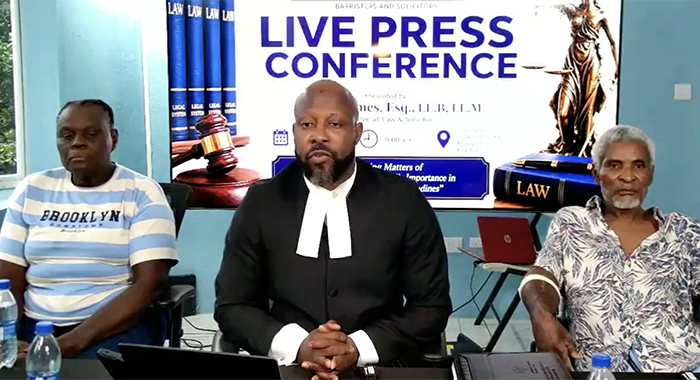
A sitting senator and practicing attorney from St. Vincent and the Grenadines is moving forward with high-stakes legal action against the island nation’s government, alleging two of the most egregious recent examples of police brutality and abuse of power in the country’s recent history. At a Wednesday press conference held in the capital city of Kingstown, Carlos James revealed that his legal firm has already submitted formal statutory notices under the territory’s Crown Proceedings Act on behalf of two vulnerable male residents who say they suffered unprovoked, brutal harm at the hands of serving police officers.
The first case centers on Kenton Harris, a chronically mentally ill man from Lodge Village who is legally unable to manage his own personal and legal affairs. Harris’ ordeal gained nationwide public attention after a graphic video filmed on May 21, 2026 near Coreas on Hillsboro Road in Kingstown circulated widely on social media. The footage, which went viral and was covered extensively by local media outlets, shows multiple uniformed officers repeatedly beating Harris while he was already in handcuffs. But according to James, the alleged abuse of Harris began months before the viral confrontation was captured on camera.
James outlined three separate alleged assaults by officers of the Royal St. Vincent and the Grenadines Police Force (SVGPF) against the vulnerable man. The first took place on March 11 at Kingstown’s Central Police Station, where James says officers physically attacked Harris, leaving him with a fractured left arm that required emergency medical intervention. More than three months after that initial incident, James says no formal investigation has been launched. While an inquiry has been opened into the May 21 beating, no official updates on potential criminal charges against the involved officers have been released to the public one month after the assault. The third alleged attack occurred while Harris was being held in a police holding cell and transported to Milton Cato Memorial Hospital (MCMH), following which James says Harris’ physical and mental health declined drastically. After the third assault, Harris was first transferred to the Mental Health Rehabilitation Centre (MHRC) in Glen, then rushed back to MCMH for urgent orthopedic care.
The formal notice of upcoming civil proceedings, which James read in full during the press briefing, names the Attorney General as the defendant and is being pursued through Harris’ mother and litigation friend, Anesta Harris-Robinson. The claims against state agents include assault and battery, professional negligence, misfeasance in public office — defined as deliberate, oppressive and malicious misuse of state power to target a mentally disabled individual — and multiple violations of Harris’ constitutional rights, most notably his fundamental right to protection from cruel, inhumane and degrading treatment. James is seeking aggravated and exemplary damages for the what the legal document describes as “highly oppressive, high-handed and arbitrary” conduct, alongside compensation for pain and suffering, lost amenities, lost earnings and future earning capacity, past and future medical and rehabilitation costs, as well as legal fees and accrued interest. James also confirmed that his legal team is exploring the possibility of filing an additional constitutional motion, noting that the Harris case could set a critical precedent for reforming police interactions with mentally ill citizens across the country.
The legal notice also includes a formal demand that the Attorney General’s Chambers preserve and turn over a full suite of evidence related to both the March 11 and May 21 incidents within a 14-day window. Required records include holding cell logs and occurrence book entries from Kingstown Central Police Station, full custody records and rosters for the incident dates plus two days before and after, formal statements from five named officers and all on-duty holding cell staff, any available surveillance footage from across the police station, and complete medical records, admission logs and diagnostic images from both MHRC and MCMH related to Harris’ care.
Speaking briefly at the press conference, Harris-Robinson called for accountability for her son. “I would like to see justice for my son, because what the police and them do to him, they didn’t have the right to do it. They’re very wrong, and I would like to see justice for him,” she said. James emphasized that local police have long been aware of Harris’ mental health condition, a fact that increased rather than decreased their legal duty of care to the man. “For the very reason that he’s known, it gives even a greater level of responsibility on the officers… His mental condition warrants that, and that duty of care, in my opinion, was broken,” James said.
The second, even more disturbing case outlined by James involves Louis Mercury, a resident of Redemption Sharpes who was shot multiple times by police inside MCMH on March 29. According to James, Mercury arrived at the public hospital around 8 p.m. that day to receive treatment for injuries he had sustained earlier in the Vermont area. Instead of being directed to the Accident and Emergency Department, Mercury was placed in a hospital ward corridor. When a hospital security guard ordered him to leave the area and Mercury refused to go until he received the medical care he needed, the guard called in a uniformed officer from the police Special Services Unit (SSU). James claims that the officer loaded his service weapon, and during the subsequent confrontation, fired between seven and eight rounds at Mercury from point-blank range, every one of which struck the man. “Our client posed no threat to life and did not resist the officer,” James stated in the legal notice.
Mercury was hit in both arms and his right leg, and underwent emergency life-saving orthopedic surgery, remaining hospitalized for five weeks before being discharged on May 5. Mercury joined James at the press conference in a wheelchair, and James confirmed that the 54-year-old is now permanently unable to walk, his right arm is almost completely immobile, and a bullet remains lodged in his right leg. Mercury requires additional corrective surgeries that will require significant blood transfusions, James said. “As we speak, Mr. Mercury is unable to walk, he’s unable to use his right hand and is unable to fend for himself,” James added. Mercury told reporters he feels his fundamental rights have been taken from him. “I want justice for what happen to me dey. I’m feeling like my rights being affected like I don’t have none, no rights,” he said, issuing a public appeal for community members to donate blood to the hospital blood bank in his name to support his upcoming procedures.
The second statutory notice of intended civil proceedings also names the Attorney General as a defendant, with the SSU officer listed as an unknown defendant, and copies the Commissioner of Police. The claim alleges unlawful, disproportionate and extremely reckless use of lethal force by the on-duty officer, alongside assault and battery, negligence, misfeasance in public office, and statutory state liability for the harmful acts carried out by its agents and employees. Mercury is seeking compensation for pain and suffering, permanent disability, past and future lost earnings, medical expenses, aggravated and exemplary damages, legal costs and accrued interest.
James questioned how a trained, experienced officer could justify using such extreme force in that context. “What will possess a right-thinking, trained, experienced police officer at close range to use a service firearm to unleash not just one or even two shots to a member of the public, but at least seven to eight bullets across the body of a citizen…?” James said. “This is not someone escaping and running into the hills and you’re firing at the person and you’re hoping one or two of the bullets hit. You’re standing in front of the individual and you have unleashed seven to eight rounds of ammunition, paralysing this person.” James added that the proportionality and necessity of the force used demand rigorous, independent scrutiny, saying “We are to ask the question whether or not this is, in fact, lethal force, excessive force, far removed from any of the training that any officer would receive… and whether or not that is proportionate in the circumstances.”
James also alleged that attempts to file a formal internal complaint about the shooting were blocked by police administration. He said Mercury’s relatives first notified a senior police officer of the shooting, and on that officer’s advice, visited the Police Public Relations and Complaints Department to submit a formal grievance. But James says a staff member at the department refused to take their statement, claiming the incident had already been reported to a senior officer. “Here it is that someone is going to lodge a formal complaint… and is being advised that a statement cannot be taken,” James said. “I find it very strange… Those are my instructions on behalf of the family… and hence the reason why, when I inquired, nobody seems to be aware of a man being shot seven to eight times by the police.” With the statutory notices now filed, the government is now required to respond to the claims in both civil and potentially criminal court in the coming weeks.