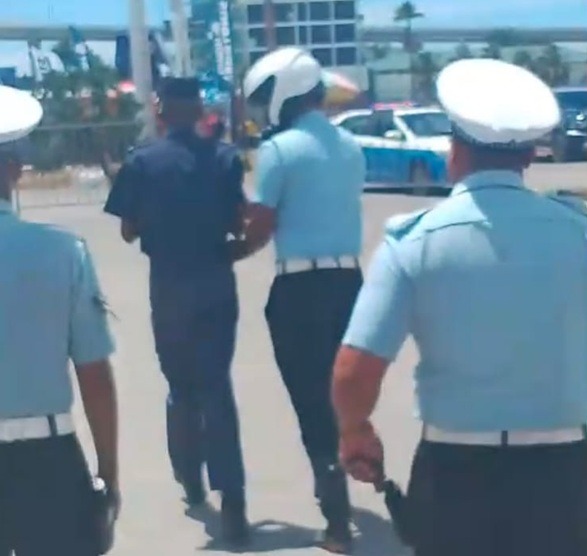
On a Saturday morning in late June 2026, a routine on-site support mission turned into a public confrontation between two key emergency services in Guyana, raising serious questions about inter-agency protocol and legal jurisdiction. The incident unfolded at the Guyana National Stadium compound in Providence, located on Demerara’s East Bank, when a Guyana Fire Service water tender, deployed to provide water for stadium restrooms and other operational needs, accidentally snagged a cable connected to a portable floodlight generator. The tension pulled the supporting pole off balance, sending it crashing onto a parked vehicle assigned to Junior Housing Minister Vanessa Benn. Benn was not inside the vehicle at the time of the mishap, and no bystanders were injured.
According to multiple informed sources familiar with the details of the incident, after the collision, responding traffic police moved to immediately arrest the fire tender’s 50-year-old driver, a Leading Fireman with the service. Videos of the encounter shared widely on social media captured fellow firefighters stepping in to block officers from taking the driver into custody. Multiple sources with knowledge of Joint Services standard operating procedures highlighted that the police’s approach deviated sharply from established inter-agency protocol.
Critics of the police response have raised two core legal and procedural concerns. First, the accident occurred within the stadium compound, a space that qualifies as private property rather than a public roadway, placing the incident outside the scope of routine traffic law enforcement. Second, protocol dictates that rather than moving forward with an on-scene arrest, senior police leadership should first contact the Fire Service’s senior command or the Fire Chief directly to arrange for statements to be collected from involved personnel at a mutually convenient time.
Complicating the situation further, responding officers were informed when they arrived that the fire crew and the driver could not leave the stadium, as they were on official standby duty with a second fire tender. One firefighter involved in the confrontation later attempted to seek a medical evaluation for injuries he claimed were sustained when officers forced him toward a police vehicle, but he ultimately left the hospital before being seen by a doctor to respond to an active fire call elsewhere.
After the confrontation drew attention from onlookers who recorded the entire incident, officers ultimately left the scene without making any arrests. In an official statement released following the event, the Guyana Police Force confirmed the collision took place at 11:41 a.m. that Saturday, noting that the fire tender had made contact with the light pole while exiting an eastern gate on the stadium tarmac, resulting in damage to the right driver’s side door and fender of the minister’s vehicle. The official statement confirmed that a commotion broke out during the on-scene investigation over attempts to take the driver into custody for investigative processing, but added that the situation was successfully de-escalated before any further violence occurred. The force’s statement did not mention that the damaged vehicle was assigned to the junior housing minister.
The confrontation has sparked new discussion about the need for clearer inter-agency coordination guidelines between Guyana’s emergency and security services, with observers noting that the incident highlights gaps in existing protocols that can lead to unnecessary public conflict between two services critical to public safety.