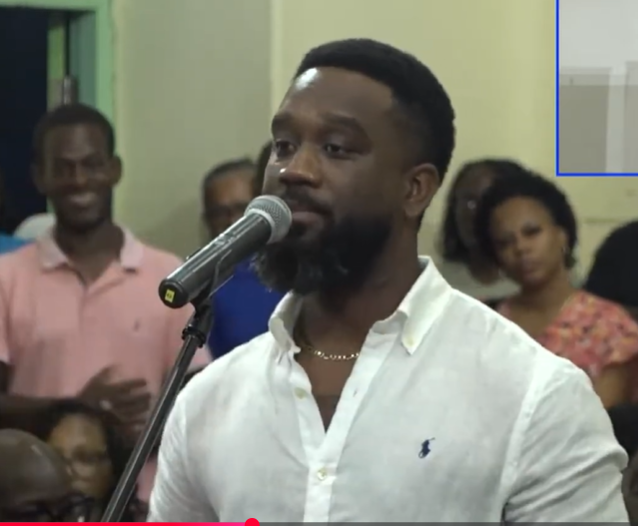
A tense town hall gathering held this Thursday brought Barbadian parents face-to-face with education leaders, as families pushed for clear answers about how new continuous assessment rules will protect individual student achievement under the government’s planned primary-to-secondary school placement overhaul. The proposed framework is set to replace the long-standing Barbados Secondary School Entrance Examination, with continuous assessment set to make up half of a student’s final placement score moving forward.
One of the most vocal critics at the meeting was Raphael Saul, a father whose 9-year-old child is set to become part of the first cohort to enter the new system when it launches this September. Saul clarified that he does not oppose project-based learning or dismiss the importance of building collaborative skills among young students, but he warned that tying group work to high-stakes secondary placement creates an unfair risk: a hardworking, high-contributing student could see their overall score dragged down by underperformance from other group members.
When Saul asked officials to clarify whether only individual contributions would count toward a student’s continuous assessment score, or if group results would also factor in, Deputy Chief Education Officer for Planning and Development Reverend Stephen Scott confirmed that both components would be weighted and combined for the final grade. Scott drew a parallel between this new structure and the School-Based Assessment (SBA) model already used for Caribbean Secondary Education Certificate (CSEC) English courses, where students work together on early research stages before completing a final standalone individual assignment. Under that system, students earn marks for both the group collaboration phase and their individual final work, Scott explained.
Saul pushed back on this framing, arguing that while group projects have clear value as a classroom teaching tool, they have no place in a high-stakes assessment that determines which secondary school a child will attend. “I am very on the same page with you as it relates to group projects and their value,” Saul said. “The challenge I have, though… is that a child who may work well individually and who may even contribute well in his or her group can end up in a situation… where the group’s grade ends up reducing their overall score.” He added that the current structure runs counter to the Ministry of Education’s own stated goal of gaining a more accurate, holistic picture of each student’s individual ability, and recommended that only individual work be counted toward the continuous assessment placement score, with group activities retained solely for learning purposes.
Acting Chief Education Officer Julia Beckles pushed back on concerns, stressing that the assessed projects are not last-minute, one-off assignments, but rather the end result of a structured two-year learning journey. “When we talk about the projects, we are talking about the end of a process,” Beckles explained. “All along the process, the child is being taught. Yes, the child is being evaluated. The teacher is taking note of strengths, taking note of weaknesses, and more importantly, the teacher now has the time to try to assist in the child’s improvement in the areas where weaknesses have been identified.” She emphasized that students do not get thrown into unguided groups for assessment; instead, they build collaboration skills incrementally with ongoing teacher support over the full two-year period.
Acting Deputy Chief Education Officer Denise Charles urged parents to reframe their understanding of the new assessment model, noting that it is rooted in project-based learning rather than the traditional, rigid school projects many families are familiar with. “What our students will be doing will not just be projects. It is project-based learning. The emphasis is on creativity, individual expression,” Charles said. Unlike traditional assessments that only allow written reports or static presentations, Charles explained that students will be able to showcase their knowledge through diverse, creative formats including videos, music, dance, and visual art. “It is going to be far more dynamic and creative than that,” she added.
Charles framed the new system as a reflection of a modernizing Barbados, designed to equip students with the soft skills—collaboration, creativity, critical problem-solving—that are increasingly demanded in a rapidly changing global workforce. “This is not the Barbados of the Common Entrance exam as we know it,” she said. “This is a different Barbados.”
Saul’s concern about group grading was not the only question raised at the meeting. Other parents asked why the new assessment will start as early as Class Three, and voiced particular worry about the first cohort, widely referred to as “COVID kids” who began their primary education through remote learning and have already faced significant educational disruption. By the end of the town hall, multiple parents reported leaving the meeting without the clear answers they had sought, saying key questions were not addressed directly by education officials.