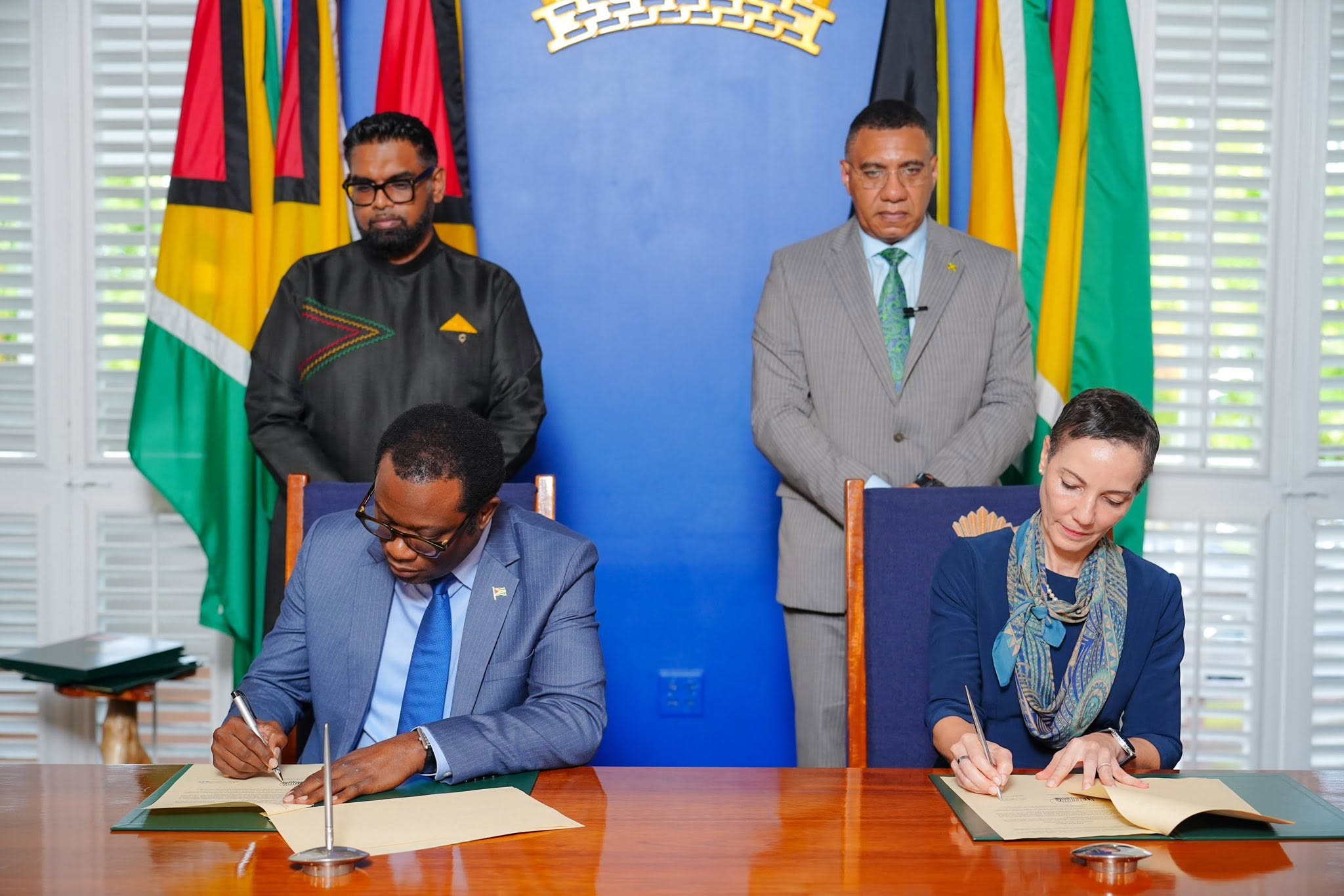
On June 26, 2026, a landmark round of bilateral diplomacy between two Caribbean Community (CARICOM) member states delivered a framework for deepened cross-sector collaboration, anchored by a new initiative to advance regional energy security. The agreement-signing ceremony took place at Guyana’s State House, where Guyana’s Foreign Minister Hugh Todd and Jamaican Foreign Minister Kamina Johnson Smith put their signatures to a series of memoranda of understanding (MoUs), with Guyana President Irfaan Ali and Jamaican Prime Minister Andrew Holness in attendance as official witnesses.
Following the formal signing ceremony, the two leaders addressed a joint press briefing, outlining the scope of the new partnership. Beyond pre-agreed cooperation in security, tourism, agriculture and financial services, the two nations have committed to establishing a dedicated working group focused exclusively on energy sector collaboration. “We are committed to having a working group examine this closely to come up with recommendations and options as to how we can collaborate in the energy sector. There are some exciting ideas that we are already talking about,” President Ali told reporters.
Prime Minister Holness confirmed that energy cooperation was a central topic of his bilateral talks with President Ali, building on remarks he made just days earlier at the 2026 Suriname Energy, Oil & Gas Summit & Exhibition (SEOGS). Speaking at a joint press conference with Suriname President Jennifer Geerlings-Simons following the summit, Holness emphasized that the rapid growth of hydrocarbon development across Trinidad and Tobago, Guyana and Suriname has created an unprecedented opportunity for the Caribbean to achieve collective energy independence. “The CARICOM regional energy security is now within reach providing, of course, that regional governments cooperate in strategic ways,” he said at the time.
Jamaica already maintains a state-owned oil refining facility, PetroJam, and is currently conducting exploratory activities for offshore oil reserves. To date, preliminary exploration data has indicated the potential for an active petroleum system off the island’s coast, Holness noted during his Suriname appearance.
During his visit to Guyana, Holness added that the two sides also held detailed discussions on alignment in housing, in addition to the previously agreed priority sectors. He stressed that the two nations share a common vision for global affairs, particularly as the international order undergoes rapid shifts. “It is clear that Jamaica and Guyana are very much aligned, and we have a similar outlook on the world, similar understanding of the changing dynamics and the new nature of global politics,” he said.
For his part, President Ali called on both countries to leverage their respective comparative advantages in areas including infrastructure development, to build a collaborative framework that delivers benefits not only for the two countries but for the broader Caribbean region. While full details of the signed MoUs have not been released to the public, President Ali confirmed that one of the agreements formalizes security and defense cooperation between the Guyana Defence Force (GDF) and the Jamaica Defence Force (JDF). Under the pact, Guyana will expand educational opportunities for JDF personnel, including offering access to a Master’s Degree in Strategic Development at the GDF’s National Defence Institute – a program that maintains institutional links with the United States Pentagon and Colombian defense institutions.