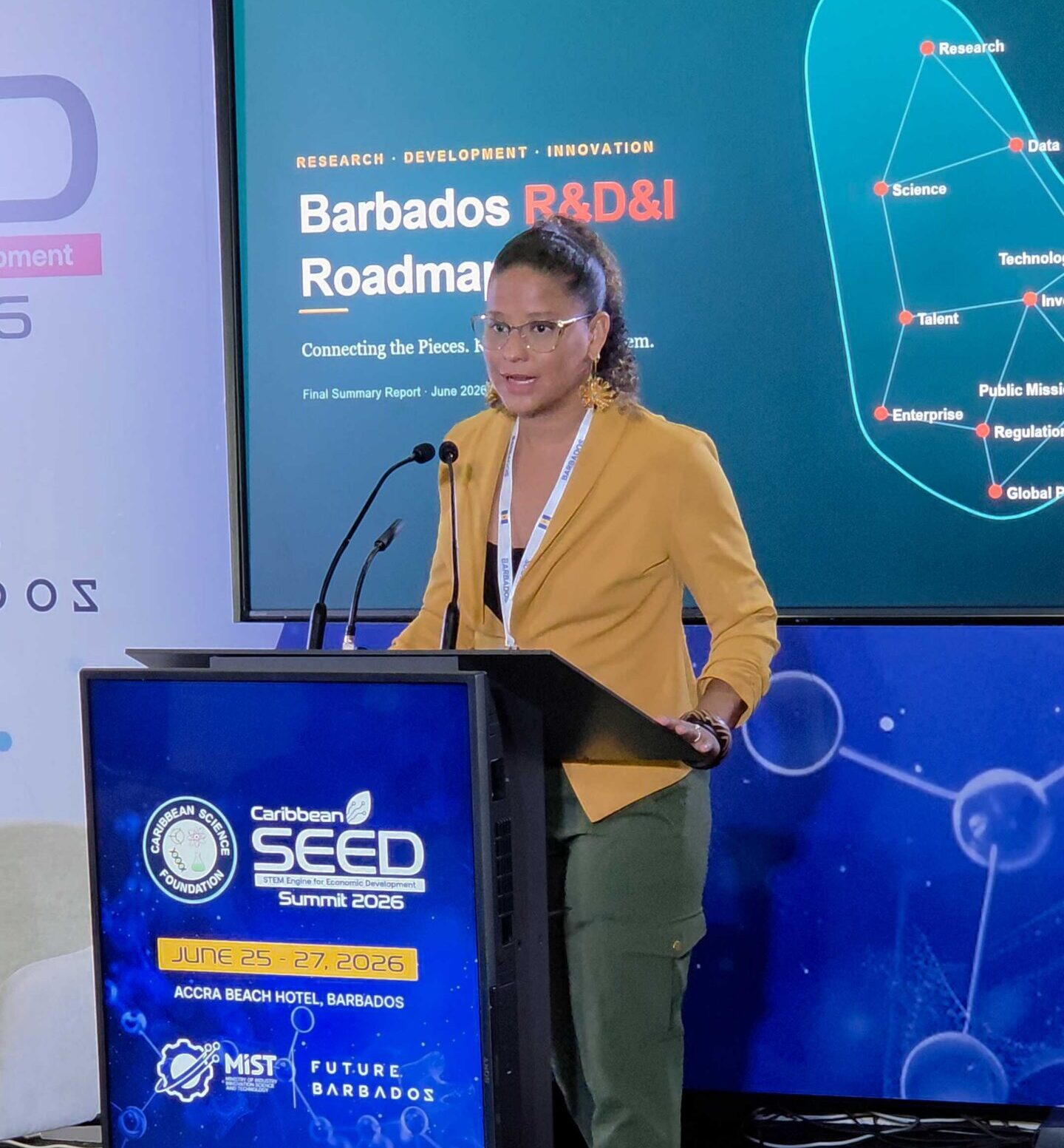
Against the backdrop of growing global technological disruption and the unique structural challenges facing small island developing states (SIDS), independent Caribbean policy research group Future Barbados has launched a landmark draft five-year strategic plan that calls for $65 million in targeted investment to pivot the island nation from repeated short-term crisis management to sustained long-term economic resilience, anchored in science, technology and innovation-driven research and development.
Known formally as the Barbados Research, Development and Innovation (RDI) Roadmap, the 75-page strategic blueprint was commissioned more than a year ago with specialized technical support from the Inter-American Development Bank (IDB). Its core mission is to formalize the country’s innovation ecosystem, unlock critical financing, and accelerate the commercialization of homegrown science and technology outputs, moving beyond decades of siloed academic-only research models.
Tamaisha Eytle Harvey, Director of Future Barbados, emphasized that large-scale investment in innovation is no longer an optional luxury for SIDS like Barbados — it is an existential necessity. Pointing to common everyday infrastructure gaps that reveal systemic weaknesses, she shared an anecdote from her commute to the roadmap’s launch event: navigating around unrecorded municipal service vehicles, avoiding unmarked road hazards, and juggling unstable digital connectivity while working remotely from her car. “Technology is moving faster than ever before. There is a need for advancements in AI, biotechnologies, everything — every part of our lives depends on technology these days,” Eytle Harvey said. “If we don’t give fiscal space, if we don’t give intellectual space to designing the long-term, more sustainable solutions, we will always be in crisis mode.”
For decades, Eytle Harvey noted, Barbados has placed full responsibility for research and development exclusively on tertiary education institutions, a model that has constrained national growth. The new roadmap reframes innovation not as a niche academic activity, but as a core engine of national economic development, embracing experimentation, iteration and even calculated failure as necessary parts of progress. “The model that we’ve been using for many decades has put responsibility for this only on one set of people. It was only a university who’s in charge of solving the problems,” she explained. “Well, here we are where all of the problems are our problems. This is a national development entity and engine to be able to spend time, spend effort and resources in a strategic way on solution development. And that means failures, that means experimentation, that means imagination.”
Despite a history of widespread regional underinvestment — where private sector research spending across Caribbean economies averages just 5.4% — Barbados has already made notable strides in building its innovation capacity. The country currently ranks 58th globally in frontier technology readiness, outperforming many peer SIDS. Eytle Harvey attributed this progress to Barbados’ long-held strong international reputation, stable political governance, and highly educated local workforce, as well as the rapid expansion of dedicated innovation institutions over the past eight years. Bodies including the Ministry of Innovation, Industry, Science and Technology (MIIST), GovTech Barbados, Barbados Pharmaceutical Inc., and the ROAD archive digitization project have all laid critical groundwork for the broader RDI strategy.
Still, major bottlenecks continue to block widespread innovation growth. Barbados’ small domestic market of just 300,000 people, widespread data fragmentation, capital flight, and a lack of structured pathways to move early-stage research from lab benches to commercial markets all hinder progress. Eytle Harvey highlighted how critical national data remains locked in disconnected, static formats: scattered across personal drives as individual PDF files and unstandardized Excel spreadsheets, rather than centralized in a accessible, collaborative platform. “Currently, we rank very highly — I hope you read my sarcasm strongly — on any investment strategy around R&D,” she noted. “Having credibility internationally with the development banks, with investors, does make a strength and robustness in our governance systems that makes it easier to build a system like this. But with all of these assets, it’s like, okay, we have the ingredients in the kitchen, but we’re really missing some things to really make this robust.”
To address these gaps, the RDI Roadmap splits the proposed $65 million total investment across three interconnected core pillars over the next five years. The first pillar, focused on direct project funding, allocates $29 million to expand doctoral research programs at the University of the West Indies and provide targeted support to help early-stage projects cross the commercial “valley of death” — the high-risk gap between proof of concept and market launch. Priority research areas under this pillar include turning invasive sargassum weed into value-added commercial products, developing new public health solutions for non-communicable diseases (NCDs), and offering matching grants to grow specialized tech clusters.
The second pillar focuses on expanding indirect financial support for private sector innovation, earmarking $16 million to train local businesses on how to access existing R&D and digital transformation tax credits, while launching new innovation voucher schemes to incentivize private research investment. The third and final pillar allocates $20 million to upgrade innovation infrastructure and cross-sector coordination, funding critical improvements to outdated physical research laboratories, building a secure sovereign open-data architecture, launching a centralized single-entry hub to streamline the transition of ideas from concept to market, and establishing an independent advisory board to enforce strong data governance and policy accountability.
Eytle Harvey noted that the full build-out of a national innovation system would ultimately require a $100 million investment, but the $65 million targeted plan is a pragmatic, achievable starting point. “The only way we’re going to get innovation to happen in the firms and the private sector is to encourage this, not just by educational workshops, but by providing them with the financing and the spaces to do it,” she said. She added that outdated research infrastructure can no longer meet global standards: “We can’t be inviting people to Barbados to do R&D, and our labs are from 1965. It’s just a reality. It’s really hard to do the research when your things are stuck on the port for six weeks.”
On the topic of open data, Eytle Harvey emphasized the untapped economic potential of a centralized, secure collaborative data platform. “We need to create this open data infrastructure that is secure, that is safe, that is sovereign, but it’s accessible and can be at one point monetized. Because ten per cent of zero, which is currently where the data is, is zero,” she explained.
The roadmap identifies six high-impact priority sectors projected to deliver strong economic returns: pharmaceutical manufacturing, the blue economy, life sciences, renewable energy, digital technologies, and food security. To fund the plan, the framework proposes a blended financing model that combines $26 million in direct government contributions, flexible risk-mitigation capital from international development partners, and active co-investment from local and Barbadian diaspora businesses.
Eytle Harvey stressed that the draft roadmap is a living, adaptive document, noting that regional strategic planning must remain flexible to keep up with the rapid pace of global technological change. “Barbados does not intend to be the best and the greatest at anything. It intends to be the robust space where we can pilot and model for the rest of the world, showing that from small island spaces, things can happen with proper political will, the necessary investments in specific places, and talent,” she said. “It does not make sense in this region at all to plan anything beyond a five-year cycle because in two years we’re gonna have to reevaluate what this is and readjust it based on what the global situation is. But if we’re not doing multiple things at the same time, we’re not going to get to those results.”
Founded to bridge long-standing gaps between government, academia and the private sector, Future Barbados carries out independent policy research, hosts inclusive public consultations, and pilots programs that turn innovative ideas into actionable on-the-ground projects. The organization provides strategic advice on priority investments, mobilizes global technical partners, and channels international funding into local development initiatives, with a core focus on innovation, good governance, and inclusive economic growth.