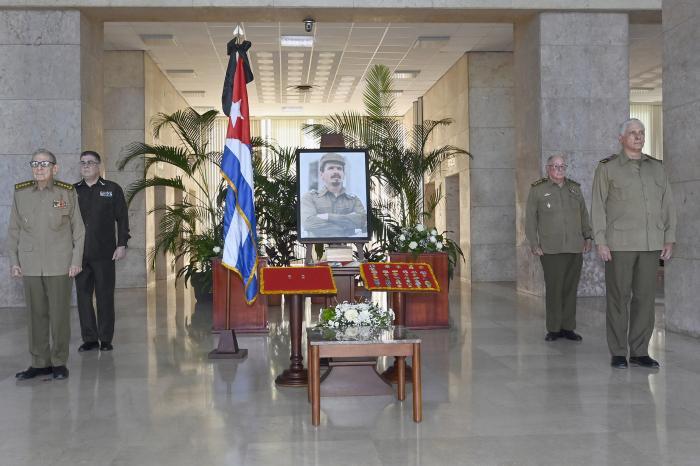
On a Tuesday morning in June 2026, one of the last surviving core figures of Cuba’s revolutionary movement, Commander of the Revolution Ramiro Valdés Menéndez, received his first formal tribute from the country’s top political and military leadership at the headquarters of the Ministry of the Revolutionary Armed Forces. Leading the honor guard for the lifelong revolutionary was Army General Raúl Castro Ruz, leader of the Cuban Revolution and Valdés Menéndez’s comrade-in-arms spanning decades of struggle from the Moncada Barracks attack to the Granma expedition, the guerrilla campaign in the Sierra Maestra, and the decades of nation-building following the 1959 revolutionary triumph.
Joining Raúl in the tribute were Miguel Díaz-Canel Bermúdez, First Secretary of the Central Committee of the Communist Party of Cuba and President of the Republic of Cuba; Army Corps General Álvaro López Miera, Minister of the Revolutionary Armed Forces; and Army Corps General Lázaro Alberto Álvarez Casas, Minister of the Interior, both of whom are members of the party’s Political Bureau.
Before the honor guard began, the urn holding Valdés Menéndez’s ashes was placed at the center of the ceremony hall. A revolutionary renowned for unwavering loyalty to Fidel and Raúl Castro, and a man who often described himself as deeply devoted to the Cuban Revolution, Valdés Menéndez left behind a legacy of service recognized across the country. Flanking the urn were the two stars marking his status as Hero of the Republic of Cuba and Hero of Labor, alongside the dozens of distinctions and decorations he earned over a lifetime of exceptional service to the nation. Resting near the urn, folded into the traditional triangular shape, was the Cuban flag that Valdés Menéndez personally carried back from Bolivia alongside Che Guevara’s remains — a treasure he never parted with for the rest of his life.
A second mourning flag, draped with a black ribbon, stood alongside five floral arrangements offered on behalf of Army General Raúl Castro, President Díaz-Canel, the Association of Combatants of the Cuban Revolution, the Cuban people, and Valdés Menéndez’s family. These offerings honored a revolutionary who famously avoided the spotlight, once saying that all the achievements of the revolution were collective work done naturally when duty called, not the triumph of any single individual.
After the formal honor guard concluded, Raúl Castro and Díaz-Canel placed white roses at the urn to cap the tribute, followed by the two military ministers. The pair then offered heartfelt condolences to Valdés Menéndez’s family, including his lifelong partner Alicia, his children, and all attendees gathered to honor the humble guerrilla fighter who gave every part of his life to building the new Cuba born in 1959.
Speaking of the comrade he has long considered a brother, who stood beside him in defense of shared revolutionary ideals and principles, Raúl recalled the words he shared when Valdés Menéndez was awarded the Honorary Title of Hero of Labor: he noted that Valdés held a unique distinction among the revolutionary cohort, serving as second-in-command of the column that Che Guevara led into Las Villas during the final offensive against the Batista regime.
In keeping with Valdés Menéndez’s own final wishes, he will be laid to rest this Thursday alongside his former commander Che Guevara at the Mausoleum of the Las Villas Front, located within the Ernesto Che Guevara Sculpture Complex in the city of Santa Clara.
Though Valdés Menéndez preferred to avoid public attention, his legacy demands recognition as Cuba honors his life. A figure who never sought the limelight, he was and will remain a central protagonist of the extraordinary collective project that is the Cuban Revolution. As Valdés Menéndez himself affirmed, the revolution “was not born to die, but to continue through time” — a legacy he helped build and safeguard for generations of Cubans.