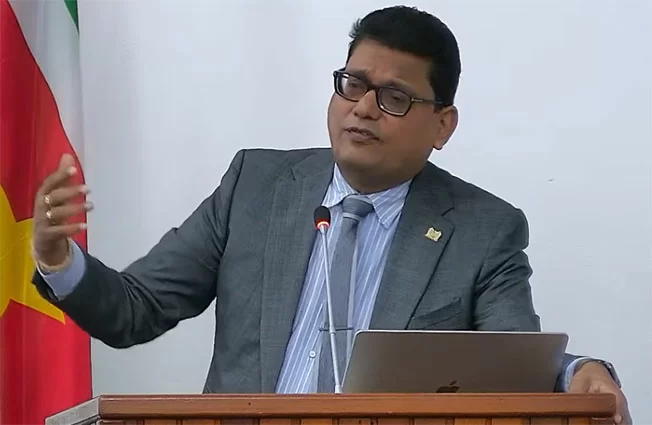
During parliamentary budget deliberations in Suriname, VHP party faction leader Asiskumar Gajadien, who also serves on the committee of rapporteurs, has pushed back against widespread public criticism of the country’s sovereign debt restructuring program and its associated Value Recovery Instrument (VRI) framework. A core point of public controversy has been repeated claims that Suriname has pledged away its future oil earnings from the offshore Block 58 development, a claim Gajadien has emphatically refuted.
Gajadien walked through detailed projections for the oil revenue Suriname is set to begin collecting from Block 58 starting in 2028, based on current development timelines. Using conservative baseline assumptions of a $60 per barrel oil price and a daily production output of 220,000 barrels, he calculated that the Surinamese state will collect roughly $300 million per year in royalty payments from the project. Under the terms of the VRI agreement, he explained, the first $100 million in annual royalties remains entirely under state control, with only 30% of any remaining royalty revenue allocated to fulfill debt restructuring obligations.
Breaking down the math, Gajadien noted that of the projected $300 million in annual royalties, approximately $240 million will still remain available for the Surinamese government to allocate to public priorities, while just $60 million goes toward debt commitments. “Block 58 is not pledged,” he stressed, reaffirming that claims of a full surrender of future oil revenues are entirely unfounded.
Alongside defending the core structure of the VRI against misrepresentation, Gajadien also raised pointed concerns about the long-term implications of Suriname’s new debt framework implemented after restructuring. He pushed back against government claims that the restructuring has delivered major fiscal savings, outlining his own calculations that show a large share of early Block 58 oil revenue will be immediately absorbed by interest and principal payment obligations. Based on a projection of roughly $800 million in total oil revenue for Suriname in 2028, just $126 million will remain available for general government spending after debt service requirements are met. “A large share of the first oil revenues will go directly toward debt repayment,” he noted.
Beyond the debt restructuring debate, Gajadien used the budget deliberations to call on Suriname’s ruling government to adopt greater transparency across all areas of policy and budget implementation. He argued that parliament must receive earlier access to audit and accountability reports from all government ministries to fulfill its constitutional oversight role. Gajadien also pushed for increased transparency in social welfare program administration, public land distribution, and general public expenditure management. “Fighting corruption starts with transparency,” he told the assembly. He added that parliament can only carry out its oversight mandate effectively if the executive branch provides complete, timely information in response to legislative requests, urging the government to provide substantive answers to all questions tabled by the National Assembly and make required policy documents available to lawmakers without delay.