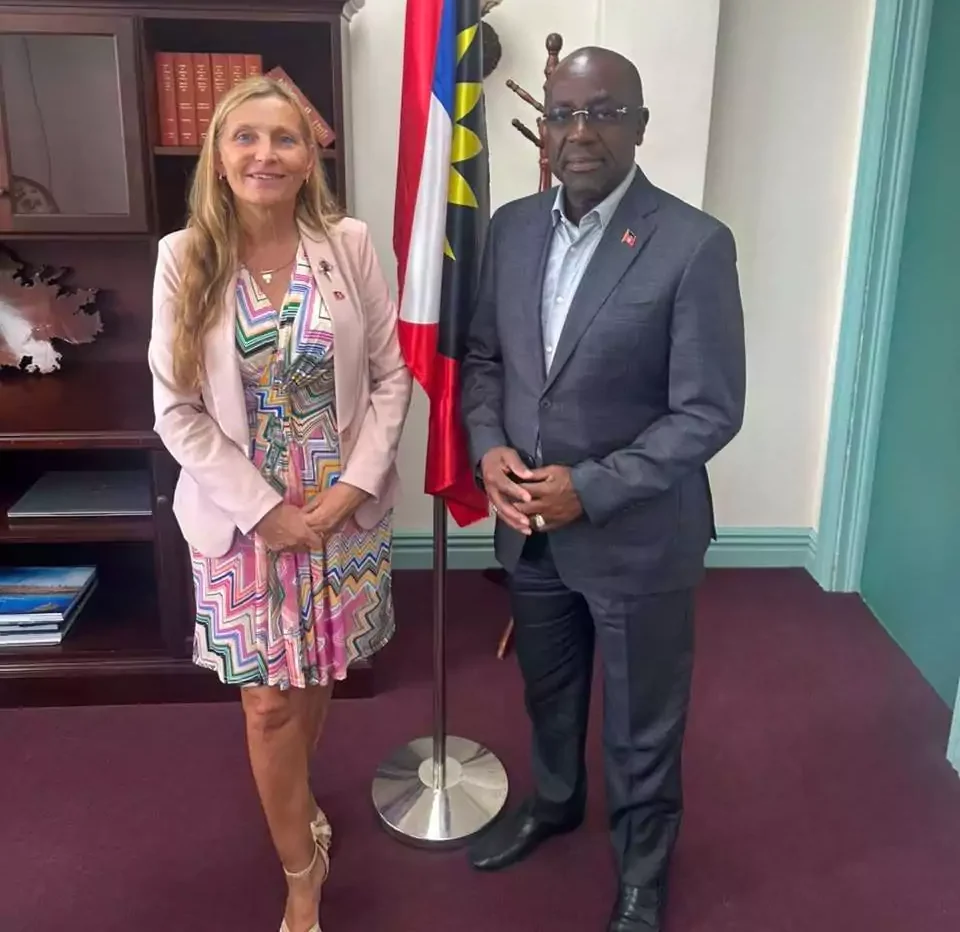
High-level diplomatic and technical discussions held in St. John’s on Thursday have opened a new chapter of potential security collaboration between Antigua and Barbuda and France, with both sides moving forward to explore a targeted bilateral agreement aimed at countering growing transnational security threats. The talks were hosted during an official working visit by Emmanuelle Doffe, France’s Liaison Judge to the Caribbean region, who held in-depth negotiations with E.P. Chet Greene, Antigua and Barbuda’s Minister of Foreign Affairs, Trade and Barbuda Affairs.
Greene opened the discussion by reaffirming the Antigua and Barbuda government’s firm commitment to deepening ties with France across justice, public security and rule of law initiatives. He emphasized that the island nation has a clear strategic interest in finalizing a formal bilateral deal that would boost collective efforts to dismantle transnational organized criminal networks, with a specific focus on curbing illicit drug trafficking and the downstream criminal activities that accompany this trade.
Minister Greene also highlighted that cybercrime has emerged as one of the fastest-growing and most destabilizing threats to Antigua and Barbuda’s national security and economic stability. As criminal groups continuously adapt their tactics and operate across international borders, he stressed that stronger coordinated international partnerships are not optional but a necessity to effectively counter these evolving threats.
Among the concrete collaborative proposals laid out during the talks was a plan to establish joint investigative teams for relevant cross-border cases. This framework would streamline cross-border probe processes and remove bureaucratic barriers to more robust, real-time intelligence sharing between the two countries’ law enforcement and judicial bodies.
Judge Doffe outlined France’s existing regional engagement strategy, noting that the European nation is already finalizing bilateral extradition and criminal cooperation pacts with multiple Caribbean nations. She pointed to existing similar arrangements that France has already concluded with Saint Lucia and Dominica, highlighting that these deals have already delivered tangible improvements to judicial coordination across the region.
She further confirmed that France stands ready to support Antigua and Barbuda’s law enforcement capacity through formal memoranda of understanding and specialized targeted training programs. These training initiatives would cover a range of critical disciplines, from criminal investigation procedure and judicial cooperation to countering financial crime, combating cybercrime, and other core law enforcement skills.
Following the conclusion of the productive talks, Judge Doffe confirmed that she will formally submit all discussed proposals to relevant decision-making bodies within the French Ministry of Justice for review and consideration. She emphasized that her current visit to Antigua and Barbuda is framed as a primarily technical mission, focused on building practical on-the-ground cooperation between France and Caribbean judicial jurisdictions on criminal justice issues, rather than routine symbolic diplomatic engagement. The core goal of this mission is to improve direct coordination between judicial authorities, prosecuting bodies, law enforcement agencies and other relevant institutions through enhanced operational collaboration, to more effectively tackle the shared challenge of transnational crime.