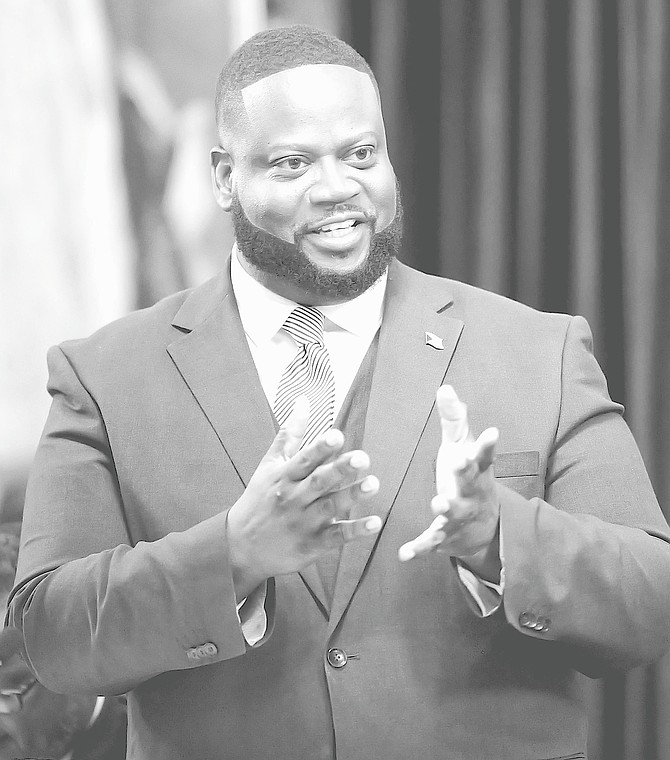
In their first addresses to the Bahamas Senate yesterday, two first-term legislators threw their support behind the Davis administration’s governance record, while outlining ambitious new policy plans to address pressing national challenges.
Senator Clint Watson used his maiden speech to unveil the government’s upcoming overhaul of the country’s approach to combating drug abuse, replacing the long-standing fragmented system with a unified, data-led national strategy. Under the new framework, former Commodore Raymond King has been tapped to lead the creation of a coordinated agency that brings together cross-sector stakeholders, ranging from public health practitioners and educators to social workers and law enforcement teams.
Watson emphasized that for decades, Bahamas’ drug policy has been disjointed, with inter-agency coordination reliant on individual relationships rather than sustained institutional structures. The government’s reforms are designed to correct this gap, shifting the country toward evidence-based drug policy that proactively responds to emerging threats. Key components of the plan include the establishment of a national drug observatory, a centralized national drug information network, and an early warning system to quickly identify and flag dangerous new illicit substances.
“This is a declaration that the fight against drugs is a national issue requiring a whole of government and a whole of society response,” Watson stated. “Drug abuse does not only destroy individuals. It damages families, it weakens communities, it steals futures.”
Fellow first-term Senator Latrae Rahming echoed Watson’s backing of the administration, arguing that the government is well-positioned to guide The Bahamas through a period of rapid global economic and social transformation. Rahming noted that shifting global dynamics, evolving technology, changing energy markets, and shifting citizen expectations are testing governments across the world. “The question before us is whether The Bahamas will meet this moment with the old habits or the new courage. I believe this Davis administration is up for the task,” he said, pointing to the administration’s positive economic track record since taking office.
Third Senator Robyn Lynes used her remarks to focus on the growing crisis of the high cost of living facing Bahamian households. She acknowledged existing government measures to ease financial pressure, including cuts to value-added tax, expanded food assistance programs, and new concessions for residential homeowners. However, she called for additional targeted reforms to the country’s real property tax system and subsidized housing programs to better support low- and middle-income families.
Lynes pointed out that rising property values, often driven by new surrounding development, do not always correspond to increased household income, and in many cases, rental income only covers basic costs like mortgages and utility bills. To address this inequity, she proposed an overhaul of the tax structure that accounts for household income and ability to pay, rather than relying solely on property valuations. The reform would allow eligible homeowners to apply for property tax reductions, or even full exemptions in qualifying circumstances.
On the topic of subsidized housing, Lynes argued that the program should introduce clear timelines for recipients and structured support to help families achieve long-term housing independence. She also added her support for expanding economic opportunities for women in business, increasing access to affordable childcare, and exploring options for evening childcare services to accommodate working parents.