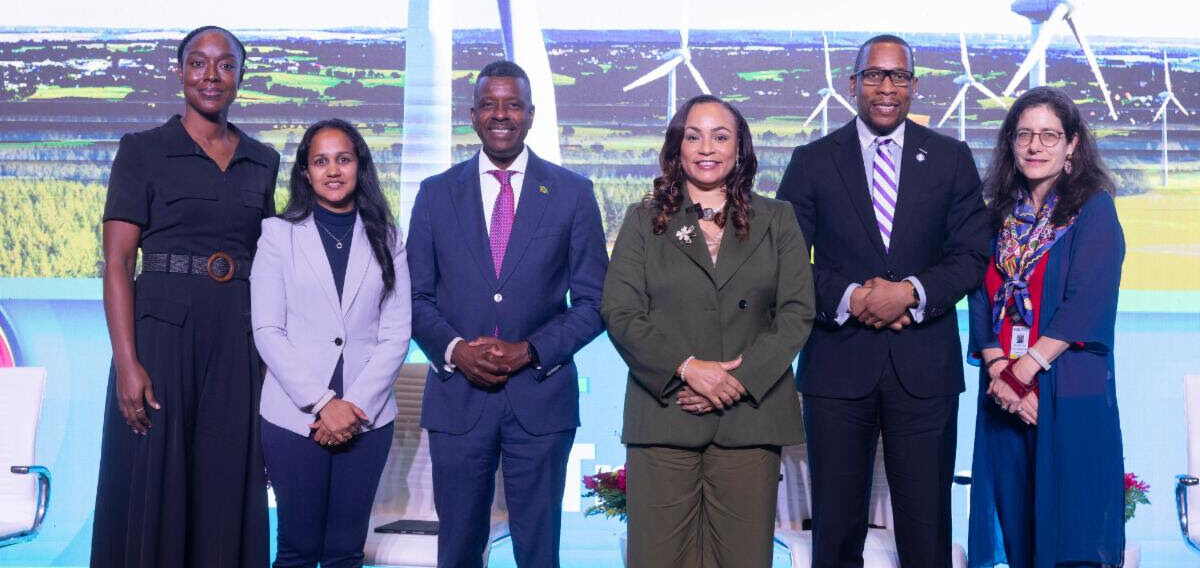
Against a backdrop of growing climate vulnerability and urgent demand for long-term economic stability, senior regional officials, private sector leaders, and development partners have issued a unified call for the Caribbean to accelerate its shift to renewable energy, warning that scattered, uncoordinated national efforts will leave the region unable to meet its energy security, climate resilience, and economic growth targets.
The collective appeal was delivered during the seminar titled *Energy Transition: The Key to a More Resilient Region*, a key side event held alongside the Caribbean Development Bank (CDB)’s 56th Annual Board of Governors Meeting. The gathering brought together a cross-selection of stakeholders from across the Caribbean and global development institutions to map out a collaborative path forward for the region’s energy transformation.
Per an official CDB press release following the event, attendees reached a consensus that the Caribbean must adopt a coordinated, inclusive regional strategy to unlock its vast untapped renewable energy potential, and deliver a power grid that is cleaner, more affordable, and consistently reliable for all communities. Over the next 12 to 24 months, participants identified three core priorities: combining small-scale national renewable energy projects into larger regional investment portfolios to appeal to major investors; expanding credit guarantees and blended financing mechanisms to draw in much-needed private sector capital; and upgrading electricity infrastructure to build climate-resilient grids that can accommodate growing shares of variable renewable energy generation.
Discussion also emphasized four additional foundational requirements for success: deeper regional integration across energy systems, strengthened technical capacity within government bodies, regulatory agencies and local utility providers, increased youth participation in energy planning and policy design, and cross-sector partnerships between public and private actors. All of these priorities align closely with CDB’s newly launched 2026-2035 strategic framework, *Transforming the Caribbean for Resilience*, which places energy transition at the core of the bank’s 10-year work plan for its borrowing member countries.
L. O’Reilly Lewis, CDB’s Director of Projects, outlined the far-reaching economic benefits that a successful energy transition would deliver for the region. “If we get the energy transition right, we can preserve foreign exchange, stabilise energy costs, create green jobs, and give our businesses room to breathe and grow,” Lewis explained. “CDB’s 10-year strategy commits us to supporting this transition: one that is inclusive, affordable, and resilient.”
A core point of consensus among attendees was that while accessible climate financing exists globally, the region lacks the structured investment frameworks needed to mobilize that capital at scale. Timothy Antoine, Governor of the Eastern Caribbean Central Bank (ECCB), noted that the Caribbean’s primary barrier is not a lack of available liquidity, but a shortage of investment-ready projects that meet global investor standards. “This is not a liquidity issue. It is an issue of investability, and that is where we must focus our attention,” Antoine said. He added that blended financing models, which combine capital from multilateral development banks and commercial financial institutions, are critical to de-risking projects and attracting large-scale investment. “We must design an investment architecture that leverages not only multilateral development banks but also commercial banks,” he noted.
Regional collaboration was repeatedly highlighted as a non-negotiable component of building long-term energy resilience. Kristin Lang, Green Climate Fund Director for the Latin America and Caribbean region, urged Caribbean nations to move beyond isolated national energy planning and embrace integrated regional systems. “You do need to think about regional energy hubs, cross-border systems, shared planning, coordinated investment, and align system design in the region,” Lang said. “Having isolated systems is not going to create resilience, it’s going to make you more vulnerable to shocks.”
Toni Pratt, CEO of Bahamas Power and Light Company Limited, shared on-the-ground evidence of the benefits of public-private collaboration, pointing to successful renewable energy expansion across the Bahamas’ Family Islands through cross-sector partnerships. “We found that inviting partnerships for solar implementation, battery energy storage, and microgrids throughout the Family Islands is one of the ways that we don’t have to bear that upfront cost, but we can reduce overall cost to our consumers by reducing our reliance on fossil fuels, which is primarily the highest cost that our consumers bear at this time,” Pratt explained.
Dr. Vince Henderson, Dominica’s Minister for Foreign Affairs, International Business, Trade and Energy, emphasized the foundational role of energy security in enabling all other forms of modern development, drawing on his country’s experience developing a 10-megawatt geothermal energy project. “Energy must be part of integrated development plans. It is fundamental to development in the 21st century,” Henderson said. “People are excited about AI and digital transformation, but without reliable power, none of that is possible. If power systems fail, we face serious consequences.”
Youth engagement also emerged as a central theme of the seminar. Co-moderator Sorayadebie Jhagroe, a Suriname-based climate advocate and member of CDB’s Future Leaders Network, stressed that young people must be active decision-makers, not just passive beneficiaries of the energy transition. “The future is now and we as youth are not merely beneficiaries of the energy transition, but we are an active part of shaping that,” Jhagroe said.
Dr. Henderson echoed that call, noting that long-lived energy infrastructure investments must be planned with the needs of future generations front of mind. “The key point is that investments must stand the test of time. They must include young people, not as an afterthought but as a central focus. These investments are for the next 25 to 50 years, and young people will drive that future,” he said.
Closing the seminar, attendees reached broad agreement that the Caribbean’s shift to renewable energy will require four core pillars to succeed: stronger cross-border regional cooperation, innovative de-risked financing solutions, climate-resilient energy infrastructure, and meaningful multi-stakeholder partnerships that bring together governments, global development institutions, private businesses, and local communities. Participants reaffirmed that achieving universal energy security through renewable transition is not only critical to building the region’s climate resilience, but also to unlocking long-term inclusive economic growth and sustainable development across the Caribbean.