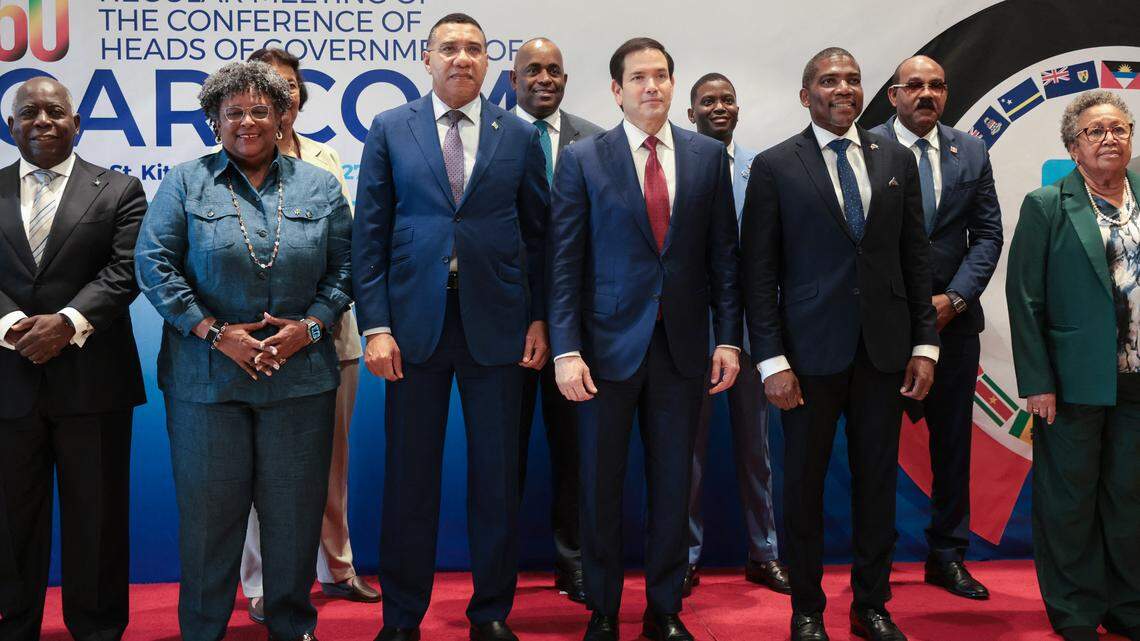
Against a backdrop of escalating global geopolitical instability, the 78th summit of the Organisation of Eastern Caribbean States (OECS), which concluded on Monday, has resulted in a collective decision to set up a broad, high-level cross-member advisory task force. This team will steer coordinated technical discussions and negotiations with the United States over Washington’s request for OECS member states to accept a limited quota of non-criminal third-country nationals and refugees currently held by U.S. authorities.
St Vincent and the Grenadines Prime Minister Dr. Godwin Friday, addressing delegates at the summit, framed the current global context as the most challenging period of geopolitical uncertainty the Caribbean region has seen in a generation. Broader hemispheric tensions, he noted, ripple through every layer of small island life, impacting national security, energy access, already sky-high cost of living, migration patterns, and diplomatic alignment. “What register as minor tremors for large global powers hit small island developing states like full-blown earthquakes,” Friday emphasized. “Our small size leaves us far more vulnerable to external shocks, and we bear the worst, longest-lasting consequences of decisions made beyond our borders.”
The U.S. request, raised earlier this year by the longstanding development partner, asks OECS members to accept deported individuals who are not citizens of any OECS country. Friday stressed that the issue demands careful deliberation and unified regional action, given its far-reaching implications for local economies, public safety, strained domestic resources, and national sovereignty. “This is a delicate and serious matter, and we are still working through it carefully to secure the best possible outcome for all our member states,” he said. Out of this commitment to coordinated action, the advisory team was born, tasked with guiding both individual and collective negotiations with Washington.
Not all member states have taken identical stances on the proposal, however. OECS Chairman and Antigua and Barbuda Prime Minister Gaston Browne drew a hard line against the U.S. plan to resettle 120 deportees on his island, calling the ongoing pressure from Washington a form of economic coercion deployed as a foreign policy tool. “I cannot willingly cooperate with any foreign power to damage our beautiful twin island state,” Browne told fellow OECS leaders. He stressed that Antigua and Barbuda has repeatedly ruled out accepting any criminal detainees, and has rejected the 120-person quota as entirely unacceptable. Instead, the country submitted a counter-proposal offering to accept a maximum of 10 non-criminal individuals annually. Browne clarified that the position is not a rejection of cooperation, but a necessary protection of the country’s limited resources and public interest.
The OECS’s deliberations come amid parallel negotiations elsewhere in the Caribbean. Last Wednesday, Jamaica confirmed it has reached an initial agreement with the U.S. to accept no more than 25 non-criminal third-country nationals and refugees. National Security and Peace Minister Dr. Horace Chang said the deal was reached after extensive talks, with a binding cap on the total number of arrivals. “At no time will the number exceed 25,” Chang confirmed, noting that Jamaica retains the right to reject any individual at any time, and either party can terminate the full agreement without lengthy advance notice. Chang also pushed back against unsubstantiated media leaks that claimed Jamaica had secretly agreed to accept 10,000 deportees from the U.S., calling the reports false.